ethereum
Inside Fusaka: Ethereum’s Next Evolution
After Pectra came stability. With Fusaka, Ethereum targets scale. From blob expansion to PeerDAS, it’s the upgrade that sets the stage for true Layer-2 efficiency and long-term growth.
OCT 17, 2025
Last updated FEB 23, 2026 · V1
Ethereum has never been a static network. Since its launch in 2015, it has undergone a series of transformative upgrades that have reshaped both its technical architecture and its long-term vision for decentralized infrastructure. From The Merge, which transitioned Ethereum to Proof-of-Stake, to Dencun and Pectra, which enhanced scalability and validator operations, each upgrade has paved the way for the next.
In December 2025, Ethereum is set to take another major step forward with the Fusaka Upgrade. Building on the foundations laid by Pectra, Fusaka introduces a new set of Ethereum Improvement Proposals (EIPs) focused on scalability, data efficiency, and network security.
In this article, we’ll take a closer look at what Fusaka is, what changes it brings, how they affect validators, developers, and institutional participants, and why this upgrade is already considered one of the most significant in Ethereum’s recent evolution.
What Is Fusaka?
Fusaka is Ethereum’s upcoming network upgrade, planned for December 2025. Following Pectra, it introduces a coordinated set of Ethereum Improvement Proposals (EIPs) aimed at boosting scalability, optimizing validator operations, and improving overall protocol efficiency.
The network is set to become faster and more stable thanks to an upgrade that brings several key improvements. These include a doubling of blob capacity for Layer-2 data, refined validator workflows through deterministic proposer lookahead and updated blob fees, and enhanced execution performance with new opcodes and cryptographic optimizations.
While Fusaka implements PeerDAS (Peer Data Availability Sampling), the system that allows nodes to verify data availability without downloading all blob data, it does not yet introduce full danksharding.
Instead, PeerDAS serves as a major step toward it, enabling safer blob scaling and laying the groundwork for Ethereum’s long-term data sharding roadmap. This makes Fusaka a pivotal milestone on the path to full danksharding and large-scale Layer-2 scalability.
Why Fusaka Matters?
Ethereum’s development follows a clear progression: Merge → Shapella → Dencun → Pectra → Fusaka, with each phase addressing core challenges needed to scale the network without compromising decentralization. Fusaka continues this trajectory, focusing on four major directions:
- Scalability and data capacity. Fusaka doubles blob capacity, enhances proto-danksharding mechanisms, and lays the groundwork for full danksharding, a key milestone for scaling Layer-2 networks.
- Validator operations. Features like deterministic proposer lookahead and optimized blob fee structures make validator workloads more predictable and the incentive model more balanced.
- Protocol efficiency. Through cryptographic and virtual machine improvements, including the new CLZ opcode, MODEXP bounds, and optimized bit manipulation. Fusaka aligns gas costs more fairly with actual resource usage, improving EVM performance and predictability across clients.
- Security and resilience. Updates include spam protection, block size adjustments, and support for modern cryptographic standards, strengthening the network’s overall robustness.
The tentative release date is December 3, 2025, though it may shift depending on testnet results and ongoing bug bounty programs.
Before the upgrade goes live on the Ethereum mainnet, three public testnets will be conducted between early October and mid-November.
For the Ethereum ecosystem, Fusaka is more than just another protocol upgrade, it’s a strategic milestone. It advances the network toward full danksharding, empowers Layer-2 scalability, and reinforces Ethereum’s position as the foundation for decentralized applications and institutional staking infrastructure.
From Pectra to Fusaka: Building the Next Layer
The Pectra upgrade, launched on May 7th, 2025, strengthened Ethereum’s validator experience and execution-layer performance. Among its key achievements was EIP-7251, which raised the maximum validator balance from 32 to 2,048 ETH, a change that simplified staking for large operators and institutional participants. Pectra also refined withdrawals, improved reward handling, and reduced validator management overhead.
The upgrade sparked significant discussion around the EVM Object Format (EOF), a proposed redesign of how smart contracts are stored and executed. Though ultimately postponed, it underscored Ethereum’s broader push toward efficiency and a better developer experience.
Building on this foundation, Fusaka shifts the focus toward scalability, data availability, and protocol optimization. If Pectra optimized validator operations, Fusaka scales the network itself, preparing Ethereum for higher transaction throughput and the growing demands of Layer-2 ecosystems.
Fusaka EIPs Overview
Future Fusaka upgrade, introduces a coordinated set of Ethereum Improvement Proposals (EIPs) focused on enhancing scalability, validator operations, execution-layer performance, and network security.
While the final lineup of EIPs may still change before the mainnet rollout, the current scope already shows how Ethereum is evolving to handle higher data loads and more complex applications without compromising decentralization.
Fusaka’s proposals can be grouped into four broad areas: scalability, validator economics, efficiency, and security, each addressing a critical aspect of Ethereum’s long-term growth.
Scalability and Data Availability
Fusaka takes a major step toward full danksharding by expanding Ethereum’s data capacity.
- EIP-7594 introduces PeerDAS (Peer Data Availability Sampling), a mechanism that allows nodes to safely verify data availability without downloading all blob data. PeerDAS enables Ethereum to later expand blob parameters securely through smaller, dedicated Blob Parameter-Only (BPO) forks.
- EIP-7892 complements this by defining how blob capacity can be incrementally adjusted, ensuring that future expansions happen safely and efficiently as the network evolves.
Together, these upgrades don’t directly increase the number of blobs but create the framework for scalable blob expansion. They enable Layer-2 networks to process more transactions at lower cost while keeping node participation lightweight and decentralized.
Validator Operations and Economics
Several proposals fine-tune how validators interact with the protocol to ensure predictable workloads and balanced incentives.
- EIP-7825 implements transaction gas caps (16.7m gas), preventing single transactions from consuming too much block space.
- EIP-7917 introduces deterministic proposer lookahead, allowing validators to anticipate upcoming block proposals.
- EIP-7918 adjusts blob fee mechanics to stabilize costs and ensure fair validator compensation.
The result is a more stable and transparent validator economy, reducing volatility in both gas and blob fees while maintaining strong network security guarantees.
Protocol Efficiency and Developer Experience
On the execution layer, Fusaka focuses on improving computational efficiency and simplifying smart contract logic.
- EIP-7823 refines cryptographic operations to improve verification performance and consistency across clients.
- EIP-7883 adjusts (rather than lowers) the gas cost for the ModExp precompile. The current pricing model underestimates real computational resources, so this EIP increases the cost to make it more accurate and sustainable, paving the way for a safe increase in the block gas limit.
- EIP-7939 adds the CLZ (Count Leading Zeros) opcode, which streamlines bit manipulation and logic operations.
- EIP-7935 raises the default block gas limit to 60 million, expanding the computational capacity per block. This change boosts throughput but also increases hardware and performance requirements for clients and validators. The limit is expected to grow gradually toward 150 million in future upgrades.
For developers, these upgrades translate to lower gas consumption, faster execution, and greater flexibility in designing complex applications on Ethereum.
Security and Resilience
Fusaka also reinforces Ethereum’s foundational security.
- EIP-7934 introduces block size constraints to prevent denial-of-service vectors and excessive resource usage.
- EIP-7951 adds a secp256r1 precompile, aligning Ethereum with widely used cryptographic standards across Web2 and enterprise environments.
These updates make the protocol more resistant to spam attacks, improve computational fairness, and expand Ethereum’s compatibility with institutional-grade cryptography.
In essence, Fusaka is not a single change but a coordinated optimization of Ethereum’s entire stack, making the network faster, more scalable, and more secure while laying the groundwork for full danksharding and long-term Layer-2 expansion.
Institutional & Ecosystem Impact
The Fusaka upgrade extends beyond technical refinement, it directly impacts how validators, developers, and users interact with the Ethereum network.
Institutions & Validators
Fusaka brings more predictable operations for validators through deterministic proposer lookahead and improved blob fee mechanics. This stability helps institutional stakers plan workloads, manage risk, and maintain steady returns, while fee adjustments contribute to a more sustainable and transparent staking economy.
Additionally, EIP-7935, which raises the default block gas limit to around 60 million, expands block capacity, meaning more transactions, higher potential priority fees (tips), and greater MEV opportunities during periods of strong demand. The trade-off is that processing larger blocks increases hardware, storage, and bandwidth requirements for nodes.
Developers & Layer-2 Builders
Expanded blob capacity and proto-danksharding upgrades allow rollups to handle more data at lower cost. Combined with EVM optimizations, this gives developers greater flexibility to build efficient, data-heavy applications while keeping gas usage low.
End-Users
For users, Fusaka means cheaper transactions and faster confirmations. As rollups scale and fees stabilize, everyday activity on Ethereum becomes smoother and more accessible.
Overall, Fusaka aligns Ethereum’s infrastructure with the growing needs of institutional staking, large-scale development, and user adoption, a crucial step toward the network’s next stage of maturity.
Challenges & Open Questions
Although Fusaka is well-defined in scope, several factors could still influence its rollout and shape future upgrades.
The upgrade is tentatively scheduled for December 3, 2025, but this date may shift depending on outcomes from testnet phases and the ongoing bug bounty program. Ethereum’s core developers typically prefer to delay a release rather than compromise stability, so flexibility remains part of the plan.
One of the main controversies surrounding Fusaka has been the proposed inclusion of the EVM Object Format (EOF), a substantial restructuring of how smart contracts are stored and executed. EOF was once considered for inclusion in Pectra, then moved into Fusaka’s initial scope. However, after intense debate (on complexity, compatibility, upgrade risk), it was ultimately removed from Fusaka to preserve timeline and stability.
This decision underscores Ethereum’s tension between pushing forward EVM modernization and delivering stable, timely upgrades. While EOF may yet return in a future fork such as Glamsterdam, its exclusion from Fusaka shows how prudent trade-offs are made in response to community and technical constraints.
What Comes After Fusaka
Fusaka marks a crucial checkpoint, but Ethereum’s development roadmap extends far beyond it. The next phase focuses on deep technical evolution, improving efficiency, scalability, and accessibility for both developers and institutions.
RISC-V and the Future of the EVM
Ethereum’s research community is exploring a transition toward the RISC-V architecture—an open, modular processor design used across industries from smartphones to supercomputers.
According to Vitalik Buterin, adopting RISC-V could make Ethereum’s virtual machine easier to understand, optimize, and extend, allowing more developers to participate in protocol research and hardware innovation.
Glamsterdam Upgrade (2026)
Planned for early 2026, Glamsterdam will be the next major Execution Layer update. Its main goals include improving gas efficiency, simplifying transaction processing, and boosting network throughput. If Fusaka scales Ethereum’s data layer, Glamsterdam will refine how that data is executed and validated.
Toward Full Danksharding
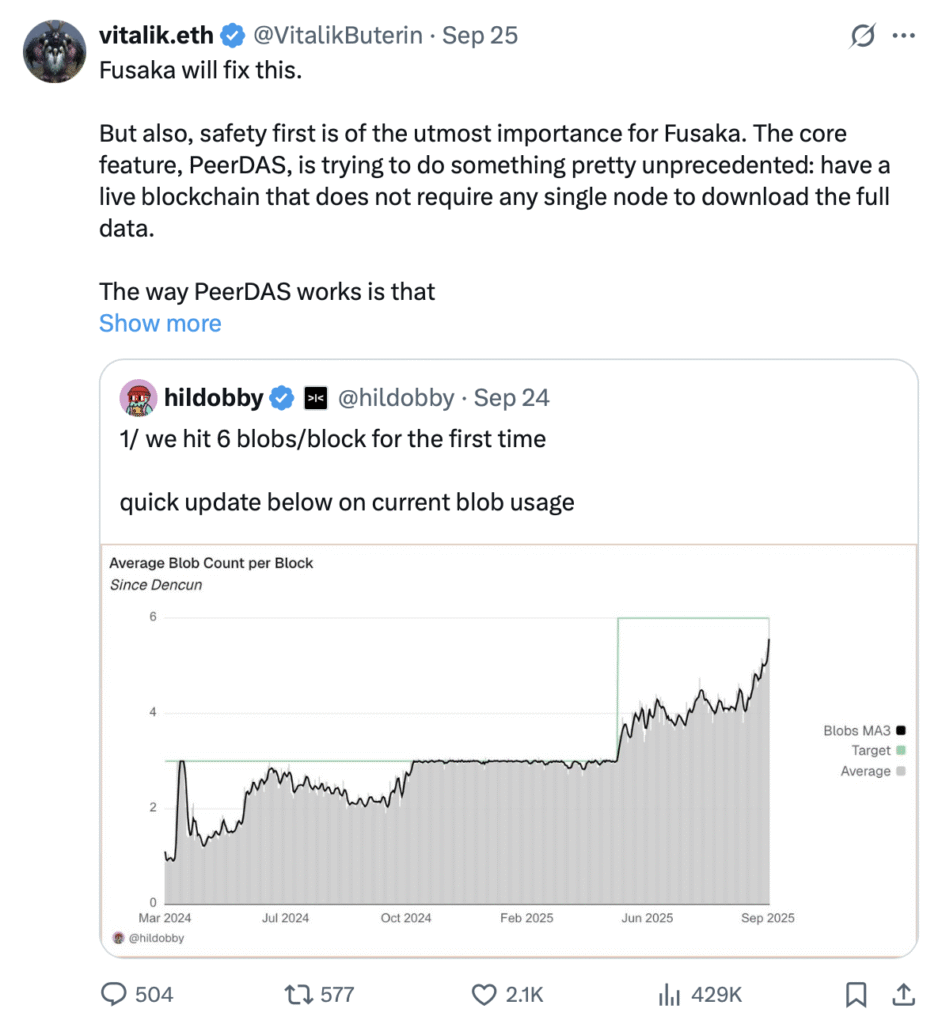
Fusaka’s blob and PeerDAS improvements lay the groundwork for full danksharding, the ultimate scalability milestone for Ethereum. In this model, nodes will download and verify only small pieces of rollup data through random sampling, massively increasing data throughput while keeping node requirements low.
Institutional Momentum
Fusaka also aligns with Ethereum’s growing institutional adoption. Following the SEC’s July 2025 ruling that ETH is not a security, staking-enabled ETFs and corporate treasury participation have accelerated. The network’s improved scalability and predictable economics make it more attractive for large-scale staking and enterprise integration.
Last Words
The Fusaka upgrade represents more than another technical milestone in Ethereum’s roadmap: it’s a strategic evolution that connects past achievements with future scalability. By expanding blob capacity, improving validator operations, and enhancing execution efficiency, Fusaka strengthens every layer of the protocol while keeping decentralization and security at its core.
As Ethereum continues to mature, Fusaka serves as a bridge between today’s modular architecture and tomorrow’s fully sharded, high-throughput network—a foundation designed to support the next generation of decentralized applications and global financial infrastructure.
***
***
All metrics displayed on the website, including without limitations value of staked assets, total number of active users, rewards rates, and networks supported, are historical figures and may not represent the actual real-time data.
Share with your network