neo
The Role of GAS in Neo N3: Powering Transactions and Smart Contracts
The Neo blockchain features a dual-token mechanism that separates governance rights from network utility. Particularly, the NEO token represents ownership and voting power, and GAS acts as the network’s operational lifeblood. GAS is the essential utility token of Neo N3. It is the currency used to pay for all operations, transactions, and smart contract deployments...
MAR 12, 2026
Last updated MAR 12, 2026 · V1
The Neo blockchain features a dual-token mechanism that separates governance rights from network utility. Particularly, the NEO token represents ownership and voting power, and GAS acts as the network’s operational lifeblood.
GAS is the essential utility token of Neo N3. It is the currency used to pay for all operations, transactions, and smart contract deployments on the blockchain. By decoupling the utility token (GAS) from the governance token (NEO), the network ensures that users can participate in the ecosystem and pay for usage without diluting their ownership stake or governance influence.
GAS as the Fuel of Neo N3
As its name implies, GAS is the fuel that powers the Neo N3 engine. Whenever a user interacts with the network, network and system fees are paid in GAS to compensate the nodes processing the request.
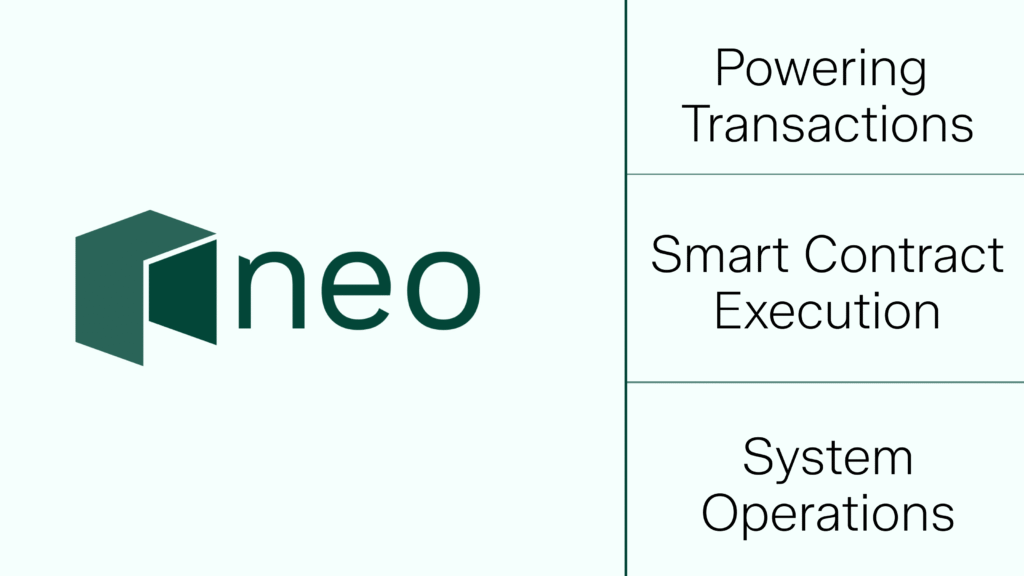
- Powering Transactions: Any standard asset transfer across the Neo N3 network requires a small fraction of GAS to process.
- Smart Contract Execution: Deploying and interacting with decentralized applications (dApps) consumes GAS. The more complex the smart contract execution, the more GAS is required to prevent spam and abuse of network resources.
- System Operations: Neo N3 introduced powerful built-in features like native oracles (for fetching real-world data) and NeoFS (decentralized file storage). Accessing these native system resources is also paid for using GAS.
Efficiency and Cost-Effectiveness in N3
Compared to Neo Legacy, the N3 upgrade introduced a significantly more optimized and modular architecture. N3 features adjustable fee models and more efficient smart contract execution environments. As a result, transaction costs become highly competitive. The Neo Council can dynamically adjust them to keep the network cost-effective for developers and users, regardless of market volatility.
GAS Generation and Tokenomics
Unlike many other networks where you must actively stake tokens to receive rewards, the Neo ecosystem rewards you simply for holding NEO, though the N3 upgrade heavily shifted the incentives toward active participation.
Every time a new block is generated on the Neo N3 network, 5 GAS tokens are minted. To align the economic model with network health, these newly minted tokens are distributed in three distinct tranches:
- Passive Holding (10%): A baseline 10% of the minted GAS is distributed proportionally to all NEO holders simply for keeping NEO in their wallets.
- Governance Participation (80%): The vast majority of the GAS generation is allocated to NEO holders who actively vote for Neo Council members.
- Neo Council Members (10%): The final portion is allocated to elected council members and consensus nodes who physically maintain and secure the network.
Ecosystem Stability
This economic model establishes long-term stability. On the one hand, NEO has a fixed, indivisible maximum supply of 100 million tokens. On the other hand, GAS is actually divisible, and its supply is dynamically managed. Furthermore, the Neo N3 model implements a burning mechanism for system fees, creating a deflationary pressure on GAS that helps balance the continuous block generation and ensures the token’s value aligns with actual network usage.
The Role of GAS in Governance
While you need the NEO token to actually cast a vote in the network’s Delegated Byzantine Fault Tolerance (dBFT) consensus mechanism, GAS is the economic incentive that drives that governance.
- Incentivizing Decentralization: By allocating 80% of newly minted GAS to voters, Neo heavily incentivizes its community to participate in the democratic process.
- Enhanced Rewards: Because the voter reward pool is so large, rewards are paid in GAS, and active voters typically receive higher GAS rewards than simply holding NEO.
Conclusion
As the Neo N3 ecosystem continues to attract developers and innovative dApps, the utility of GAS will only expand. The brilliant design of the dual-token model, combined with an economic structure that heavily rewards active governance, ensures that Neo remains a sustainable and powerful platform for the future smart economy.
Share with your network