Institutional
solana
Solana’s Record $650B Stablecoin Transaction Volume: Where Payments Are Going?
Solana cleared roughly $650 billion in stablecoin transaction volume during February 2026, the highest monthly figure of any blockchain. USDC leads the flow, with PYUSD, USDG, USD1, and Western Union’s planned USDPT building on Solana payment rails.
MAY 12, 2026
Last updated JUL 10, 2026 · V1
TL;DR
- Solana processed approximately $650 billion in stablecoin transaction volume (adjusted) during February 2026, the highest monthly figure recorded by any blockchain that month.
- USDC on Solana is the dominant token in that flow, with growing presence from PYUSD, USDG, USD1, and the planned USDPT from Western Union.
- Sub-cent fees and 400ms block times explain why Solana wins on velocity even with a stablecoin supply base of roughly $15B to $16B, far smaller than Ethereum one.
- Real-world rails such as Aon, Gusto, MetaMask Card, and Noah x Jupiter are turning USDC on Solana into a payments backbone post-GENIUS Act.
What is USDC on Solana?
USDC on Solana is positioned as a fully reserved digital dollar issued natively by Circle on the Solana blockchain, redeemable 1:1 for USD. It is a SPL token that lives at a single canonical mint address controlled by Circle.
Native issuance differs from bridging in a key way. A bridged token is a wrapped representation backed by the original asset locked on another chain, which adds smart contract risk.
Circle issues USDC natively on more than 20 chains, and each native version should be minted directly against dollar reserves. USDC on Solana is not a wrapper around Ethereum USDC, but primary issuance.
The bridging mechanics rely on Circle’s Cross-Chain Transfer Protocol, known as CCTP. CCTP burns USDC on the source chain and mints fresh USDC on the destination chain, avoiding the locked-collateral model entirely.
For users, the practical result is that sending USDC between Solana and Ethereum can be done without exposure to third-party bridge collateral. Circle lists Solana as one of its primary distribution chains alongside Ethereum, Base, and Arbitrum.
The $650 Billion Month
Solana recorded approximately $650 billion in stablecoin transaction volume (adjusted) during February 2026, the largest monthly figure of any blockchain that period. The previous Solana monthly highs sat well below this figure (≈$201B).
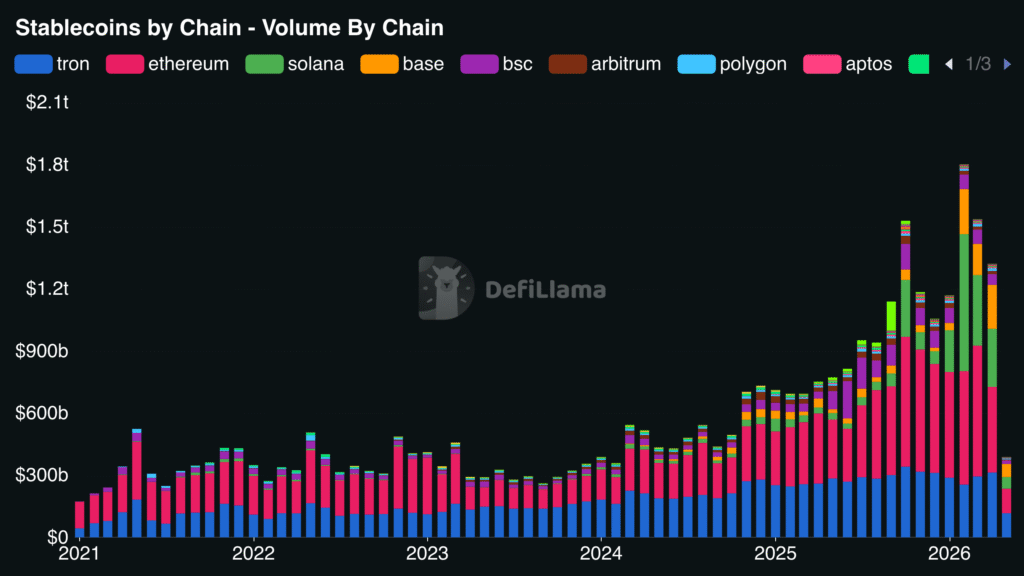
Here is how the major chains ranked for stablecoin transaction volume in February 2026, according to publicly reported on-chain figures:
| Chain | Approx. Stablecoin Volume (Feb 2026) | Approx. Stablecoin Supply |
| Solana | ~$650B | ~$15B–$16B |
| Ethereum | ~$500B–$600B | ~$158B+ |
| Tron | ~$400B–$500B | ~$85B+ |
| BSC | ~$100B–$150B | ~$13B+ |
The main takeaway is that Solana led on monthly throughput while sitting in third place by stablecoin supply. That ranking inversion is what put the $650B figure at the center of payments coverage in May 2026.
Why Solana Wins on Velocity, Not Supply
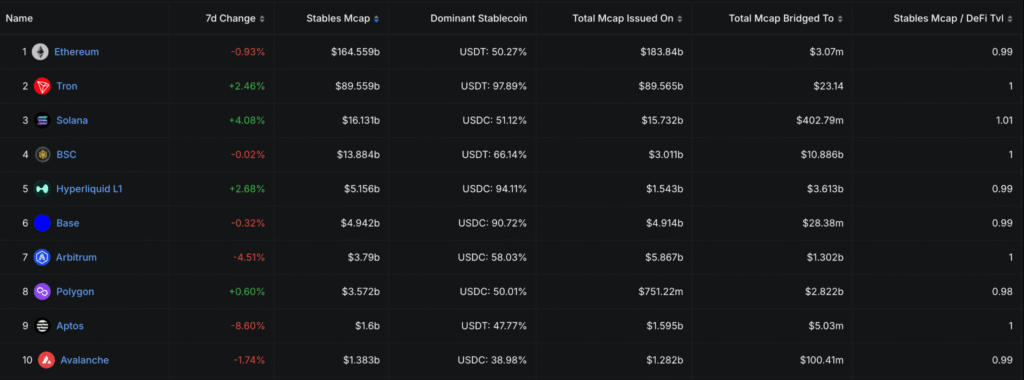
Solana’s lead on stablecoin transaction volume comes from velocity. Solana’s stablecoin supply is roughly $15B to $16B, while Ethereum carries north of $160B in stablecoin supply.
Velocity measures how often each dollar of stablecoin moves within a given period. On Solana, the velocity ratio for February 2026 translates to each dollar circulating dozens of times within the month.
Three properties of the chain drive that velocity:
- Sub-cent transaction fees, with median fees around $0.0005 per transfer
- Block times of 400ms, giving near-instant inclusion
- Throughput capacity that has cleared 1,500+ transactions per second sustained
For high-frequency payment flows, fees and finality matter more than total supply. A payroll provider sending out 10,000 payouts a day cares about cost per transaction and confirmation time, not the size of the chain’s stablecoin supply.
Everstake runs validator infrastructure on Solana designed for heavy workloads. The Shredstream product delivers ultra-low-latency block data to institutions, and SWQoS (Stake-Weighted Quality of Service) helps high-priority transaction senders land their transactions reliably during periods of network congestion.
For institutions evaluating Solana as a payments rail, infrastructure access is a key variable. Validator-grade data feeds reduce settlement uncertainty for payment processors and exchanges.
Beyond USDC: PYUSD, USDG, USD1, and Western Union’s USDPT
USDC is the largest stablecoin on Solana, but it is not alone. The chain now hosts
- PYUSD from PayPal,
- USDG from the Global Dollar Network,
- USD1 from World Liberty Financial,
- and a planned USDPT from Western Union announced in late 2025.
Each issuer chose Solana for the same throughput-and-fee combination, but their distribution strategies differ. PYUSD focuses on consumer payments and merchant settlement.
USDG targets institutional partners through a network model that includes Robinhood, Kraken, and Galaxy. USD1 is positioned around cross-border flows, while USDPT is being built around Western Union’s remittance corridor.
Here is the current landscape of major stablecoins issued natively on Solana:
| Stablecoin | Issuer | Primary Use Case |
| USDC | Circle | General payments, DeFi, treasury |
| PYUSD | PayPal | Consumer payments, merchant settlement |
| USDG | Global Dollar Network | Institutional, exchange settlement |
| USD1 | World Liberty Financial | Cross-border transfers |
| USDPT (planned) | Western Union | Remittances |
The competitive pressure is leaning toward distribution rather than technology. Issuers are differentiating on which payment networks, fintech apps, or remittance corridors plug into their token.
Real-World Payment Use Cases
Stablecoin volume on Solana apart from onchain trading is being driven by businesses moving real money. The use cases span insurance, payroll, card payments, and cross-border transfers.
The clearest examples in production today are:
- Aon PoC settling insurance premium flows in PYUSD on Solana, cutting reconciliation cycles for commercial clients
- Gusto offering same-day contractor payouts through stablecoin rails, with Solana as one of the primary settlement chains
- MetaMask Card integrating USDC on Solana for everyday card spending, settling transactions on-chain in real time
- Noah x Jupiter providing payroll solutions where employers fund payouts in stablecoins and contractors receive in local currency
- Mastercard announcing direct stablecoin settlement integrations across multiple chains, with Solana included in the rollout
- Visa settling card-network obligations in USDC on Solana through Cross River Bank and Lead Bank since December 2025, with annualized settlement volume of approximately $3.5 billion
Aon successfully tested the processing premium volumes in the millions, Gusto handles payroll for hundreds of thousands of small businesses, and MetaMask Card has rolled out across multiple regions.
These integrations follow the same pattern. The fintech or enterprise may pick Solana because it can handle thousands of payments per minute at sub-cent cost.
USDC on Solana vs USDC on Ethereum
USDC on Solana and USDC on Ethereum are the same dollar but live on chains with different cost and speed profiles. The main practical differences are fees, finality, and liquidity depth.
Below is a side-by-side comparison of the two chains for USDC transfers as of April 2026:
| Attribute | USDC on Solana | USDC on Ethereum |
| Median transfer fee | ~$0.0005 | $1–$5 (varies with gas) |
| Block time | 400ms-600ms | ~2-12 seconds |
| Finality | ~13 seconds | ~13 minutes |
| Throughput | 1,500+ TPS sustained | ~15 TPS base layer |
| USDC liquidity (DEX + CEX) | ~$15B+ | ~$50B+ |
| Best fit | Payments, retail, payroll | Treasury, large settlements, DeFi |
Solana wins on cost and speed by a wide margin. Ethereum wins on DeFi liquidity depth and the size of integrated treasury infrastructure.
For a fintech routing 10,000 payments a day at $10 each, Ethereum mainnet fees can exceed the value of the payments themselves. For a treasury moving $50M in a single transfer, Ethereum’s liquidity and compliance tooling still set the bar.
The two are not in a winner-takes-all race. They are settling into different layers of the stablecoin stack.
Post-GENIUS Act Growth
The GENIUS Act, signed into US law in 2025, gave stablecoin issuers a federal regulatory framework and accelerated bank and fintech adoption. The act generally created a path for licensed issuers to operate under federal supervision, defined reserve requirements, and established issuer-side safeguards (1:1 reserves, BSA/AML compliance, bankruptcy priority).
For Solana, the regulatory clarity unlocked a wave of new issuance and integration:
- PayPal expanded PYUSD distribution on Solana in 2026.
- The Global Dollar Network launched USDG with Solana as a primary chain
- Mastercard announced direct stablecoin settlement support across multiple chains, including Solana
- Western Union disclosed plans for USDPT on Solana for its remittance corridor
- Franklin Templeton expanded its tokenized money market product with Solana distribution
- Tokenized stocks projects on Solana scaled distribution after the act passed
The pre-GENIUS environment had banks and fintechs sitting on the sidelines.
What This Means for SOL Stakers
Higher stablecoin transaction volume on Solana strengthens the economics of running a validator. Validators capture priority fees and MEV rewards from the transaction flow on the chain.
When Solana processes $650B in stablecoin volume in a month (adjusted), the priority fee market scales accordingly. That additional fee revenue flows to validators, which delegators participate in through their staked SOL.
Everstake operates one of the longest-running Solana validator setups, with certified compliant infrastructure for institutions. The validator combines SWQoS for transaction landing performance and Shredstream for ultra-low-latency block data delivery.
Delegators can stake their SOL through the Solana staking page without surrendering custody. Institutions evaluating Solana can review the institutional staking and Shredstream pages, plus the Shredstream technical overview for validator-grade data feeds.
The volume story and the validator story are connected. A chain processing real economic activity at scale supports the validator economics that secure it.
FAQ
Is USDC on Solana the same as USDC on Ethereum?
USDC on Solana and USDC on Ethereum are both natively issued by Circle and redeemable 1:1 with USD. They are the same dollar, but each lives on its own chain and is minted separately against reserves.
A user holding USDC on Solana cannot send it directly to an Ethereum address. Moving between chains uses Circle’s CCTP protocol or a third-party bridge.
How do I send USDC on Solana?
To send USDC on Solana, the recipient needs a Solana wallet address that supports SPL tokens, such as Phantom, Solflare, or Backpack. Open the wallet, paste the recipient address, and send USDC as a regular SPL transfer.
The transfer typically confirms in under 1 second and costs around $0.0005 in network fees. The recipient must have a USDC token account, which is created automatically on first receipt for a small one-time rent fee.
Why is USDC cheaper on Solana?
USDC on Solana is cheaper to send because Solana’s base layer fees are denominated in fractions of a cent. The chain processes 1,000+ transactions per second on its base layer, so block space is not a scarce resource the way it is on Ethereum mainnet.
Ethereum mainnet fees scale with demand for limited block space. Solana’s architecture spreads transaction load across more capacity per block, which keeps median fees near $0.0005.
What was Solana’s stablecoin transaction volume in February 2026?
Solana processed approximately $650 billion in stablecoin transaction volume (adjusted) during February 2026. That figure was the highest monthly stablecoin volume on any blockchain that month.
USDC accounted for the majority of the flow, with PYUSD, USDG, and USD1 contributing the rest.
Why does Solana lead on stablecoin volume but not supply?
Solana leads on transaction volume because of velocity, even with stablecoin supply of roughly $15B to $16B versus Ethereum’s $160B+. Each dollar of stablecoin on Solana circulates many times more often than each dollar on Ethereum.
Sub-cent fees and 400ms block times make high-frequency payment use cases viable on the chain.
Which stablecoins are issued on Solana?
The major stablecoins natively issued on Solana include USDC from Circle, PYUSD from PayPal, USDG from the Global Dollar Network, and USD1 from World Liberty Financial. Western Union has announced a planned USDPT stablecoin for its remittance corridor.
Can businesses use Solana for payroll or insurance settlement?
Businesses are using Solana for both today. Aon tested settling insurance premiums in PYUSD, Gusto runs same-day contractor payouts through stablecoin rails that include Solana, and Noah x Jupiter provides employer-funded payroll where contractors receive in local currency.
How did the GENIUS Act affect stablecoins on Solana?
The GENIUS Act, signed into US law in 2025, established a federal framework for stablecoin issuance and accelerated adoption by banks and fintechs. After the act passed, PayPal expanded PYUSD on Solana, USDG launched, and Mastercard added direct stablecoin settlement support that includes Solana.
Disclaimer
This article is for informational purposes only and does not constitute financial, investment, legal, or tax advice. Nothing here is an endorsement or recommendation to buy, sell, hold, or stake any digital asset, or to use any platform or service mentioned. Mention of third parties does not imply affiliation or endorsement.
Digital assets and staking carry significant risks, including volatility, regulatory uncertainty, and total loss of capital. Data referenced reflects publicly available sources as of the date of publication and may change. Readers should conduct their own research and consult qualified professionals before making any decisions.
Share with your network