Chainlink
Institutional
Chainlink Staking 2026: Oracles, CCIP, and Multi-Chain Rewards
Chainlink Staking v0.2 lets holders back oracle and CCIP services through a 45M-LINK pool with a 28-day unbonding mechanism. CCIP processed over $18B in cross-chain volume in Q1 2026, connecting 70+ blockchains and integrating with Swift for tokenized asset settlement.
MAY 21, 2026
Last updated AUG 10, 2026 · V1
TL;DR
- Chainlink stakers receive rewards by backing the performance of the network’s oracle services and CCIP cross-chain messaging with locked LINK.
- The current Chainlink Staking v0.2 protocol operates a 45,000,000 LINK capacity with an effective rate near 4.32%, a 90-day ramp-up period, and a 28-day unbonding cooldown followed by a 7-day claim window.
- Slashing applies to node operators at a fixed 700 LINK per valid alerting event on the ETH/USD Data Feed, with the alerter rewarded 7,000 LINK.
- Beyond staking, Chainlink is the neutral data and interop layer connecting Ethereum L2s, Solana, Aptos, Monad, and Polygon AggLayer.
- It powers stablecoin settlements, RWA tokenization, and DeFi activity across fragmented ecosystems.
- CCIP passed the threshold of over $18B in Q1 2026 cross-chain transfer volume, connects 70+ blockchains, and integrates with Swift‘s network of 11,500+ banks.
- Everstake operates Chainlink infrastructure since 2020 and offers non-custodial LINK staking through institutional-grade setups.
What is Chainlink staking and how does it work
Chainlink staking lets LINK holders back the performance of oracle services and CCIP with locked tokens, receiving rewards in return. The program adds a cryptoeconomic security layer to the network, complementing the off-chain reputation systems and node performance monitoring that already secure Chainlink Data Feeds.
The staking model has three core participants:
- Community Stakers: LINK holders who lock tokens up to the per-address staking cap
- Node Operator Stakers: professional node runners who must stake LINK (between 1,000 LINK and 75,000 LINK) and face slashing
- Alerters: participants who flag misbehavior or downtime in oracle reports
Capacity is finite, not open-ended. The Staking v0.2 community staking is currently full at 40,875,000 LINK, with the remaining 4,125,000 LINK allocated to node operators servicing Chainlink Data Feeds.
Rewards in v0.2 come from a dynamic mechanism designed to support new sources over time. Rewards may include token emissions, Chainlink Build project allocations distributed via the Chainlink Rewards program (Cubes), and eventually user fees from oracle services as the program expands.
Slashing only applies to node operators today. At launch, node operators serving the ETH/USD Data Feed on Ethereum are slashed a fixed 700 LINK each if a valid alerting condition is met, specifically, more than 3 hours of feed downtime since the last valid oracle report. For raising a valid alert, the alerter is rewarded 7,000 LINK.
Chainlink Staking v0.2 explained
Chainlink Staking v0.2 launched on November 28, 2023, replacing the v0.1 beta and expanding the staking capacity size by 80% to 45,000,000 LINK. The upgrade introduced a modular smart contract architecture that lets the team add new oracle services, alerting conditions, and reward sources without forcing stakers through another full migration.
The headline changes from v0.1 to v0.2 are:
- Staking capacity raised from 25,000,000 LINK to 45,000,000 LINK
- New 28-day unbonding mechanism (plus 7-day claim window)
- Modular architecture supporting future service expansion
- Dynamic reward mechanism that can absorb external sources like user fees
- Slashing of node operator stake for valid alerting conditions on oracle services secured by staking
The launch ran in three phases. v0.1 stakers had a nine-day Priority Migration period starting November 28, 2023, followed by a four-day Early Access window on December 7, 2023, and finally General Access on December 11, 2023.
Per-address staking is capped at 15,000 LINK for community participants. Node operators stake a minimum of 1,000 LINK and a maximum of 75,000 LINK. This cap exists to keep distribution wide and to protect the security guarantees that come from a large number of independent stakers.
The v0.2 codebase passed a competitive crowdsourced audit on Code4rena over 18 days. The same platform previously reviewed CCIP and Staking v0.1, and has audited codebases from ENS, Aave, The Graph, and OpenSea.
How to stake LINK
Staking LINK in the native v0.2 protocol takes five steps once the community staking has open capacity. The availability is the main gating factor, not the technical process.
The full flow:
- Make sure to have enough LINK that you’d like to stake and small amount of ETH to cover Ethereum gas fees
- Connect a self-custody wallet such as MetaMask or Ledger to Ethereum Mainnet
- Visit the official staking.chain.link dashboard and check the capacity
- Approve a token allowance transaction, then submit the stake transaction (minimum 1 LINK)
- Track attributed rewards through the dashboard once the 90-day ramp-up begins
Two reward categories exist after ramp-up. Claimable Rewards can be withdrawn immediately, while Locked Rewards convert into Claimable Rewards linearly over the 90-day ramp-up period, proportional to time elapsed.
Staking additional LINK to an address that already has a stake resets the 90-day ramp-up timer on existing Locked Rewards.
Unstaking requires a 28-day cooldown period, followed by a 7-day claim window during which the staker must complete the unstake.
If no action is taken within the claim window, the staked LINK automatically re-enters v0.2.
Unstaking via the unbonding mechanism may incur penalties on accrued rewards depending on how long a staker has participated, and any Locked Rewards that have not fully vested are forfeited and redistributed to other community stakers who maintained their positions.
Choosing a node operator matters if you become one yourself, since slashing risk attaches at that level. Community stakers do not face direct slashing in the current configuration, but they share in network-level outcomes through the alerting and reward system.
For multi-chain stakers comparing options, multi-chain staking with a single provider can simplify operations across Chainlink, Solana, Ethereum, and other networks.
Chainlink oracles, price feeds, and data feeds
Chainlink oracles connect smart contracts to external data, APIs, and computation that do not exist natively on a blockchain. This solves the “oracle problem”: the inability of blockchains to call external systems directly without trusted middleware.
The three core data services in production are:
- Chainlink Data Feeds: aggregated price and reference data published on-chain at heartbeat intervals or on price deviation
- Chainlink Data Streams: pull-based, low-latency market data for derivatives, perpetuals, and options
- Chainlink Proof of Reserve: on-chain attestations verifying collateral backing for stablecoins and tokenized assets
Chainlink Data Feeds underpin a large share of on-chain finance. Major DeFi protocols including Aave, Compound, GMX, Synthetix, and Curve rely on Chainlink price data for liquidations, lending rates, and synthetic asset pricing.
The aggregation model uses a decentralized oracle network (DON) of independent node operators. Nodes communicate off-chain via a leader-based protocol, aggregate signed observations into a single report off-chain, and only that aggregated report is submitted on-chain by a single node per round.
A consolidated comparison of the data services:
| Service | Use Case | Update Model | Example Customer |
| Data Feeds | Pricing, settlement | Push (heartbeat / deviation) | Aave, Compound |
| Data Streams | Perps, options, RT trading | Pull (low-latency) | GMX, Synthetix V3 |
| Proof of Reserve | Stablecoin & RWA backing | Periodic attestation | Cardano‘s wrapped BTC |
| VRF | On-chain randomness | Per-request | Axie Infinity, lotteries |
CCIP and cross-chain interoperability
Chainlink CCIP is a cross-chain messaging and token transfer protocol that connects 70+ public and private blockchains through a single integration. Unlike traditional bridges that mint synthetic wrapped tokens through custodial multisigs, CCIP uses Chainlink‘s decentralized oracle networks plus a separate Risk Management Network to validate every message.
The security model rests on three independent layers:
- The committing DON that observes source chains and signs message reports
- The executing DON that delivers verified messages to destination chains
- The Risk Management Network, a fully independent set of nodes that double-checks each transfer for anomalies
This defense-in-depth design directly addresses the failure mode that has cost the industry near $3B in bridge exploits to date. Most bridge hacks trace back to a single point of compromise: a multisig, a single relayer, or a single validator set.
CCIP activity has scaled fast. CCIP processed over $18B in cross-chain transfer volume in Q1 2026, after total cross-chain transfers via CCIP rose 1,972% to $7.77B in 2025.
A side-by-side view of how CCIP differs from a traditional bridge:
| Feature | Traditional Bridge | Chainlink CCIP |
| Validation | Single multisig or relayer | Two DONs + Risk Mgmt Network |
| Cross-chain token standard | Wrapped synthetics | Cross-Chain Token (CCT) standard |
| Token issuer control | Minimal | Issuer keeps full contract ownership |
| Bridge hack history | ~$3B stolen industry-wide | No major protocol-level compromise to date |
| Compliance support | Limited | ACE rules engine, SOC 2 Type 2 |
The Cross-Chain Token (CCT) standard lets issuers deploy tokens that move across chains without inheriting any CCIP-specific code in the token contract. This eliminates vendor lock-in and gives token teams full control over their own contracts.
A cross-chain stablecoin built on CCT can move between Ethereum, Solana, Aptos, and Polygon without separate wrapped versions on each chain. This is the model now powering Aave’s cross-chain GHO, Coinbase and Lido’s Wrapped Assets.
Chainlink across the major ecosystems
Chainlink integrates with 70+ blockchains and rollups, going far beyond its Ethereum roots. Each major ecosystem uses Chainlink services tuned to its execution model and developer base.
A breakdown of integrations across the headline networks:
| Ecosystem | Chainlink Services Live | Use Cases |
| Ethereum + L2s | Data Feeds, Data Streams, CCIP, VRF, Staking | DeFi, RWA, perps |
| Solana | Data Feeds, CCIP, VRF | DEX pricing, gaming, CEX bridges |
| Aptos | Data Feeds, CCIP, VRF | Move-based DeFi apps |
| Monad (testnet) | Data Feeds, CCIP | High-throughput DeFi |
| Polygon AggLayer | Data Feeds, CCIP | Unified L2 liquidity |
| Avalanche | Full stack | Subnets, institutional rails |
| BNB Chain | Full stack | Retail DeFi |
Solana integration matters because the chain’s high-throughput model needs price feeds that can keep pace with sub-second block times. Chainlink Data Feeds on Solana support DEXs, lending markets, and Coinbase Wrapped Assets cross-chain flows between Base and Solana secured by CCIP.
For users staking on Solana alongside LINK, Solana staking is available through the same non-custodial flow.
Aptos added CCIP support in 2024, opening the Move-based chain to cross-chain stablecoin transfers and tokenized asset flows. Monad‘s parallel EVM execution layer also integrates Chainlink Data Feeds for DeFi pricing, with CCIP deployed day-one on Monad testnet.
Polygon AggLayer is a unification layer connecting Ethereum L2s and other networks through shared liquidity and message passing. Chainlink services provide the price data and cross-chain messaging that AggLayer-connected chains use for asset settlement.
Chainlink for RWA and tokenization
Chainlink is positioned as the data and interop standard for real-world asset (RWA) tokenization, with the World Economic Forum estimating $867T in global financial assets that could eventually be tokenized. RWA tokenization in 2026 has surpassed the $27B in distributed asset value, with Chainlink infrastructure underpinning a large share of equities, fund, and bond issuance.
Three Chainlink services do the heavy lifting for RWA:
- Proof of Reserve verifies the off-chain reserves backing a tokenized asset on-chain
- NAVLink publishes net asset value data for tokenized funds and money market products
- ACE (Automated Compliance Engine) enforces jurisdiction-specific compliance rules on transfers
The Chainlink Runtime Environment (CRE) orchestrates these services into end-to-end institutional workflows. CRE handles off-chain computation, multi-system coordination, and ISO 20022 message formatting for bank integrations.
A live example: ANZ, China AMC, and Fidelity International used CCIP and ACE to settle tokenized assets cross-chain with compliance verification. The solution combined trusted data, cross-chain messaging, and automated compliance into a single workflow.
FTSE Russell now publishes its Russell 1000, Russell 2000, FTSE 100, and WMR FX benchmarks on-chain through Chainlink DataLink, reaching 60+ public and private blockchains. FTSE Russell benchmarks more than $18T in assets globally.
Institutional integrations: Swift, AWS, and the bigger picture
Chainlink sits at the center of two of the most consequential institutional integrations in onchain finance: Swift and AWS. Both bring Chainlink services directly into the procurement and operational tech that banks and enterprises already use daily.
The Swift partnership delivered a production milestone at Sibos 2025. Swift‘s 11,500+ member banks can now process tokenized asset transactions through their existing Swift infrastructure, with CCIP carrying the cross-chain messages.
Swift member banks can now:
- Attach blockchain wallet addresses to standard messages
- Settle tokenized currencies, bonds, and equities across chains
- Connect to smart contract oracles using ISO 20022 message formats
- Process digital and tokenized assets at scale through CCIP
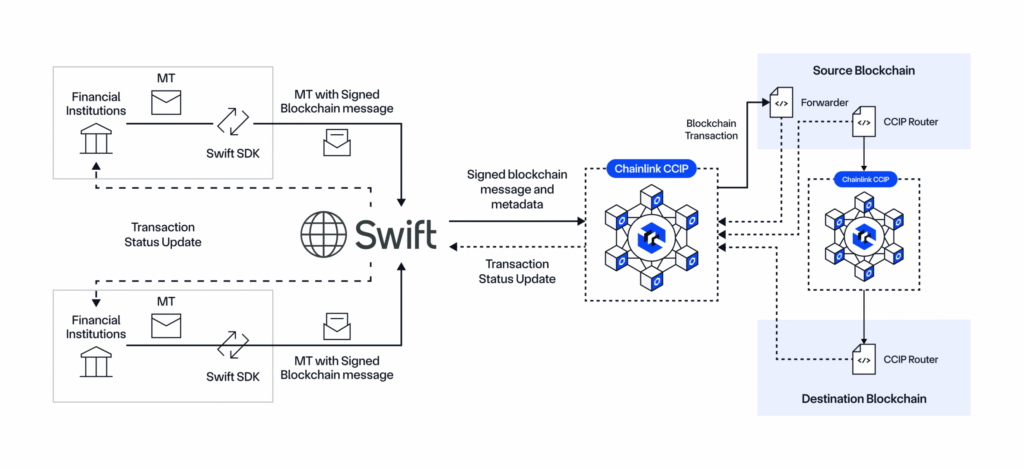
On April 6, 2026, Swift completed a milestone enabling tokenized bond transactions across blockchains and traditional banking systems via CCIP. The transactions involved tokenized versions of traditional debt instruments moving between separate blockchain environments and Swift‘s banking rails.
AWS listed the Chainlink data standard on AWS Marketplace on April 24, 2026. The listing makes Chainlink Data Feeds, Data Streams, and Proof of Reserve available to AWS‘s base of millions of developers through standard cloud procurement.
Chainlink security and zero major failures
Chainlink infrastructure has enabled tens of trillions in transaction value, and its core production oracle services have avoided any major successful exploit to date. The track record is the result of layered defenses, decentralized node operations, and rigorous third-party audits rather than a marketing posture.
The security architecture includes:
- Decentralized oracle networks (DONs) with multiple independent node operators
- Independent Risk Management Network for CCIP transfers
- Time-weighted average prices and deviation thresholds in Data Feeds
- Cryptographic signing of every report (OCR 2.0)
- Defense-in-depth code audits by Code4rena, Trail of Bits, and others
Chainlink currently positions itself as the only publicly known oracle and interoperability platform holding SOC 2 Type 1, SOC 2 Type 2, and ISO/IEC 27001:2022 certifications, with SOC audits conducted by Deloitte & Touche LLP.
Common oracle attack vectors that Chainlink is said to specifically address:
- Flash loan manipulation is reduced by aggregating prices across many sources with deviation guards
- Single node failure is addressed by multi-node consensus on every report
- Stale data is designed to be countered by heartbeat triggers that force updates on intervals
- Cross-chain replay attacks are defended against by CCIP‘s independent Risk Management Network
- Wrapped token de-pegging is monitored by Proof of Reserve attestations
DeFi protocols built on Chainlink include Aave, Compound, GMX, Synthetix, Curve, and Lido.
Combined, these protocols hold tens of billions in on-chain assets with Chainlink as the underlying price source, contributing to the $30T+ in cumulative transaction value enabled by Chainlink since launch.
Staking LINK with Everstake
Stake LINK with Everstake through non-custodial infrastructure operated by a team that has been a Chainlink node operator since 2020. Everstake has run production-grade staking across 130+ networks with five-pillar compliance certifications and a dedicated DevOps and security team.
Everstake‘s Chainlink services include:
- Non-custodial LINK staking with full self-custody of keys
- Node operator services with priority access for qualified participants
- Validator infrastructure with 99.98%+ uptime targets
- Institutional-grade support including reporting and compliance tooling
For larger participants, Everstake offers institutional staking with custom service-level agreements, enterprise reporting, and white-glove onboarding.
Reward expectations for LINK staking with Everstake track the network’s effective rate of around 4.32%, subject to change according to capacity and the dynamic staking rewards mechanism. Actual rates depend on the staking program’s configuration at the time of entry.
FAQ
Is Chainlink staking secure?
Chainlink Staking v0.2 has passed a Code4rena crowdsourced audit, plus formal audits from established firms. Community stakers do not face slashing in the current configuration.
What is the unbonding period for LINK staking?
The unbonding mechanism in Chainlink Staking v0.2 consists of a 28-day cooldown followed by a 7-day claim window during which the staker must complete the unstake. If no action is taken within the claim window, the staked LINK automatically re-enters v0.2. Unstaking may incur penalties on accrued rewards, and any Locked Rewards that have not fully vested are forfeited and redistributed to other community stakers.
How does CCIP differ from a bridge?
CCIP uses Chainlink‘s decentralized oracle networks plus an independent Risk Management Network to validate every cross-chain message. Traditional bridges typically rely on a single multisig or relayer set, which is the failure mode behind near $3B in bridge hack losses to date. CCIP also supports the Cross-Chain Token (CCT) standard, letting issuers move tokens across 70+ chains without vendor lock-in.
Can I stake LINK with Everstake?
Yes. Stake LINK with Everstake using non-custodial infrastructure operated by a team that has served as a Chainlink node operator since 2020. Everstake also offers priority access for users with larger stake sizes.
What is the minimum amount needed to stake LINK?
The minimum stake in Chainlink Staking v0.2 is 1 LINK for community stakers, with a per-address cap of 15,000 LINK. Becoming a node operator requires a minimum of 1,000 LINK and a maximum of 75,000 LINK, plus an open slot for the operators.
Does Chainlink work on Solana and other non-EVM chains?
Yes. Chainlink runs Data Feeds, CCIP, and VRF on Solana, Aptos, and 70+ other networks. Coinbase Wrapped Assets such as cbBTC use CCIP for cross-chain messaging between Base and Solana.
When does the Chainlink Staking v0.2 community staking reopen?
The community staking might currently be at full capacity (40,875,000 LINK). Slots open when existing stakers unbond, and the protocol roadmap calls for further expansion as Chainlink staking expands to secure additional services like CCIP.
Disclaimer
This article is for informational purposes only and does not constitute financial, investment, legal, or tax advice. Nothing here is an endorsement or recommendation to buy, sell, hold, or stake any digital asset, or to use any platform or service mentioned. Mention of third parties does not imply affiliation or endorsement.
Digital assets and staking carry significant risks, including volatility, regulatory uncertainty, and total loss of capital. Data referenced reflects publicly available sources as of the date of publication and may change. Readers should conduct their own research and consult qualified professionals before making any decisions.
Share with your network