Polygon
How to Choose a Polygon Validator: Staking POL in 2026
This guide explains how to choose a Polygon validator using four criteria that matter most: uptime history, commission rate, stake concentration, and multi-chain operator track record. It walks delegators through the POL staking process on Ethereum mainnet, covers the unbonding period, and flags the common mistakes that could potentially erode net rewards.
MAY 08, 2026
Last updated JUN 12, 2026 · V1
Key Takeaways
- Validator choice directly shapes your reward rate, slashing exposure and governance influence on Polygon.
- The four selection criteria that matter most are:
- Uptime history
- Commission rate
- Stake concentration
- Multi-chain operator track record
- POL staking transactions take place on the Ethereum mainnet, not on the Polygon PoS chain.
- The current gross reward rate is near 2.5%-3%, with validator commission deducted before delegators are paid.
- The unbonding period runs roughly 3-4 days.
This Polygon staking guide is built for delegators who want a clear framework for picking an operator. Choosing a Polygon validator affects your reward rate, risk exposure, and your level of governance participation. The four criteria that matter are:
- Uptime history
- Commission rate
- Total stake (avoid over-concentration)
- Operator track record across other networks
A weak choice quietly drains rewards through downtime or fee creep. A strong choice keeps staking rewards consistent and helps decentralize the network.
What Polygon Validators Do
Polygon runs on Proof-of-Stake consensus with a capped active validator set of 103. Each validator stakes POL as collateral, signs blocks, and validates transactions on the Polygon PoS chain.
The role unique to Polygon is checkpointing to Ethereum. Roughly every 34 minutes, validators push a cryptographic snapshot of the Polygon state to the Ethereum mainnet. This anchors Polygon’s security to Ethereum and finalizes batched transactions.
Polygon’s economic design allocates 12% of the 10 billion POL total supply to staking rewards. The protocol incorporates a constant annual emission (inflation) of 2%. Of this amount:
- 1% goes to validators and delegators as staking rewards.
- 1% is directed to the Community Treasury to fund the ecosystem
Distribution is proportional to each validator’s share of the total staked POL, with an additional bonus paid to the validator who proposes a successful checkpoint.
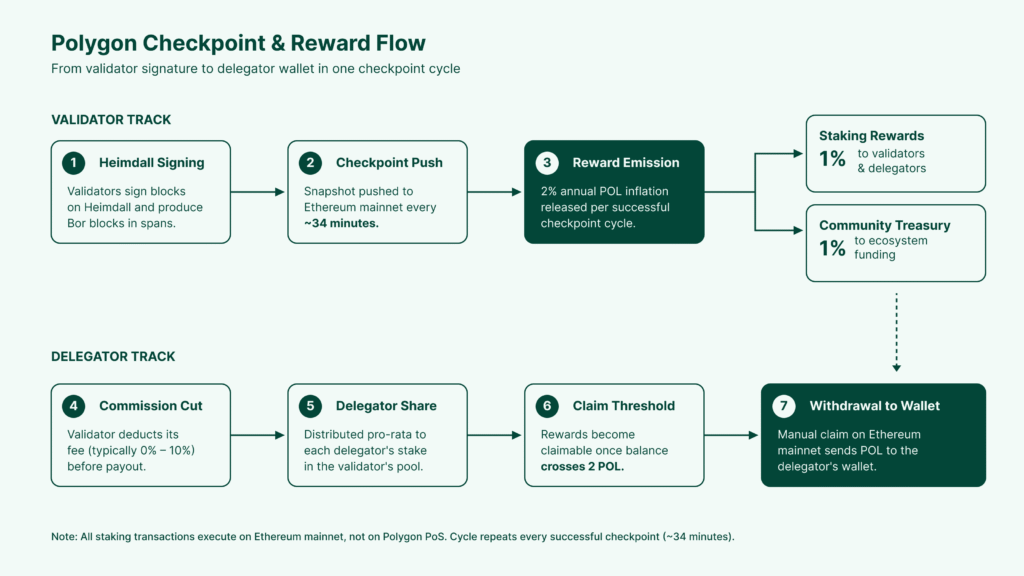
Delegators do not run nodes themselves. They assign stake to a validator, who passes rewards back minus commission. Validators never gain custody of delegator tokens, since all stake operations execute through audited smart contracts on Ethereum.
Network Stake Today :
More than 3.6 billion POL sits staked across active Polygon validators, anchoring checkpoints to Ethereum every ~34 minutes.
Criteria for Choosing a Validator
This is where most delegators slip up. The cheapest commission rarely produces the strongest net rewards because uptime and infrastructure quality outweigh small fee differences over time.
The table below summarizes how to evaluate any candidate operator for POL validator selection.
| Criterion | What to Look For | Red Flag |
| Uptime | 99.9%+ sustained over 6 months | Frequent missed checkpoints |
| Commission | Stable history | Frequent rate changes |
| Slashing Record | Zero penalties across all networks | Any historical penalizing event |
| Multi-chain Operations | 5+ active networks | Single-network operator |
| Public Reporting | Live dashboard, transparent fees | No published metrics |
Uptime History
Uptime measures how reliably a validator signs blocks and submits checkpoints on time. Drop below 99% and your reward rate falls, while missed checkpoints can cascade into delayed finality.
Look for at least 6 months of consistent 99.9% uptime. Live data is published on Polygonscan and Validator.info.
Commission Rate
Commission is the percentage of rewards that the validator retains. Most operators charge between 5% and 10%, with 7% sitting near the median.
On Polygon the economics differ from most networks. Bor block production rotates through a selected subset of validators per span, while Heimdall handles checkpoint signing, so rewards come from per-checkpoint distributions on Ethereum, not continuous block proposing.
This structure lets a well-optimized operator run sustainably at 0% commission, without the warning signs 0% carries on chains like Ethereum or Cosmos.
Everstake has held 0% commission on Polygon for 3+ years, supported by:
- infrastructure amortized across 30+ active networks (130+ historically),
- Polygon’s per-checkpoint reward model.
When comparing Polygon validators, the metrics that matter are checkpoint signing performance, Bor block-production miss rate, and multi-network track record. A stable 0% rate from a reliable operator outperforms a non-zero rate from one with checkpoint misses or Bor downtime.
Stake Distribution
Polygon caps the active set at 103 validators. When too much stake is concentrated in the top three or four operators, network decentralization weakens, and governance becomes lopsided.
Spreading delegation across mid-tier validators improves both network health and your own risk profile.
Slashing and Multi-chain Track Record
As of mid-2026, automated stake-confiscation slashing remains inactive on Polygon PoS. Although the protocol’s smart contracts include slashing functions and Heimdall v2 references slashing incentives in its design, the on-chain slash function is not currently used for delegator-fund confiscation.
Instead, validator discipline is enforced through three softer mechanisms.
- Validators that miss checkpoints or experience downtime forfeit the reward share tied to those checkpoints, since rewards are distributed per successful signature.
- Under PIP-4, validators with sustained poor performance can be off-boarded from the capped active set of 103.
- Delegators can unbond and redelegate, gradually starving an underperforming operator of delegated stake though the ~3–4 day unbonding window and the operator’s own self-bond mean this market mechanism works slowly, not instantly.
Slashing on Polygon targets two behaviors:
The practical takeaway for delegators: direct loss from slashing is not the main risk on Polygon today. The real costs of a bad validator pick are missed rewards from downtime and the lockup time required to switch.
- Double-signing
- Prolonged downtime
Even where slashing enforcement is still maturing, validator behavior continues to affect realized rewards through missed checkpoints and dropped attestations.
Operators running validators across multiple networks bring sharper operational discipline. Check whether your candidate runs active validators on:
- Ethereum
- Cosmos
- Solana
- Polkadot
- Cardano
On Polygon, rewards come from per-checkpoint distributions tied to Heimdall signing and Bor uptime. So a 5%–10% fee from an operator with checkpoint misses delivers worse net rewards than 0% from one with redundant infrastructure and 24/7 monitoring.
How to Stake POL Step by Step
Watch Everstake’s comprehensive guide on POL staking:
POL staking executes on the Ethereum mainnet, not on Polygon PoS. Before starting, prepare:
- A wallet such as MetaMask, Ledger, or Trust Wallet
- POL tokens held on Ethereum (bridge from Polygon if needed)
- A small ETH balance to cover gas fees
Step 1: Set Up Your Wallet
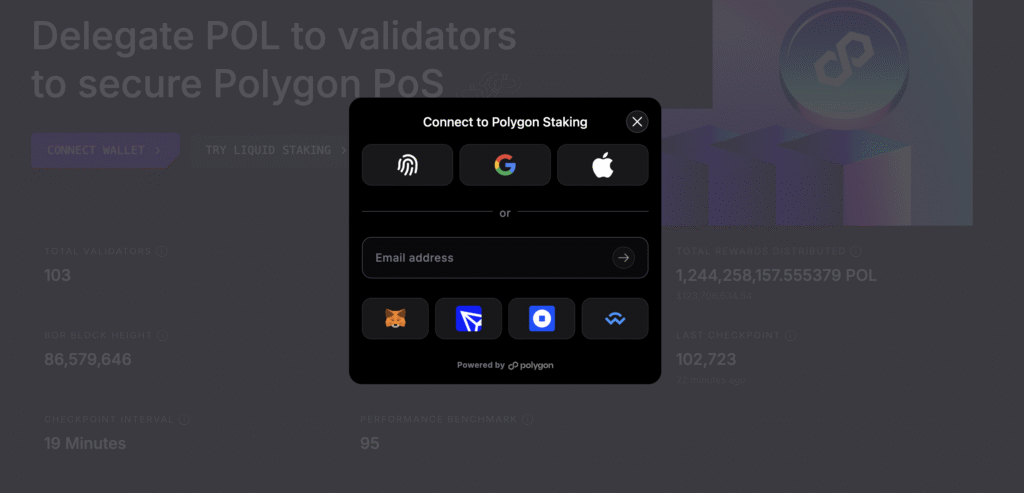
Connect your wallet to the official Polygon staking portal at staking.polygon.technology.
Verify the URL carefully every time. Phishing sites that mimic the staking portal are a common attack vector.
Connect your wallet.
Step 2: Pick a Validator
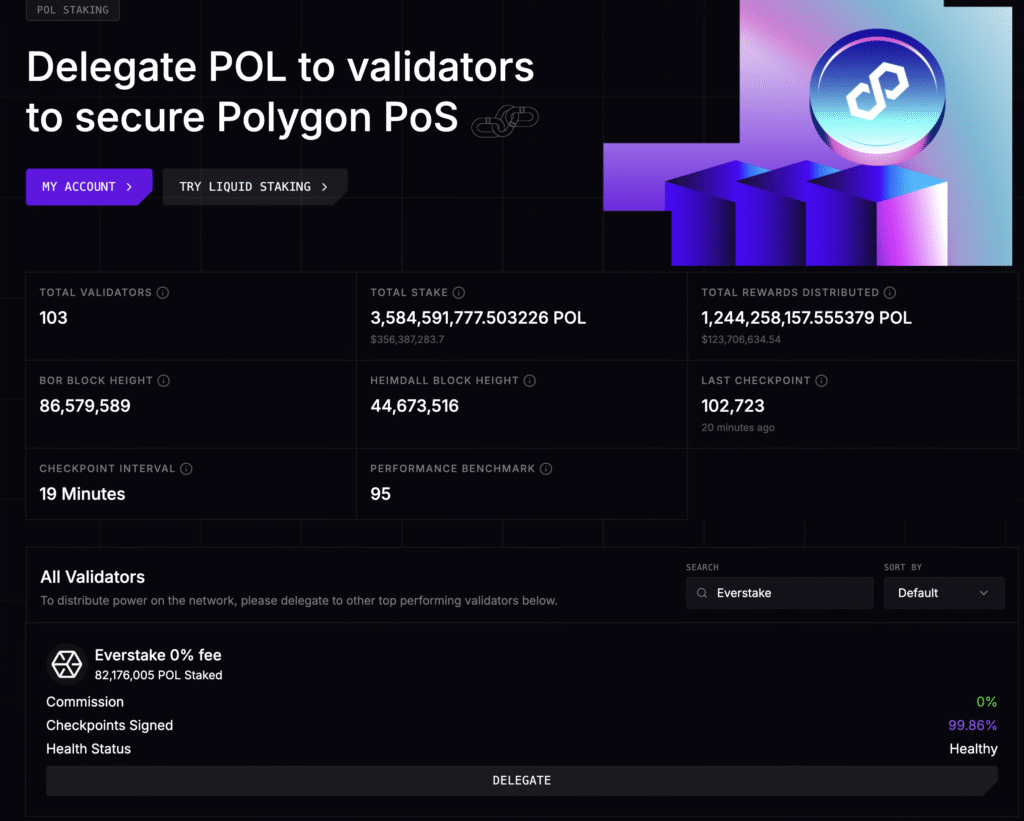
Browse the active validator list. Filter by uptime, commission, and total stake using the criteria above before opening any delegation flow.
Step 3: Delegate
Click “Delegate,” enter your POL amount, and confirm the Ethereum transaction. The minimum delegation is 1 POL, though gas costs make small stakes inefficient.
Step 4: Monitor Rewards
Track accrued rewards through the staking dashboard. Rewards become claimable once they cross the 2 POL threshold.
Step 5: Be Mindful of the Unbonding
Unbonding takes approximately 3-4 days on Polygon. During this window, your stake stops accruing rewards.
For a deeper walkthrough of the protocol, see our Polygon staking page.
Common Mistakes
Even experienced delegators repeat these errors. Reviewing them before staking saves meaningful rewards over time.
Ignoring uptime history. Headline reward rates assume perfect performance. A validator with two outage incidents in 6 months likely costs delegators 0.5% or more in lost rewards.
Concentrating stake on a single validator. Even top-tier operators face risks, including:
- Hardware failures
- Key compromises
- Protocol penalties
Splitting across 2 to 3 validators removes single-point-of-failure exposure.
Skipping the operator’s track record. Strong Polygon validators almost always run nodes on multiple chains. Multi-chain experience signals operational maturity and dedication to redundant infrastructure.
Forgetting gas costs. Each delegation, claim, and unstake call costs ETH gas on the Ethereum mainnet. Frequent claiming with small stakes erodes net rewards quickly.
Everstake as a Polygon Validator
Everstake has run a Polygon validator since the network’s PoS launch. The team has supported infrastructure across 130+ blockchain networks and serves more than 1.6 million users worldwide.
Performance highlights for the Everstake Polygon validator:
- Sustained 99.98%+ uptime since inception
- Zero slashing incidents on Polygon
- Multi-chain validator presence on Ethereum, Solana, Cosmos, Cardano, and Polkadot
- Transparent commission with no surprise rate changes
The team operates redundant node infrastructure with 24/7 monitoring and on-call response procedures. Institutional delegators can integrate via Fireblocks and other major custodians through the institutional staking suite.
Everstake has run validators across 130+ networks, achieving sustained 99.98%+ uptime and over 1.6 million users across the platform to date.
FAQ
What is the minimum POL needed to stake?
You can delegate from 1 POL, but rewards are claimable only after they cross 2 POL. Choose a stake size that justifies Ethereum gas costs on each claim.
How long is the Polygon unbonding period?
Unbonding takes approximately 3-4 days from the moment withdrawal is initiated. Reward accrual stops immediately upon unstaking.
Can I lose POL through slashing?
Slashing for double-signing and prolonged downtime is built into the protocol. Although enforcement is still being phased in across all violation types, choosing validators with strong infrastructure minimizes the risk.
What is the difference between staking POL directly and using sPOL?
Direct delegation locks your POL with a chosen validator for the full unbonding period. sPOL is Polygon’s native liquid staking token, launched in April 2026, which represents staked POL in tokenized form and may be supported by certain DeFi protocols.
How often are rewards distributed?
Rewards accrue continuously based on each block and checkpoint cycle. You manually claim them through the staking portal whenever the balance crosses 2 POL.
Is it better to stake on a centralized exchange or directly with a validator?
Direct delegation keeps custody with you and typically delivers higher net rewards. Exchanges layer additional fees on top of the validator commission and hold your private keys, which introduces custody risk.
How do I choose a long-term Polygon validator?
Prioritize operators with multi-year operating history, multi-chain experience, public uptime data, and stable commission. The best Polygon validator for is the one with the cleanest track record across all four criteria.
Disclaimer:
This guide is provided for informational purposes only and does not constitute legal, financial, tax, or investment advice. The information contained herein reflects the state of applicable regulations and market practices as of the date of publication and is subject to change without notice. Readers should not rely on this material as a substitute for independent professional advice tailored to their specific circumstances.
Institutions should consult qualified legal and compliance counsel before making any decisions relating to staking arrangements, custody models, or regulatory status.
The information provided is not intended for recipients residing in the United Kingdom.
Share with your network