Institutional
solana
SOL ETF in 2026: Inflows, Tokenized Equities, and Solana’s Institutional Moment
SOL spot ETFs crossed $1.02 billion in cumulative inflows by April 2026, six months after their October 2025 launch. Mastercard, Western Union, Franklin Templeton, and Ondo run production payments and tokenization infrastructure on Solana for institutional clients.
MAY 15, 2026
Last updated JUL 10, 2026 · V1
TL;DR
- SOL spot ETFs crossed $1.02 billion in cumulative inflows by April 2026, reaching the milestone in roughly 6 months post-launch
- Bitwise’s BSOL stakes 100% of underlying SOL through Helius, targeting 6%+ annual staking rewards passed through to shareholders
- The SEC and CFTC classified SOL as a digital commodity in March 2026, aligning with Clarity Act discussions in Congress
- Mastercard, Worldpay, and Western Union have deployed production payment integrations on Solana
- Franklin Templeton, Ondo, and Securitize run tokenized funds and equities on Solana for institutional clients
- The Internet Capital Market thesis positions Solana as a settlement infrastructure for tokenized financial markets
- Institutional staking may typically accrue 6-7% APR in protocol rewards, with custodian integrations and SLA-backed validator services available
What Institutional Allocators Need to Know About SOL ETFs
The SOL ETF is a regulated spot fund holding native SOL tokens, with the first US products launching on October 28, 2025. Cumulative inflows crossed $1.02 billion by April 2026. Mastercard, Western Union, Franklin Templeton, and Ondo are deploying production infrastructure on Solana.
The thesis is based on network capabilities: high-throughput rails for tokenized assets, payments, and real-world asset settlement.
What is a SOL ETF?
A SOL ETF is a regulated exchange-traded fund that holds spot SOL tokens, is listed on US exchanges, and is accessible through standard brokerage accounts.
The structure mirrors the earlier approvals of Bitcoin and Ethereum spot ETFs, with one critical difference. Several SOL ETFs stake their holdings from day one and pass protocol rewards through to shareholders.
Key structural elements include the following.
- Custody handled by qualified custodians like Anchorage Digital, Coinbase Custody, and BitGo
- Daily creation and redemption tied to the spot SOL price
- Native staking is enabled in select products from launch
- Listed on Nasdaq and Cboe BZX
For asset managers, RIAs, family offices, and treasury teams operating under fiduciary mandates, the ETF wrapper potentially resolves operational and audit barriers that previously blocked direct token purchases.
Issuers active in the SOL ETF market include:
- Bitwise (BSOL, the Bitwise Solana Staking ETF)
- VanEck (VSOL)
- 21Shares
- Grayscale
- Franklin Templeton
- Fidelity
SOL ETF Inflows and AUM Data
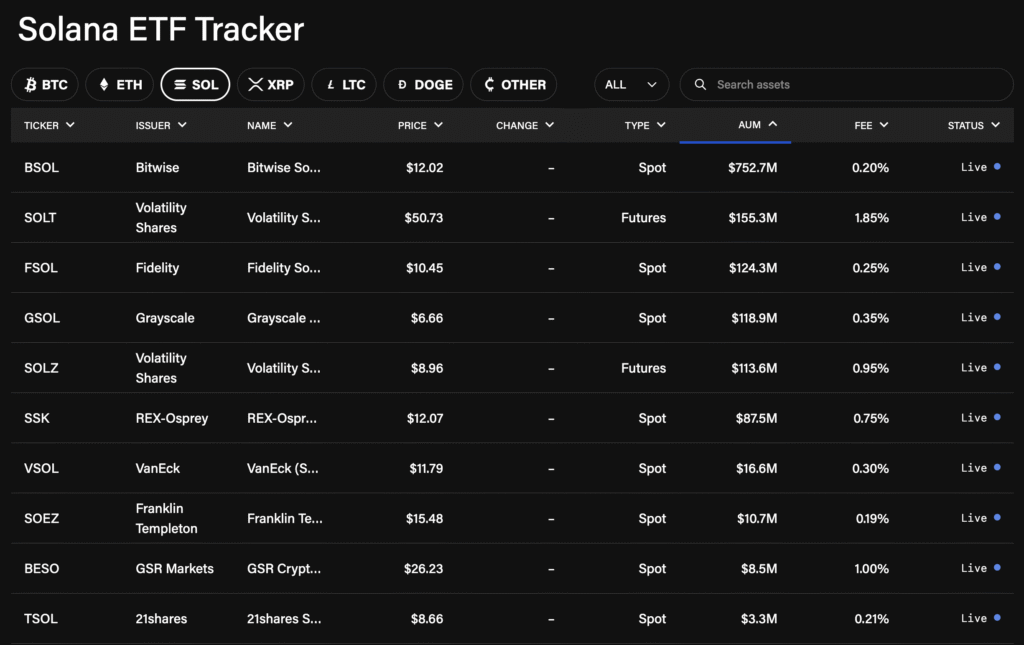
SOL spot ETFs crossed $1.02 billion in cumulative inflows by April 25, 2026, with Bitwise’s BSOL absorbing roughly 78% of total flows.
SOL spot ETFs crossed $1.02 billion in cumulative inflows by April 25, 2026. Bitwise’s BSOL alone holds approximately $611.8 million and concentrates 78% of category flows.
BSOL recorded the strongest ETF debut of 2025 across any asset class, according to Bloomberg Intelligence analyst Eric Balchunas. The fund surpassed $500 million within its first month of trading.
Goldman Sachs holds approximately $108 million in SOL ETF positions. Morgan Stanley has filed for its own SOL ETF, signaling continued issuer expansion.
Comparing Spot Crypto ETF Adoption
| Product | Launch Date | First-Year Inflows | Native Staking |
| Bitcoin Spot ETF | January 2024 | ~$36.2 billion | Not applicable |
| Ethereum Spot ETF | July 2024 | ~$8.64 billion | Not enabled at launch |
| SOL Spot ETF | October 28, 2025 | $1.02B+ (6 months) | Enabled (BSOL, others) |
SOL ETFs reached cumulative inflows faster than Ethereum ETFs at comparable maturity on a relative AUM basis. The native staking feature distinguishes SOL products from earlier crypto ETF generations.
Solana Spot ETF Approval and What It Means
The SEC approved generic listing standards for spot crypto ETFs on September 7, 2025, cutting the approval timeline from over 240 days to approximately 75 days.
In one month after that 21Shares received the first SEC spot SOL ETF approval on October 16, 2025, with broader US trading beginning October 28, 2025.
The SEC approved generic listing standards on September 7, 2025, reducing crypto ETF approval timelines from 240+ days to approximately 75 days.
For institutions, the practical effects include the following.
- Eligibility for inclusion in 40 Act funds and registered products
- Clear path for futures and options markets
- Fiduciary clarity for pension and endowment allocators
- Prime brokerage and lending desk support
- Audit and accounting treatment alignment with established commodity standards
The March 2026 digital commodity classification by the SEC and CFTC further reinforced SOL’s regulatory standing alongside BTC and ETH.
Tokenized Equities on Solana
Solana hosts the largest share of all-time on-chain spot tokenized equity volume (which is a subject to change).
Securitize, the largest US-regulated tokenization platform, runs equity issuance and transfer agent services on Solana. Currenc Group, a Nasdaq-listed financial services firm, settles tokenized stock products on Solana for institutional clients.
Tokenized equities use cases on Solana include:
- 24/7 settlement for cross-border trading desks
- Programmable corporate actions
- Fractional share structures for retail and accredited buyers
- Atomic delivery-versus-payment with stablecoins
- Sub-second confirmation for high-frequency arbitrage flows
The throughput case is operational. Solana’s sub-second confirmation supports order book and AMM venues for tokenized equities, where slippage and settlement timing matter for institutional flow.
For asset managers evaluating tokenization platforms, Solana’s growing share of public equity volume reflects an operational preference. Payment-grade chains support payment-grade products.
The volume concentration on Solana follows a clear pattern. Issuers prioritize chains where market makers can run continuous quoting strategies without prohibitive infrastructure costs.
Sub-cent transaction fees and 400ms block times allow tokenized equity venues to operate with spreads comparable to traditional NMS equity markets, a threshold that earlier tokenization deployments could not meet.
Several Nasdaq-listed firms have signaled tokenization roadmaps that include Solana as a primary settlement venue, joining Securitize and Currenc Group in the institutional issuer base.
Payments and Enterprise Integrations
Mastercard, Worldpay, and Western Union have deployed production payment integrations on Solana.
Mastercard announced support for a multi-token network, including Solana stablecoins, enabling card-linked transactions to settle on-chain with USD equivalence for merchants. Worldpay processes merchant settlement in USDC on Solana for select corridors. Western Union piloted remittance corridors using Solana rails for instant cross-border transfers.
KEY STAT Mastercard, Worldpay, and Western Union have all deployed production payment infrastructure on Solana, joining Aon, Anchorage Digital, and R3.
Beyond payment rails, additional enterprise integrations include:
- Anchorage Digital integrated Kamino Finance for institutional collateral and lending operations
- Aon processes stablecoin-denominated insurance settlements on Solana
- R3 announced a Corda-Solana bridge for permissioned-to-public asset transfers
These deployments share an operational thread. High-throughput, low-cost settlement supports payment-grade transaction volumes without batching delays or fee spikes that have constrained other Layer-1 deployments.
For data infrastructure supporting these integrations, see ShredStream by Everstake, an ultra-low-latency Solana data feed engineered for institutional workflows.
Tokenized Funds and RWAs on Solana
Ondo Finance and Franklin Templeton operate tokenized fund products on Solana for institutional clients.
Franklin Templeton’s BENJI money market fund deployed on Solana following deployments on Ethereum and Stellar. The fund holds short-duration US Treasuries and offers daily liquidity to qualified institutional buyers.
Ondo’s USDY tokenized treasury product also runs on Solana, alongside deployments on Ethereum and Sui. Real-world asset categories on Solana now include:
- Money market funds and tokenized US Treasuries
- Private credit and structured products
- Commodity-backed tokens, including gold and silver
- Real estate tokenization pilots
- Tokenized private equity and venture funds
Total RWA on Solana sits in the hundreds of millions, behind Ethereum but growing faster relative to it. The thesis for issuers is straightforward. Lower minting and redemption costs, sub-second confirmation for arbitrage flows, and growing wallet penetration among institutional custodians all favor Solana for new product issuance.
For comprehensive Solana ecosystem data and validator analysis, see the Solana Staking Insights Annual 2025 report.
The Internet Capital Market Thesis
The Internet Capital Market thesis frames Solana as the settlement layer for tokenized financial markets.
The framing originated within the Solana ecosystem and has been adopted in institutional research notes from major sell-side desks covering the network. The argument rests on three operational pillars.
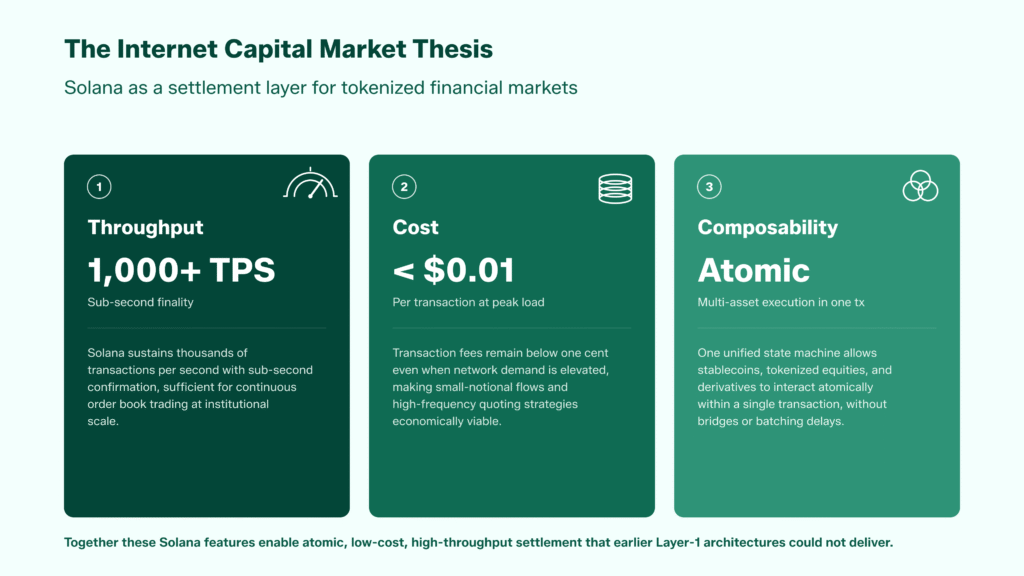
- Throughput: Solana sustains 1,000+ TPS with sub-second finality, sufficient for order book trading
- Cost: Transaction fees remain below $0.01 even at peak load, enabling small-notional flows
- Composability: A single state machine allows atomic execution across stablecoins, equities, and derivatives
For asset managers evaluating chain selection for product issuance, these properties directly translate into operational economics. A tokenized equity venue clearing thousands of small trades per second has fundamentally different infrastructure requirements than a slow, expensive Layer-1.
The Internet Capital Markets Solana thesis competes with similar framings from Ethereum L2s and other high-throughput chains. Solana’s single-state execution model gives it a structural advantage for atomic, multi-asset operations that span stablecoins, equities, and derivatives within a single transaction.
The operational economics are straightforward to model. A market maker quoting a tokenized S&P 500 product across stablecoin pairs needs to update quotes thousands of times per minute. Given $10 transaction fees and 15-second block times, this strategy is economically unviable. On Solana, the same strategy operates at a fraction of the operating cost while clearing in sub-second windows.
This cost differential explains why payment processors, tokenization platforms, and traditional financial institutions converge on Solana for production deployments.
Institutional Staking Implications
For institutions holding SOL on balance sheets or in ETF structures, staking is the operational question that follows allocation.
Staked SOL typically accrues protocol rewards at an APR of 6-7%( a subject to change) before validator commissions. Bitwise’s BSOL demonstrates the institutional appetite for staked exposure. The fund stakes 100% of holdings via Helius and passes rewards through to shareholders.
For institutions allocating directly rather than through ETF wrappers, the question is execution. Which validators meet compliance, slashing coverage, and reporting requirements suitable for fiduciary deployment?
Institutional staking requirements typically include:
- KYB onboarding and compliance documentation
- Slashing insurance or coverage arrangements
- Audit-ready reporting for monthly and quarterly close
- SLA commitments on uptime and missed-block rates
- Custody integrations with qualified custodians like Anchorage, BitGo, and Coinbase Custody
The success of BSOL validates the broader institutional staking thesis. Treasuries, asset managers, and custodians that hold SOL can access staking rewards through compliant validator services without operational burden.
Validator selection criteria for institutional allocators typically weigh:
- Operator history: Years of operation, total stake, slashing track record
- Geographic distribution: Multi-region failover, jurisdictional diversification
- Reporting cadence: Daily attestations, monthly reconciliations, on-demand audit trails
- Insurance coverage: Slashing protection limits, claim resolution timelines
- Custody compatibility: Native integrations with Anchorage, Fireblocks, BitGo, and Coinbase Custody
For insurance treasuries, the validator selection process often runs in parallel with traditional vendor due diligence. A SOC 2 Type II report, ISO 27001 certification, and verified disaster recovery procedures are standard requirements for institutional onboarding.
For institutional staking infrastructure, explore Everstake’s Solana validator services or learn more about institutional staking products.
FAQ
Is the SOL ETF approved?
Yes. The SEC approved spot SOL ETFs in October 2025, with US trading beginning October 28, 2025. Solana became the third cryptocurrency to receive SEC spot ETF approval after Bitcoin and Ethereum. Issuers include Bitwise, Grayscale, 21Shares, Franklin Templeton, Fidelity, and VanEck.
Can you stake ETF SOL?
Yes, in select products. Bitwise’s BSOL stakes 100% of its SOL holdings through Helius and targets 7%+ annual staking rewards passed through to shareholders. This distinguishes SOL ETFs from earlier BTC and ETH spot ETFs, which did not enable staking at launch.
Can institutions stake SOL?
Yes. Qualified institutions stake SOL through custodian integrations and validator services. Everstake offers non-custodial institutional staking with onboarding, audit reporting, and custom SLAs.
What are SOL ETF inflows?
SOL ETF inflows are net assets flowing into spot Solana exchange-traded funds. SOL spot ETFs reached $1.02 billion in cumulative inflows by April 25, 2026. Bitwise’s BSOL alone absorbed the majority of category flows.
Why is Solana attracting institutional adoption?
Solana’s throughput, sub-second finality, and low transaction fees support payment-grade and tokenization use cases. Mastercard, Western Union, Franklin Templeton, Ondo, Securitize, and Aon have deployed production infrastructure on Solana.
What is the Internet Capital Market thesis?
The Internet Capital Market thesis positions Solana as the settlement layer for tokenized financial markets. The argument rests on Solana’s high throughput, transaction fees below $0.01, and a composable single-state execution model that enables atomic multi-asset operations.
How does the SOL ETF compare to BTC and ETH ETFs?
SOL spot ETFs reached $1.02 billion in cumulative inflows over roughly 6 months, faster than ETH ETFs at similar product maturity on a relative AUM basis. BTC ETFs accumulated approximately $36.2 billion in their first year. ETH ETFs gathered approximately $8.64 billion in cumulative net inflows over a comparable period.
What does the SOL digital commodity classification mean?
The SEC and CFTC jointly classified SOL as a digital commodity in March 2026, placing it alongside BTC and ETH. This classification clears the path for futures contracts, prime brokerage support, and inclusion in 40 Act-registered products.
Disclaimer
This article is for informational purposes only and does not constitute financial, investment, legal, or tax advice. Nothing here is an endorsement or recommendation to buy, sell, hold, or stake any digital asset, or to use any platform or service mentioned. Mention of third parties does not imply affiliation or endorsement.
Digital assets and staking carry significant risks, including volatility, regulatory uncertainty, and total loss of capital. Data referenced reflects publicly available sources as of the date of publication and may change. Readers should conduct their own research and consult qualified professionals before making any decisions.
Share with your network