Cardano
Cosmos
Tezos
web3 infrastructure
What Is Delegated Proof-of-Stake (DPoS)? How It Works in 2026
Delegated Proof-of-Stake is a consensus model where token holders elect a small group of validators to produce blocks. Networks like EOS, TRON, Tezos, Cosmos, and Cardano use DPoS or close variants to balance speed against decentralization.
MAY 01, 2026
Last updated AUG 06, 2026 · V1
TL;DR
- Delegated Proof-of-Stake (DPoS) is a consensus mechanism where token holders vote for a small, elected group of validators.
- These validators (also called delegates, witnesses, or block producers) take turns producing blocks. Instead of every staker running infrastructure, voters delegate their stake to operators they trust.
- The model was proposed by Daniel Larimer in 2013 and launched on BitShares in 2014.
- It now powers networks such as EOS, TRON, and (in adapted forms) Tezos, Cosmos, and Cardano.
- DPoS prioritizes speed, governance participation, and low energy use. It trades off some decentralization because of smaller validator sets.
What is Delegated Proof-of-Stake?
Delegated Proof-of-Stake (DPoS) is a blockchain consensus mechanism in which token holders elect a limited group of validators.
- These validators produce blocks and secure the network.
- Voting power is typically proportional to the amount of stake a holder commits. The elected validators take turns proposing and signing blocks.
- Delegators who voted for them share in the resulting rewards.
DPoS sits between classic Proof-of-Stake (PoS) and Proof-of-Work (PoW) on the spectrum of consensus design.
PoW (used by Bitcoin) relies on miners expending computational energy. Standard PoS lets anyone with enough stake become a validator based on protocol rules.
DPoS narrows the validator set further by adding a voting layer. Consensus is handled by a small, elected committee rather than a large open pool.
The appeal of DPoS lies in predictability and throughput. Networks fix or cap the active validator set at numbers like 21, 27, or 101. This produces sub-second block times and straightforward governance.
However, concentration introduces challenges: fewer validators mean tighter control over block production. Networks accept that design choice in exchange for performance.
How does DPoS work?
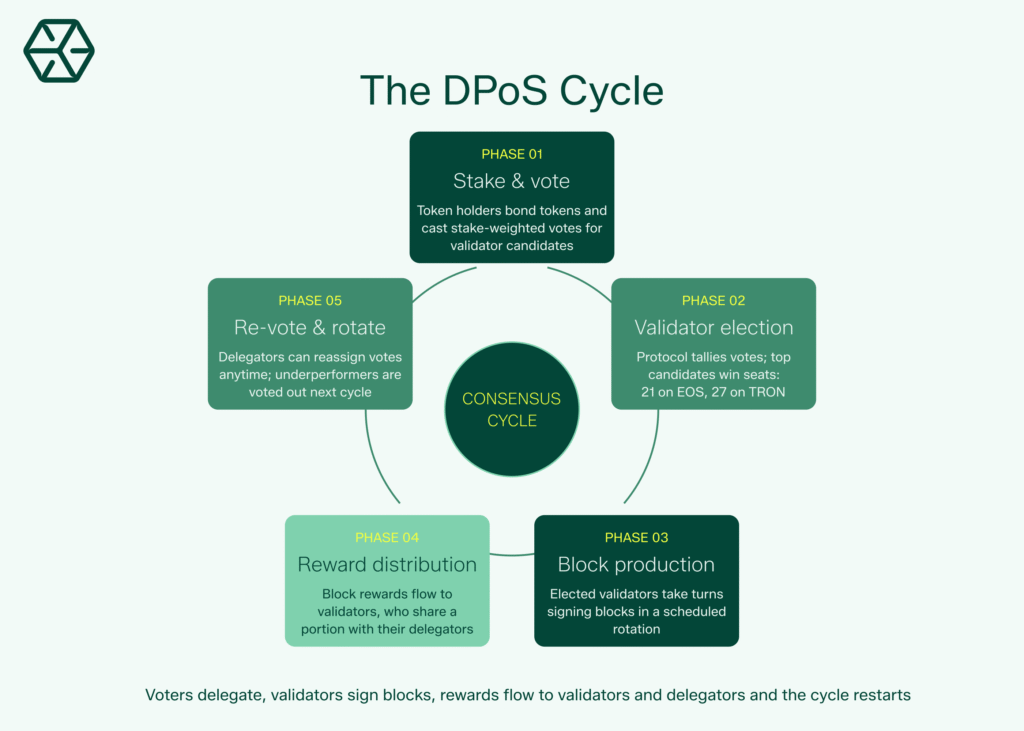
DPoS runs on a repeating cycle of voting, validator election, and block production, with rewards distributed back to both operators and delegators. The mechanics differ slightly between networks, but the core flow is consistent across implementations.
Here is how a typical DPoS cycle works, step by step:
- Stake and vote. Token holders lock or bond their tokens and cast votes for validator candidates. Voting weight usually equals the token balance committed.
- Validator election. The protocol tallies votes at set intervals. On TRON, for example, the top 27 candidates are elected every 6 hours. On EOS, 21 block producers are selected from a broader candidate pool.
- Block production. Elected validators take turns signing blocks in a scheduled rotation. EOS produces a block roughly every 0.5 seconds, with finality reached when a supermajority of producers confirm.
- Reward distribution. Block rewards flow to the validator. The validator then shares a portion with its delegators, according to each operator’s published commission rate.
- Re-voting and rotation. Delegators can reassign votes at any time. Underperforming or malicious validators can be voted out during the next election cycle.
The roles:
- Validators (also called delegates, witnesses, block producers, or super representatives) run the infrastructure that signs blocks. They are responsible for uptime, software upgrades, and accurate transaction processing.
- Delegators are token holders who do not run nodes but contribute their stake as voting weight. Delegators keep custody of their tokens in most DPoS designs, and they participate in securing the network without operational overhead.
Rewards are generated through a combination of new token issuance and transaction fees. The exact split between validator commission and delegator share is set by each operator and disclosed publicly. If a validator misbehaves (by double-signing, for instance), many DPoS networks apply penalties such as slashing or removal from the active set.
DPoS vs PoS: Key Differences
DPoS and PoS share a common foundation but diverge on validator selection, governance, and performance characteristics. Both require token holders to commit stake as collateral. The differences become clearest when placed side by side.
| Feature | Proof-of-Stake (PoS) | Delegated Proof-of-Stake (DPoS) |
| Validator selection | Open set, based on stake and protocol rules | Fixed or capped set, elected by token-holder vote |
| Typical validator count | Hundreds to hundreds of thousands | 21 to 101 active validators |
| Stake requirements for operators | Often high self-bond thresholds | Lower self-bond; elected through delegation |
| Governance model | On-chain proposals, stake-weighted voting | Continuous delegate elections plus on-chain votes |
| Block time | Seconds to tens of seconds | Sub-second on many chains |
| Energy use | Low | Low |
| Decentralization profile | Broad validator distribution | Concentrated among elected delegates |
DPoS networks generally confirm transactions faster and run lighter validator operations. Standard PoS networks distribute validation more widely. Neither model is strictly better. The right choice depends on whether a given network prioritizes throughput and application performance or broader validator participation.
Which blockchains use DPoS?
Several major networks run on DPoS or closely related variants, each adapting the core model to its own priorities. The implementations differ in validator count, election frequency, and how tightly governance is coupled with block production.
- EOS. One of the earliest large-scale DPoS networks, EOS uses 21 active block producers elected by EOS token holders. Blocks are produced in a fixed rotation roughly every 0.5 seconds, with a supermajority required for finality.
- TRON. TRON uses 27 validators called Super Representatives, re-elected approximately every 6 hours based on TRX holder votes. The design targets high throughput for payments and decentralized applications.
- Tezos. Tezos runs on Liquid Proof-of-Stake (LPoS), a variant of DPoS. Delegation is optional rather than mandatory, block rights are distributed proportionally to stake, and token holders vote directly on protocol amendments. Staking Tezos operates through a process called baking.
- Cosmos. Cosmos Hub uses a Bonded Proof-of-Stake (BPoS) model often grouped with DPoS. The active validator set is capped (currently around 180 validators on the Hub). Delegators bond ATOM to their chosen validators. Learn more about staking Cosmos and how delegation works on the Hub.
- Cardano. Cardano runs on Ouroboros, a PoS protocol with a delegation layer that closely resembles DPoS in practice. ADA holders delegate stake to stake pool operators (SPOs). Pools are randomly selected as slot leaders, with odds proportional to the stake delegated to them. Time is divided into epochs of 5 days and 432,000 slots, with a new block produced roughly every 20 seconds. ADA is never transferred during delegation, and Cardano does not apply slashing on delegators.
- Lisk used to operate on DPoS, but since 2024 the network relies on Ethereum as a settlement layer.
Each of these networks adapts the DPoS idea to a slightly different end.
- EOS and TRON lean hardest into throughput. Tezos preserves flexibility and formal on-chain governance.
- Cosmos extends the bonded-and-delegated model across an interconnected ecosystem of application-specific chains.
- Cardano keeps stake in the holder’s wallet and uses probabilistic slot-leader selection among stake pools.
Advantages of DPoS
DPoS delivers a set of operational strengths that make it a common choice for high-throughput application platforms. The benefits come from the deliberate constraints on validator set size and the explicit role of voter participation.
- Speed and throughput. With a small, coordinated validator set, networks can produce blocks sub-second and confirm transactions with low latency.
- Energy efficiency. Like all stake-based systems, DPoS avoids the computational overhead of mining, so power draw is minimal compared with PoW networks.
- Governance participation. Token holders vote continuously on who runs the network, giving the community a direct mechanism to remove underperforming operators.
- Lower operational barriers for delegators. Delegators contribute to network security by voting with their stake, without running node infrastructure or meeting high self-bond thresholds.
- Predictable performance. A fixed rotation of elected validators produces consistent block intervals, which is useful for applications that need reliable confirmation times.
These advantages explain why DPoS and its variants remain widely used across application-focused chains. When a network is designed around consumer payments, gaming, or high-frequency smart contracts, DPoS is often a natural fit.
Risks and criticisms
DPoS has real trade-offs, and the same design choices that deliver speed also introduce structural risks worth examining. A balanced view requires looking at both sides of the model.
- Centralization risk. A validator set of 21 or 27 is inherently more concentrated than networks with hundreds or thousands of validators. Large token holders can exert outsized influence on who gets elected.
- Voter apathy. DPoS depends on active participation, but many token holders never vote. Low turnout can let a small group determine outcomes, undermining the democratic premise of the model.
- Cartel formation. Elected validators can theoretically coordinate, share rewards among themselves, and vote to keep each other in the active set. This risk has been discussed publicly across multiple DPoS communities.
- Reduced validator competition. A fixed active set creates high barriers for new entrants. Challengers must attract enough delegation to displace established operators, which is difficult once incumbents build brand recognition.
- Governance capture. Because governance and consensus are tightly linked in DPoS, a coordinated group of validators can influence protocol-level decisions, not just block production.
None of these criticisms are fatal to DPoS as a model, but they are important context. Each network addresses them differently. Common mitigations include random leader selection within the elected set, minimum self-bond requirements, and frequent re-elections.
How Everstake operates on DPoS networks
Everstake runs validator infrastructure across a wide range of DPoS and PoS networks. These include Cosmos, Tezos, Cardano, and other delegation-based chains. As a professional validator operator, Everstake focuses on high uptime, transparent commission policies, and reliable participation in network governance votes.
Everstake maintains certified compliant infrastructure ready for institutional volumes. Dedicated hardware, redundant failover, and continuous monitoring are designed to meet the operational requirements of large delegators.
For organizations looking to delegate at scale, Everstake offers institutional staking with service-level commitments, compliance tooling, and direct support.
FAQ
What is DPoS in simple terms?
DPoS is a consensus model where token holders vote for a small group of validators to produce blocks. Instead of every staker running a node, voters delegate their stake to operators they trust.
How does delegated proof of stake work?
Token holders cast stake-weighted votes for validator candidates. The top candidates are elected, take turns producing blocks, and share rewards with the delegators who voted for them. Voters can reassign their votes at any time.
What is the difference between PoS and DPoS?
Standard PoS allows an open set of validators based on stake. DPoS caps the active set and uses token-holder voting to choose which operators run the network. DPoS is typically faster; PoS is typically more distributed.
Is Ethereum a DPoS network?
No. Ethereum uses standard Proof-of-Stake with a very large validator set, not DPoS. Any address meeting the 32 ETH self-bond threshold can run a validator without being elected.
Which blockchains use DPoS?
EOS, TRON, and BitShares are older canonical DPoS networks. Tezos uses a related model called Liquid Proof-of-Stake (LPoS). Cosmos uses Bonded Proof-of-Stake (BPoS), and Cardano uses Ouroboros, a delegation-based PoS protocol. All share DPoS characteristics.
Can delegators lose their tokens?
In most DPoS designs, delegators retain custody of their tokens, which are bonded rather than transferred. Some networks apply slashing penalties if the validator misbehaves, so choosing a reliable operator matters.
How often are DPoS validators elected?
It depends on the network. TRON re-elects its 27 Super Representatives every 6 hours. EOS updates its 21 block producers continuously based on vote tallies. Tezos and Cosmos use cycle-based or epoch-based models.
What is the role of a validator on a DPoS network?
A validator runs the infrastructure that signs blocks, maintains uptime, participates in governance votes, and distributes rewards to its delegators. Validators are evaluated on performance, transparency, and commission policy.
Share with your network