ethereum
Ethereum Strawmap: The Five North Stars Explained
Strawmap is the Ethereum Foundation’s most ambitious long-range protocol roadmap to date, outlining major upgrades through 2029 targeting speed, scale, privacy, and quantum-proof security. It devises a course from today’s 12-second blocks and ~15 TPS to a future where L1 settles transactions in seconds at 10,000 TPS, rollups handle 10 million TPS, and cryptographic security...
MAR 09, 2026
Last updated JUL 09, 2026 · V1
Strawmap is the Ethereum Foundation’s most ambitious long-range protocol roadmap to date, outlining major upgrades through 2029 targeting speed, scale, privacy, and quantum-proof security.
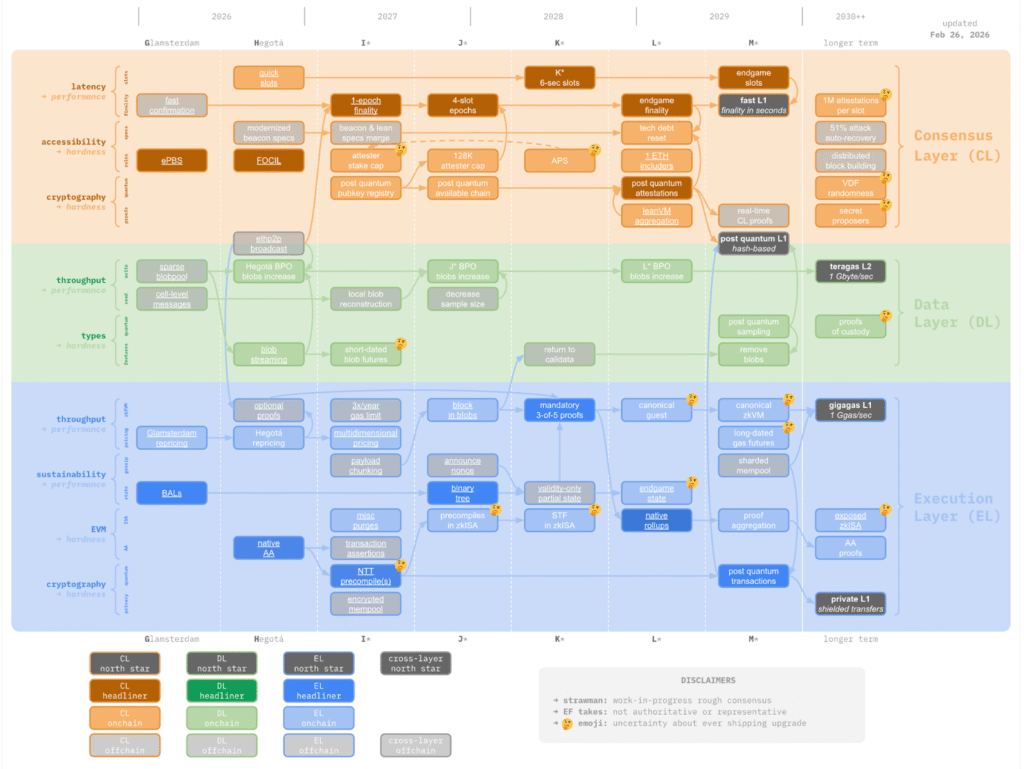
It devises a course from today’s 12-second blocks and ~15 TPS to a future where L1 settles transactions in seconds at 10,000 TPS, rollups handle 10 million TPS, and cryptographic security is designed to last centuries.
TL;DR
- Fast L1 – Block finality shrinks from 16 minutes to seconds, with slot times eventually dropping from 12s to 2s
- Gigagas L1 – 10,000 TPS on the base layer via embedded zkEVMs and real-time ZK proof generation
- Teragas L2 – 10 million TPS across rollups via expanded data availability, reinforcing Ethereum’s modular scaling model
- Post-Quantum – Quantum-resistant hash-based signatures replace current cryptography, with migration beginning as early as 2026
- Private L1 – Native shielded ETH transfers built into the protocol, making privacy a default rather than an afterthought
- For Validators – Expect tighter attestation windows, new ZK-proof hardware requirements, fairer MEV via ePBS, forced transaction inclusion via FOCIL, and mandatory quantum-safe key migration
- A new fork is planned every 6 months through 2029.
Let’s break down 5 North Star goals from the Strawmap, since they serve as a guiding vision for the ultimate end states of Ethereum leading up to 2029.
1. Fast L1: Accelerated Finality
Currently, Ethereum produces blocks every 12 seconds. The new roadmap outlines a gradual reduction, following a formula that could eventually bring the target slot times down to just 2 seconds. Vitalik Buterin expects slot times to decrease incrementally through a progression of 12 › 8 › 6 › 4 › 3, and potentially 2 seconds, noting the final two steps depend on heavy research.
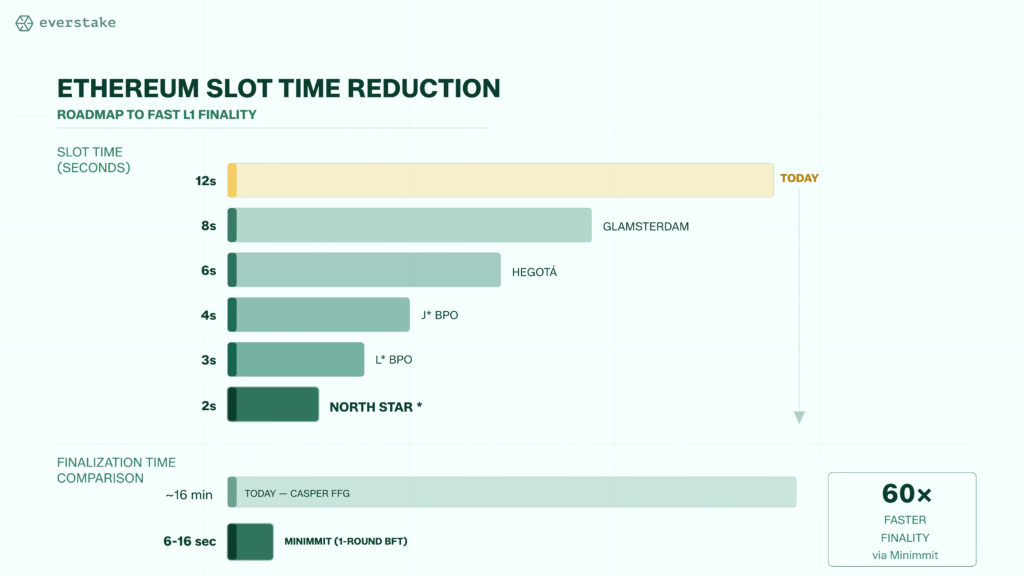
The driving ambition behind the shorter slots is to shrink finalization time from the current 16 minutes to as low as 6-16 seconds. This is to be achieved via a new consensus mechanism called Minimmit, which is a one-round Byzantine Fault Tolerant mechanism, replacing the existing finality system. Buterin described this as a “ship of Theseus” style rebuild where individual components of Ethereum’s consensus get replaced one by one until the whole system is new, without any single upgrade being too disruptive.
2. Gigagas L1: 10,000 TPS
The Strawmap establishes a Gigagas L1 goal, targeting 10,000 transactions per second through the integration of embedded zkEVMs and real-time proof generation.
By 2029, the roadmap anticipates mandatory zk-proof generation for block validity, embedding zkEVM concepts into Ethereum’s consensus and execution stack. This objective represents a fundamental bet on ZK-verified execution.
The Ethereum Foundation’s Realtime Proving roadmap describes a staged path where a small set of validators first runs ZK clients in production, and only after a supermajority of stake is comfortable, gas limits can rise to levels where proof verification replaces re-execution for practical validation on reasonable hardware.
3. Teragas L2: 10 Million TPS Across Rollups
Layer-2 scaling remains integral to Ethereum’s architecture. The Strawmap targets major increases in rollup throughput by expanding data availability bandwidth, describing teragas-level throughput (1 GB/sec) for rollups. Teragas doubles down on Ethereum’s modular scaling model with L1 for security and settlement, and L2 for execution.
This builds directly on the December 2025 Fusaka upgrade, which introduced PeerDAS. Cheaper transactions have also coincided with a rise in spam and address-poisoning attacks. It is a reminder that scaling comes with tradeoffs the community will need to actively manage.
4. Post-Quantum L1
The Foundation is moving aggressively to protect the blockchain from the looming threat of quantum computing, which Buterin warns could emerge as early as 2028. The Strawmap calls for a transition to hash-based signatures and recursive STARKs, moving the network away from its current quantum-vulnerable ECDSA cryptography. At least one of these quantum-resistant changes is already being considered for the Hegotá upgrade, scheduled for the latter half of 2026.
Researchers are evaluating three responses to recent Poseidon2 attacks: increasing round counts, returning to Poseidon1, or using BLAKE3. A registry for post-quantum public keys is expected around 2026, enabling early adoption of quantum-safe cryptographic schemes.
5. Private L1
The roadmap explicitly lists shielded ETH transfers as a first-class citizen of the protocol, signaling a willingness to pay the necessary computational costs to ensure that privacy is no longer just an application-layer concern. Today, Ethereum transactions are fully public by default, and privacy has historically been left to application developers or rollups. Native L1 privacy would make confidential transfers available to everyone without relying on third-party infrastructure.
Validator Perspective: What the Strawmap Means for Stakers
The Strawmap has significant implications for anyone running a validator or staking ETH, Everstake included.
The changes range from operational demands to economic restructuring.
ePBS and MEV Dynamics
The Glamsterdam upgrade would introduce enshrined Proposer-Builder Separation (ePBS) to stop block builder centralization from spilling into validator centralization. The idea keeps proposers free to outsource block construction to a permissionless builder market, while preserving staking decentralization. Today this relationship is handled off-chain via MEV-Boost relays. ePBS introduces standard protocol mechanisms for payload exchange and payments, offering greater transparency and unified rules for participants. This changes the game for the builder/relay market but does not eliminate MEV itself.
However, an academic paper on the “free option problem” for ePBS estimates option exercise at about 0.82% of blocks on average under an 8-second option window, reaching about 6% on high-volatility days, pushing attention toward liveness under stress, not only steady-state fee outcomes.
Censorship Resistance via FOCIL
Proposals like FOCIL and encrypted mempools directly support anti-censorship, fairness, and resilience goals. Under FOCIL, 16 randomly selected attesters each nominate transactions that must be included, and a block can be rejected if those transactions are missing, forcing inclusion power to be partially distributed even if one builder dominates ordering. For validators, it marks a new active role in censorship resistance.
New Hardware Demands for ZK Proof Generation
The Gigagas L1 goal is probably the most operationally demanding change for validators. The Realtime Proving path means a small set of validators first runs ZK clients in production, and only after a supermajority of stake is comfortable do gas limits rise to levels where proof verification replaces re-execution.
This could require more powerful hardware than what validators run today, causing a real concern for solo stakers and smaller operators.
Shorter Slots
The target of reducing the slot times from 12 seconds toward 2 seconds places much tighter latency and uptime demands on validators. Attestation deadlines will compress accordingly, meaning network connectivity quality and geographic location will matter more than ever for avoiding missed attestations and penalties.
Post-Quantum Key Migration
The plan associates major milestones with a move to post-quantum hash-based signatures. Validators will eventually need to migrate their signing keys from the current ECDSA/BLS schemes to new quantum-resistant equivalents. The registry planned for 2026 suggests this migration will be voluntary at first, then mandatory, giving stakers a runway to prepare, but requiring action.
Reward Dynamics and the ETH Supply Model
Currently, 35.8 million ETH is staked (about 28.9% of total supply), with 1.1 million active validators earning an average annual returns of around 3.3% including MEV and priority fees. The Strawmap’s throughput increases will likely increase fee activity over time, but the move to zkEVM execution may also shift who captures MEV and how. Validators should watch how ePBS and FOCIL together reshape the reward structure, especially the balance between base rewards and MEV-derived income.
The Bigger Picture for Validators
The Strawmap represents the most ambitious protocol evolution since The Merge. For validators like Everstake it’s largely positive in intent. ePBS protects staking decentralization, FOCIL distributes inclusion power, and post-quantum upgrades future-proof long-term capital. The practical challenges lie in hardware requirements (especially for ZK proving), narrow slot timing, and the need to actively manage key migrations.
As the Strawmap moves Ethereum toward a high-performance future, the role of a seasoned validator becomes indispensable.
Everstake has been supporting the Ethereum ecosystem since its early days, consistently securing the network through its most transformative periods with a proven track record of 99.98% uptime.
Our commitment remains rooted in technical excellence and the long-term interests of our institutional and retail stakers. We are actively monitoring the roadmap’s evolving demands to ensure our infrastructure continues to provide the stability and performance the community expects.
Ethereum Direction
The “ship of Theseus” framing Buterin uses is apt: no single upgrade will feel revolutionary in isolation, but the cumulative effect will result in an Ethereum that is fundamentally unrecognizable from today’s.
Validators and stakers who understand the direction of the network, and prepare accordingly, will be best positioned not just to survive these changes, but to benefit from them.
For validators, the roadmap demands active engagement rather than passive participation. Hardware will need to evolve to meet ZK proving requirements, attestation windows will tighten as slot times compress, and key infrastructure will need to be migrated ahead of mandatory quantum-safe deadlines. At the same time, ePBS and FOCIL represent meaningful structural improvements.
As the protocol enters this ambitious new chapter, Everstake stands as a reliable partner dedicated to preserving the decentralization and security of Ethereum for the years to come.
Share with your network