ethereum
Pectra Anniversary: How Ethereum Changed Between May 2025 and May 2026
The Pectra hard fork activated on May 7, 2025, bundling 11 EIPs that changed validator limits, blob capacity, and wallet behavior. By May 2026, compounding validators surpassed 26%, Fusaka’s PeerDAS scaled rollup data, and Layer 2 fees settled below two cents.
MAY 07, 2026
Last updated AUG 09, 2026 · V1
TL;DR
- The Pectra upgrade activated on May 7, 2025.
- It introduced 11 EIPs focused on user experience, staking efficiency, and Layer 2 scaling.
- One year later, Ethereum shows higher validator consolidation, expanded blob usage, and broader smart account adoption.
- The network processes more data for rollups at lower costs.
- Activity on Layer 2 solutions grew notably. Overall ecosystem resilience increased without major disruptions.
- The follow-up Fusaka hard fork went live on December 3, 2025, extending Pectra’s foundation through PeerDAS.
A Quick Recap of What Pectra Changed
Pectra combined the Prague execution-layer fork and the Electra consensus-layer fork into one release with 11 EIPs. It was the most substantial change to Ethereum since The Merge in 2022.
Everstake has previously covered the full breakdown in our Pectra Upgrade article.
A parallel piece on institutional impact explored what changes were introduced by Pectra for larger stakers.
Three of the 11 EIPs focused on staking, while the rest reworked scaling, cryptography, and account behavior.
Let’s focus on headline staking changes:
- EIP-7251: Lifted the maximum effective validator balance from 32 ETH to 2,048 ETH.
- EIP-6110: Moved validator deposits to the Execution Layer, cutting activation time from roughly 12 hours to about 13 minutes.
- EIP-7002: Enabled validator exits and partial withdrawals through standard execution-layer transactions.
Outside of staking, EIP-7702 introduced smart-account behavior for regular wallets.
EIP-7691 raised the blob target per block from 3 to 6, with a max of 9.
EIP-2537 added a BLS12-381 precompile for faster cryptographic verification.
Unlike The Merge, which replaced consensus, or Dencun, which added blobs, Pectra touched many layers at once. It reshaped staking economics, wallet behavior, and rollup data costs in a single hard fork.
The Validator Set Changes
The validator landscape projected in our July 2025 coverage has materialized faster than expected. At launch, only ~3,700 validators had opted into the new compounding model. By October 2025, that number grew sharply. Our follow-up article Compounding Validators Now Account for Over 10% of the Validator Body reported a major milestone.
As of May 2026, over 26% of validators are compounding.
Here is how the 0x02 compounding-credential adoption progressed across the year:
| Date | Compounding Validators | ETH Held | Share of Staked ETH |
| June 2025 | ~3,700 | ~750,000 ETH | ~2% |
| October 2025 | 5,281 | 3,580,916 ETH | ~10.03% |
| May 2026 | 12,431 Larger consolidated set | ~10.3M ETH | Compounding above 26% |
This change confirms the thesis our research team laid out at activation.
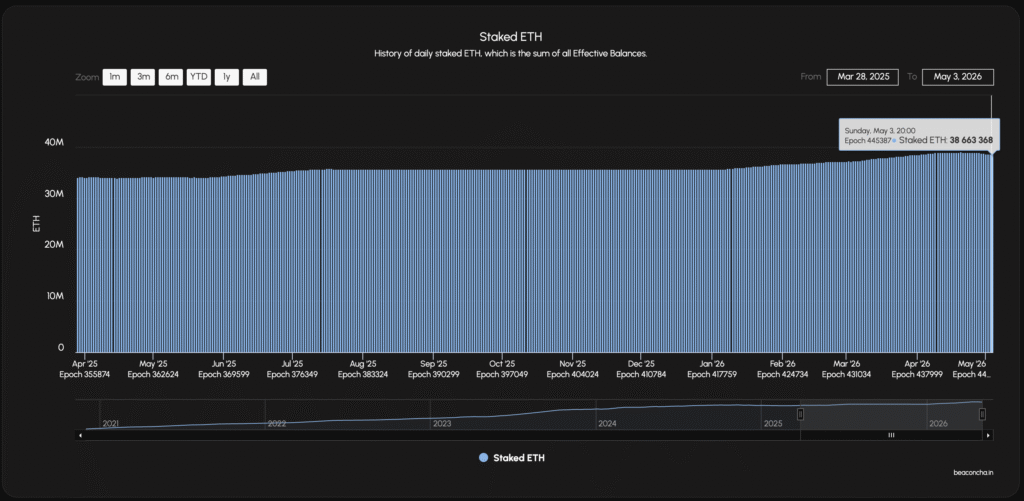
Capital efficiency improved without harming execution-layer rewards, and large operators consolidated nodes to reduce DevOps overhead. According to Everstake’s 2025 annual report, total staked ETH reached approximately 36.08 million ETH, which represents about 29.3% of total supply.
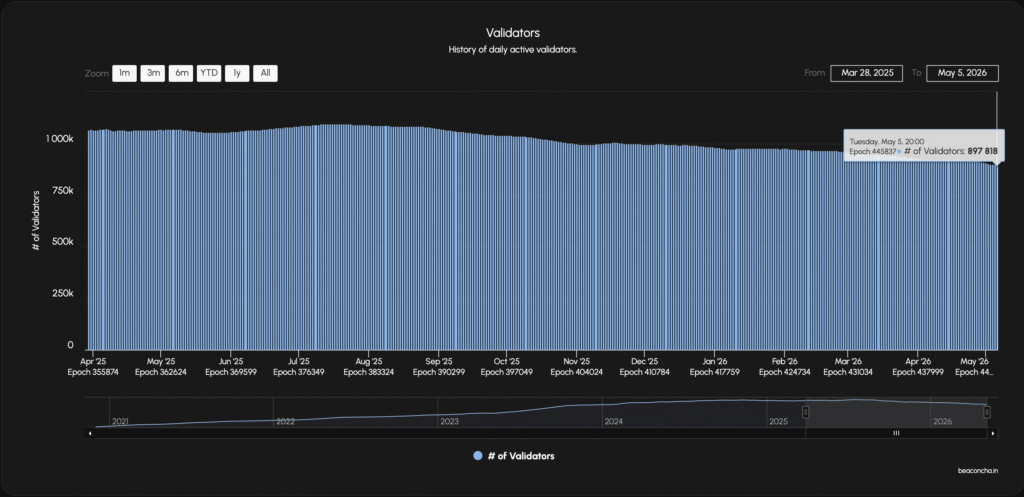
Validator activation also performed as designed. EIP-6110 delivered the promised drop from roughly 12 hours to about 13 minutes. The temporary exit spike of validators reversed within months. Active validator count then climbed past pre-Pectra levels.
The number of validators has decreased 16% compared to pre-Pectra, yet the Total Staked Amount on Ethereum Staking Contract has grown 4.7M ETH (nearly $10.5B as of May 2026)
Blob Economics: From Cheap to Practically Free
The blob market was perhaps the most dramatic story of the post-Pectra year. Our original analysis cited Galaxy Research data showing blob usage rising 21% and daily ETH burn falling sharply. The trajectory continued well past those early figures.
Below is a comparison of blob metrics across the year:
| Metric | Pre-Pectra (April 2025) | Post-Pectra (mid-2025) | Post-Fusaka (early 2026) |
| Blob target per block | 3 | 6 | 10, then 14 via BPO forks |
| Blob max per block | 6 | 9 | 15, then 21 via BPO forks |
| Avg blobs per day | ~21,200 | ~25,600 | Significantly higher |
| Average blob price | Variable, often spiked | ~$0.00000000035 (1 wei) | Stable near zero |
| Daily ETH burn from blobs | 11.22 ETH | 3.26 ETH (a 71% drop) | Lower still |
- Fusaka went live on December 3, 2025 at slot 13,164,544.
- Its headline feature was PeerDAS (EIP-7594).
- The follow-up BPO1 and BPO2 forks pushed the blob target to 10 and then 14 per block.
According to the Bankless report on activation day, PeerDAS unlocked roughly 8x data throughput for rollups. L2 transaction fees on major networks now sit consistently below $0.02. L2 aggregate TPS crossed 1.22K by late 2025, scaling Ethereum’s base layer by a factor of about 20x.
What Changed for Institutional Operators in Practice
Our May 2025 article on institutional impact predicted concrete operational wins. Twelve months later, those predictions hold up well. Several effects are stronger than projected:
- Reduced DevOps load: Operators who once managed hundreds of 32 ETH validators consolidated into fewer 2,048 ETH validators. Network peer-to-peer traffic dropped accordingly.
- Faster operational response: With activation cut to ~13 minutes, large operators can scale into or out of staking positions within a single session.
- Softer slashing curve: Our DevOps team calculated the initial slashing penalty fell 128x, from 1/32 of effective balance to 1/4,096. A 2,048 ETH validator now faces about 0.024% rather than 3.125%.
- Cleaner compliance flows: EIP-7002 withdrawals through the execution layer made automated exit logic possible. This aligns better with regulatory and audit frameworks.
The 0x02 credential model also enables top-ups and auto-compounding. Rewards above 32 ETH stay inside the validator and grow the balance over time, instead of being swept to a withdrawal address. Everstake operates a compounding validator and has tracked the trend since the first weeks after Pectra.
A subtler effect is on consensus-layer load. Fewer validator indices mean fewer attestation aggregations and lighter peer-to-peer chatter. Our internal research found no negative impact on execution-layer rewards for high-balance validators. The two-group comparison study covered 64+ ETH validators against random 32 ETH validators with the same total stake. Performance was effectively equivalent, which removed a key concern around consolidation.
Pectra Impact on Institutional-Scale Staking
Everstake’s main optics is that Pectra upgrade has favored the constant inflow of institutional-scale staking. In practice these changes resulted in multiple staking metrics ATH that all happened after Pectra upgrade:
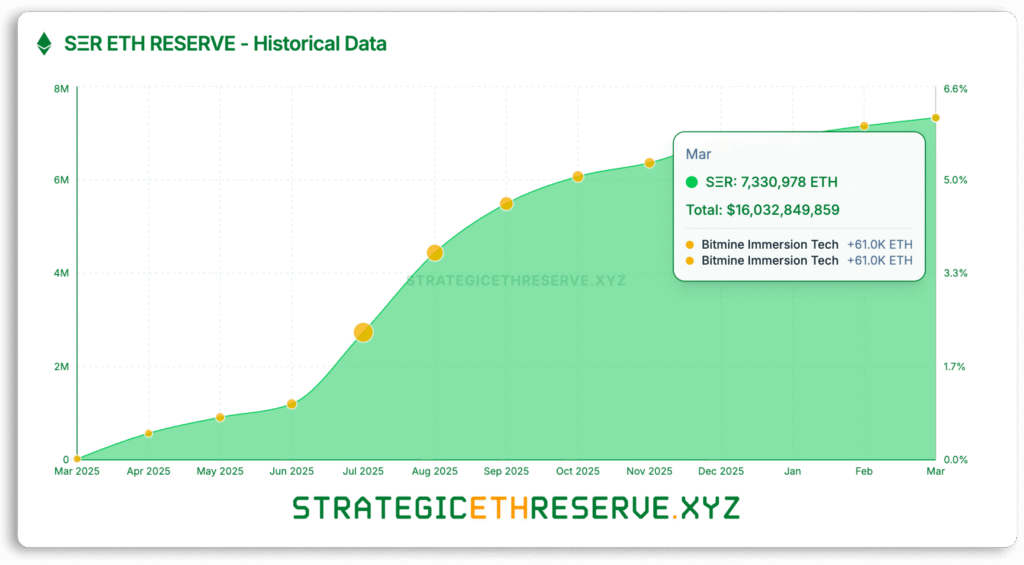
- A new sector of public companies (DATs) accumulating Ethereum emerged, as was mentioned in our 2025 crypto report, with a sharp “hockey stick” trajectory of corporate holdings, breaching 7.3 million ETH ($16.3 billion) by March 2026. BitMine Immersion Tech alone has staked over 4.4M ETH to date.
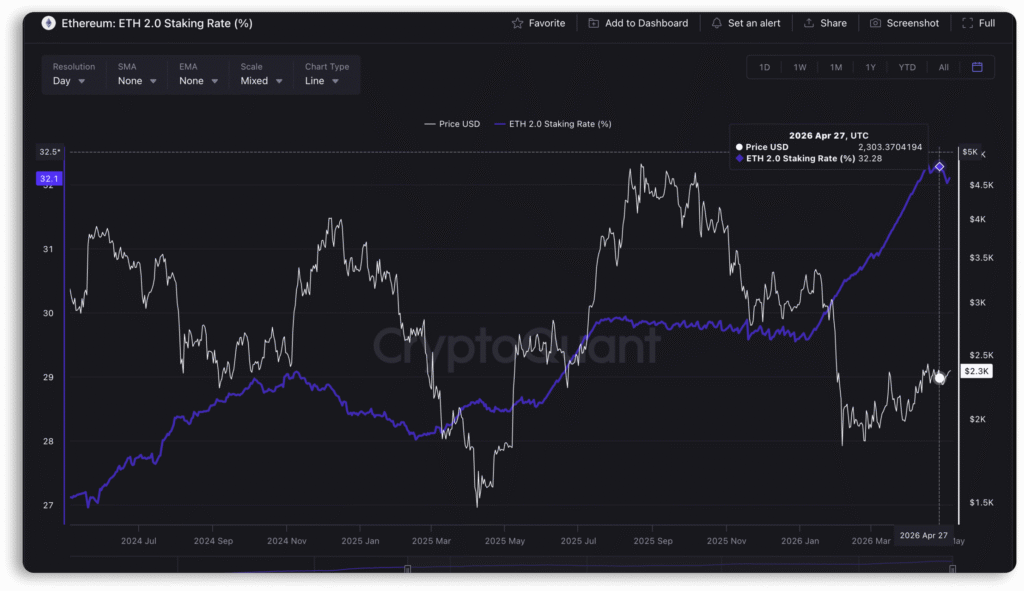
- Total Ethereum staked ATH – 32.2%
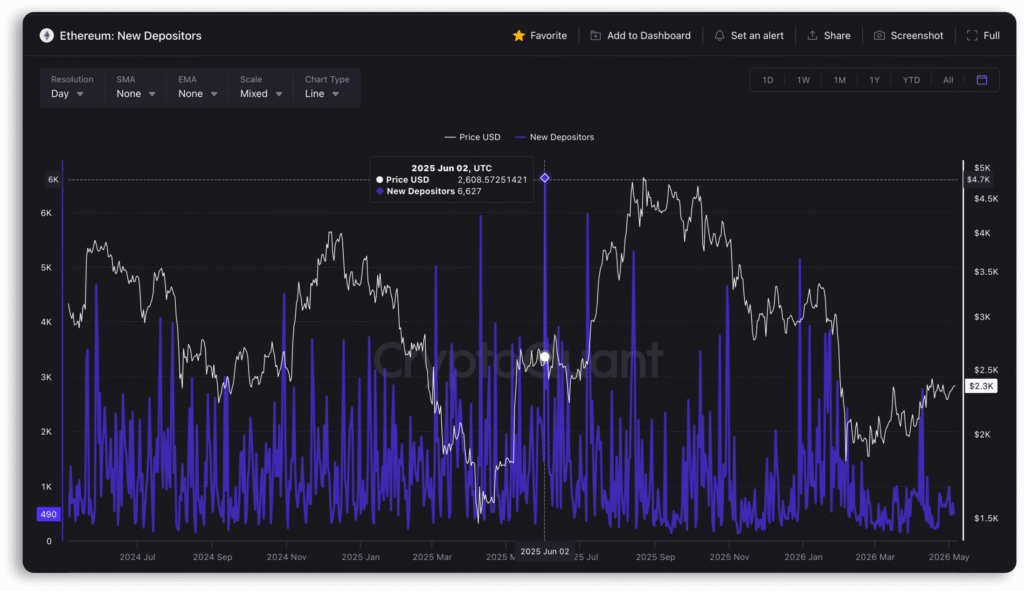
- The ATH for daily new deposits to the Ethereum 2.0 contract is 6,627, set on June 2, 2025, with the average sitting around 2,000 per day. This metric tracks the number of new accounts that have deposited at least 32 ETH into the deposit contract.
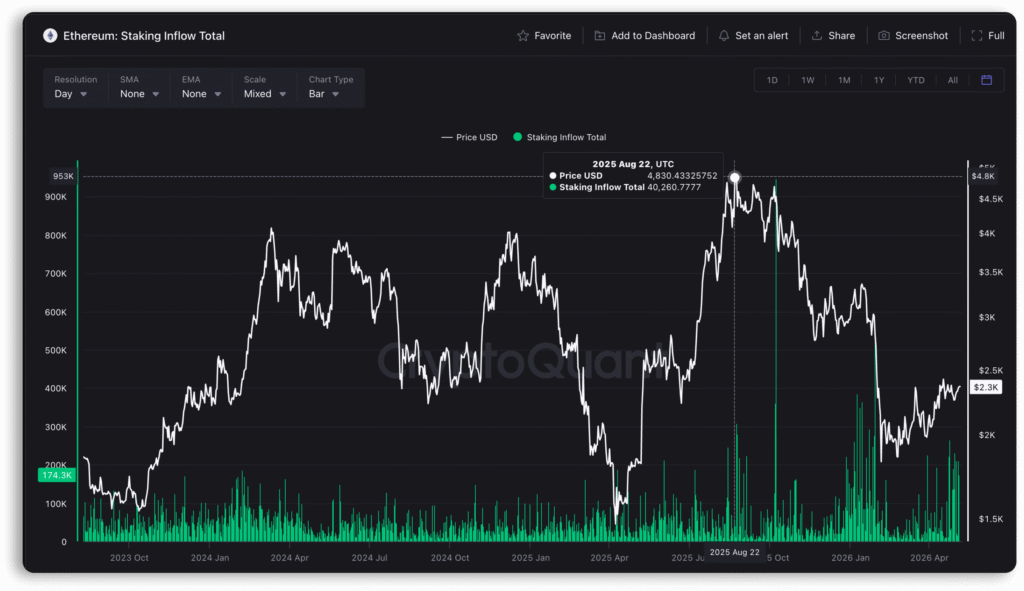
- The ATH for total Ethereum staking inflow was reached on October 8, 2025, with 946,848 ETH deposited. This metric reflects the total amount of ETH flowing into the deposit contract.
EIP-7702 aka Smart Wallets
The wallet experience changed in a way most users never noticed. EIP-7702 allowed a regular EOA to behave like a smart contract for the duration of a single transaction. That unlocked batched calls, gas sponsorship, session keys, and paymaster flows without forcing migration to a new wallet.
By late 2025, smart-contract wallet behavior accounted for over 25% of new address activations on Ethereum. The figure comes from industry reporting cited by The Capital on Medium. MetaMask and other wallets shipped native support during the year. dApp developers built EIP-7702-aware flows for onboarding.
What the Numbers Look Like at the One-Year Mark
A snapshot of the network on the eve of Pectra’s first anniversary:
- Total staked ETH: approximately 38.6 million (~32% of supply).
- Compounding validators: as of May 2026 above 26% of the validator stake share and rising.
- Average L2 transaction fee: consistently below $0.02.
- Staking participation: grew from around 28% to over 32% of staked ETH.
- Total Ethereum ETP and ETF assets under management: approximately $14 billion by May 2026.
- EF set target validator count as 128,000.
Looking Toward Glamsterdam
Pectra is not a final destination, and Fusaka confirmed that. The next named upgrade is Glamsterdam, expected mid-2026, followed by Hegotá later in the year. Glamsterdam focuses on ePBS, L1 scaling and parallel transaction processing, block gas-limit increases toward 200 million or higher, and ZK proof verification. Hegotá is set to introduce FOCIL, Verkle Trees and statelessness, which will shrink node storage requirements substantially.
The trajectory suggests three priorities for the next twelve months:
- Parallel execution: To raise base-layer throughput from roughly 15 TPS toward higher numbers.
- Stateless clients: To lower hardware barriers for solo node operators.
- Native privacy and account abstraction: Building on EIP-7702 with proposals like EIP-8141 and EIP-8182.
Bottom Line
Pectra delivered on its stated goals within a year. Validator consolidation moved from theory to mainstream practice, blob costs collapsed to near zero, and smart-account behavior reached meaningful adoption. The Fusaka activation in December 2025 reinforced the trajectory by scaling data availability through PeerDAS.
The conversation has shifted from whether Pectra’s mechanisms work to how quickly the ecosystem can absorb them. By May 2026, Ethereum runs leaner at the validator level and cheaper at the rollup level. It is also more flexible at the wallet level than it was one year earlier. The roadmap continues with Glamsterdam and Hegotá. The foundation laid by Pectra and Fusaka is what makes those next steps technically feasible.
FAQ
When did the Pectra upgrade activate, and what made it significant?
The Pectra upgrade was activated on May 7, 2025. It was Ethereum’s most substantial change since The Merge in 2022, combining the Prague execution-layer fork and Electra consensus-layer fork into a single release with 11 EIPs that reshaped staking, scaling, and wallet behavior all at once.
How did Pectra change validator staking?
Pectra raised the maximum effective validator balance from 32 ETH to 2,048 ETH through EIP-7251, allowing operators to consolidate many small validators into fewer large ones. It also cut validator activation time from roughly 12 hours to about 13 minutes, and enabled exits and partial withdrawals through standard execution-layer transactions.
What happened to blob costs and Layer 2 fees after Pectra?
Blob costs dropped dramatically. The daily ETH burn from blobs fell from 11.22 ETH to 3.26 ETH, a 71% drop. After the Fusaka upgrade in December 2025 added PeerDAS, data throughput increased roughly 8x, and Layer 2 transaction fees on major networks now consistently sit below $0.02.
What is EIP-7702?
EIP-7702 allows a regular wallet (EOA) to behave like a smart contract for the duration of a single transaction. This unlocked features like batched calls, gas sponsorship, and session keys without forcing users to migrate to a new wallet. By late 2025, smart-contract wallet behavior accounted for over 25% of new address activations on Ethereum.
How much ETH is currently staked, and how has participation grown?
By May 2026, total staked ETH reached approximately 38.6 million, representing about 32% of total supply. Staking participation grew from around 28% to over 32%, and compounding validators now make up over 26% of the validator body.
What is Fusaka?
Fusaka activated on December 3, 2025, with PeerDAS (EIP-7594) as its headline feature, scaling data availability for rollups.
What comes next for Ethereum?
The next major upgrade is Glamsterdam, expected mid-2026, focusing on ePBS, L1 scaling, parallel transaction processing and ZK proof verification. Hegotá will follow later in 2026, introducing FOCIL, Verkle Trees and statelessness to reduce node storage requirements.
Disclaimer
This article is for informational purposes only and does not constitute financial, investment, legal, or tax advice. Nothing here is an endorsement or recommendation to buy, sell, hold, or stake any digital asset, or to use any platform or service mentioned. Mention of third parties does not imply affiliation or endorsement.
Digital assets and staking carry significant risks, including volatility, regulatory uncertainty, and total loss of capital. Data referenced reflects publicly available sources as of the date of publication and may change. Readers should conduct their own research and consult qualified professionals before making any decisions.
Share with your network