ethereum
Ethereum Glamsterdam Upgrade Explained: ePBS, BALs, and the 2026 Roadmap
Glamsterdam is Ethereum’s next hard fork, targeting Q3 2026 activation with two headline EIPs: EIP-7732 (ePBS) and EIP-7928 (Block-Level Access Lists). Together they restructure block production and enable parallel execution, supporting a planned gas limit increase from 60M toward 200M.
MAY 27, 2026
Last updated AUG 07, 2026 · V1
TL;DR
- Glamsterdam is Ethereum’s next hard fork after Fusaka, targeting activation in Q4 2026.
- Its 2 headline proposals are EIP-7732 (Enshrined Proposer-Builder Separation) and EIP-7928 (Block-Level Access Lists).
- These changes move Ethereum toward parallel execution and in-protocol builder commitments and payments.
- ETH holders need to take no action. Stakers and node operators must update both CL and EL clients before mainnet activation.
- Everstake, a validator and staking provider active in the Ethereum ecosystem since The Merge, will support the upgrade across all validator infrastructure.
What Does “Glamsterdam” Mean?
Glamsterdam is a portmanteau of two upgrade names: Gloas (the consensus-layer component) and Amsterdam (the execution-layer component). Ethereum has historically named hard forks by pairing a star name with the city that hosted the most recent Devconnect developer conference. Amsterdam hosted Devconnect in 2022, making it the EL anchor for this cycle.
The name signals a coordinated CL and EL upgrade. Both layers must activate together, which is why the naming convention matters to client teams and node operators.
Glamsterdam at a Glance
Glamsterdam targets mainnet activation at the end of August 2026 as the internal working target. This date is aspirational and subject to devnet readiness and cross-client testing.
The upgrade succeeds Fusaka (activated December 2025) and precedes Hegotá, which was initially targeted for H2 2026, but the developers might reschedule the date closer to Q4 2026-Q1 2027.
Its core objective is to shift Ethereum’s scaling narrative from L2-only throughput back toward a high-performance L1.
Upgrade Comparison Table (as of May 2026)
| Upgrade | Target Date | Headliner | Scope |
| Pectra | H1 2025 | Account abstraction (EIP-7702), EIP-7251 validator consolidation, higher blob counts | CL + EL |
| Fusaka | December 2025 | PeerDAS, extended blob data availability | CL + EL |
| Glamsterdam | H2 2026 | ePBS (EIP-7732), Block-Level Access Lists (EIP-7928) | CL + EL |
| Hegotá | H1 2027 | FOCIL | CL |
Where Glamsterdam Fits in Ethereum’s Roadmap
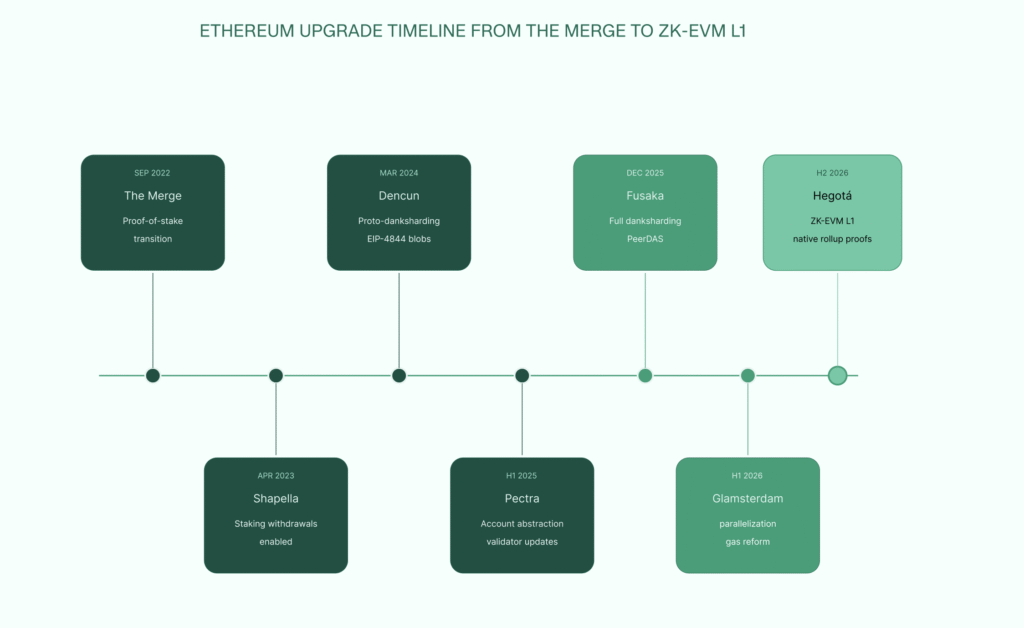
Ethereum’s upgrade history follows a clear progression from consensus security toward execution performance. Each hard fork has delivered a distinct capability layer.
From The Merge to Pectra: What Each Upgrade Delivered
- The Merge (September 2022) transitioned Ethereum from proof-of-work to proof-of-stake, eliminating miner block production.
- Shapella (April 2023) enabled ETH withdrawals from the Beacon Chain, completing the staking lifecycle.
- Dencun (March 2024) introduced EIP-4844 (proto-danksharding), cutting L2 data posting costs by ~90% through blob transactions.
- Pectra (H1 2025) was a step toward account abstraction via EIP-7702 and validator consolidation via EIP-7251, raising the max effective balance to 2,048 ETH.
Fusaka (2025) PeerDAS and the L2 Data Availability Foundation
Fusaka introduced PeerDAS (Peer Data Availability Sampling), which expanded Ethereum’s blob throughput for L2 rollups. This upgrade laid the data availability foundation that supports continued L2 scaling, while Glamsterdam targets the block-production pipeline and execution engine on top of that.
Glamsterdam (H2 2026) Block Production and Execution Overhaul
Glamsterdam targets the block-production pipeline and execution engine simultaneously. EIP-7732 enshrines proposer-builder separation into the protocol, replacing the trusted off-chain relays used today (e.g., MEV-Boost) with in-protocol bids, commitments, and payments, while EIP-7928 enables parallel transaction execution by pre-declaring state access.
Hegotá (H1 2027) Verkle Trees and Stateless Clients
Hegotá will bring FOCIL (Fork Choice-enforced Inclusion Lists) for censorship resistance, which was scoped out of Glamsterdam to maintain delivery discipline. Other headliner proposals include 2D PeerDAS for enhanced data availability and potentially Verkle Trees, reducing node storage requirements by approximately ~90%.
Ethereum Upgrade Timeline
The Two Headliner EIPs
Glamsterdam is anchored by 2 proposals that each solve a structural problem on Ethereum.
EIP-7732 Enshrined Proposer-Builder Separation (ePBS)
Today, approximately over 88% of Ethereum blocks are built off-chain through MEV-Boost, a system that relies on trust-based relays between validators and block builders. This creates centralization risk: builders operate without on-chain identity, relays can censor transactions, and validators have no protocol-enforced recourse if a builder fails to deliver.
EIP-7732 addresses this by enshrining proposer-builder separation directly in the Ethereum protocol. Builders become first-class participants with on-chain identity and cryptographically signed bids.
The proposal introduces the Payload Timeliness Committee (PTC), a new validator committee responsible for attesting that a block payload was delivered on time.
This is a new type of validator duty that every solo staker and operator must prepare for.
Periodically, each staker will be included in this committee, which requires software updates and the node’s readiness to perform this new type of attestation.
EIP-7732 also extends the data propagation window from 2 seconds to approximately ~9 seconds. This larger window creates room for bigger blocks, more blob capacity, and provides more headroom for future ZK-proving workflows that may benefit from longer validation windows.
EIP-7928 Block-Level Access Lists (BALs)
Ethereum currently executes transactions sequentially because nodes cannot know which state a block will touch until execution begins. This single-threaded model is the primary constraint on L1 throughput.
EIP-7928 introduces Block-Level Access Lists (BALs): a record included in every block that maps every account and storage slot the block touches, along with the post-execution state values. Nodes receive this map upfront, enabling parallel disk reads and parallel transaction validation.
BALs open 3 downstream capabilities:
- Parallel execution across CPU cores during block processing
- Executionless state reconstruction, helping light clients, stateless clients, and syncing nodes
- A credible path to raising the gas limit toward 200M, up from today’s ~60M
This gas-limit expansion, combined with the ePBS propagation window, creates the technical foundation for higher TPS on Ethereum.
Glamsterdam Scheduled for Inclusion
Beyond the two headliners, Glamsterdam has eight additional EIPs Scheduled for Inclusion (SFI) per EIP-7773. The ones most relevant for fees and execution economics:
EIP-7976 Increase Calldata Floor Cost
Raises the floor cost of calldata to better reflect the bandwidth burden of large transactions, primarily affecting rollups that post calldata-heavy batches.
EIP-7981 Increase Access List Cost
Raises the cost of EIP-2930 access list entries, recalibrating pricing now that BAL infrastructure (EIP-7928) makes access information protocol-enforced.
EIP-8037 State Creation Gas Cost Increase
Raises the cost of creating new state entries to better reflect the long-term burden of state growth on every node. This is Glamsterdam’s primary anti-state-bloat lever and complements the parallel execution model introduced by BALs.
EIP-7954 Increase Maximum Contract Size
Raises the EIP-170 contract size limit, giving developers headroom for larger contracts.
EIP-7778 Block Gas Accounting without Refunds
Removes gas refunds from block-level accounting, simplifying gas economics and improving predictability for block builders.
EIP-8024 Backward compatible SWAPN, DUPN, EXCHANGE
Introduces new stack-manipulation opcodes for the EVM.
EIP-7843 SLOTNUM opcode
Adds an opcode that exposes the current slot number to smart contracts, useful for time-aware contract logic.
Will Glamsterdam Lower Ethereum Gas Fees?
Glamsterdam activates distinct mechanisms that may lower fees on Ethereum L1, though the magnitude depends on network demand. The mechanisms are:
- Conditions for gas-limit expansion via BALs (EIP-7928): more transactions can fit per block, distributing base fee pressure across higher capacity
- MEV restructuring via ePBS (EIP-7732): in-protocol builder competition may reduce reliance on off-chain relays and reshape priority fee dynamics during congestion.
On L2, Glamsterdam’s longer ePBS propagation window may reduce data posting costs further for rollups. This benefits end users of L2 networks like Arbitrum, Optimism, Base, and zkSync.
Gas fees are ultimately demand-driven. If L1 usage scales with capacity, the base fee may remain stable or rise despite the upgrades.
Developer and UX Improvements
EIP-7708 ETH transfers emit a log.
Native ETH movements (value-transferring transactions, CALLs, CREATEs, and SELFDESTRUCTs) emit a log with the same shape as the ERC-20 Transfer event, allowing indexers, block explorers, and wallets to track ETH balance changes through the same log-based mechanism they already use for tokens.
Burns from contract destruction emit a separate Burn log. Today, ETH transfers from smart contract wallets aren’t automatically logged, which has historically caused issues with exchange deposit detection.
What Didn’t Make Glamsterdam
The Glamsterdam candidate list initially exceeded 50 EIPs. The final cut reflects deliberate scope discipline by Ethereum core developers.
EIP-7782 6-Second Slots (Shelved)
EIP-7782 proposed halving slot time from 12 to 6 seconds. Core developers declined it from Glamsterdam: it would delay real-time ZK proving (already approaching the 12s target), force timing recalibration if slot restructuring happened later, and was less mature than competing proposals with no full client implementation.
FOCIL Fork-Choice Inclusion Lists (Moved to Hegotá)
FOCIL (Fork-Choice Inclusion Lists) provides censorship resistance by requiring builders to include transactions nominated by validators. It was moved to Hegotá after the Base team and others warned that combining ePBS and FOCIL in a single upgrade would create untested interaction complexity at mainnet scale.
Implementation complexity across the 50+ candidate EIPs remains the primary risk to on-time delivery.
What Glamsterdam Means for Each Stakeholder
Each stakeholder group faces a different set of actions and implications from Glamsterdam.
For ETH Holders
No action is required for ETH holders. The Glamsterdam hard fork will not change wallet addresses, balances, or any user-facing behavior. Anyone telling you to “upgrade your ETH” ahead of a fork is running a scam. Ethereum.org recommends ignoring all unsolicited messages about token migrations related to protocol upgrades.
For Stakers and Home Validators
Stakers running their own validators must update both CL and EL clients before mainnet activation. The new PTC duty requires CL client support. Operators should monitor release schedules for Lighthouse, Prysm, Teku, Nimbus, Lodestar (CL) and Geth, Nethermind, Besu, Erigon (EL).
Everstake has operated as a professional Ethereum validator since The Merge in September 2022. Everstake will deploy client updates across its validator infrastructure ahead of the activation window and publish upgrade status for its staking users.
For Node Operators
The parallel execution model introduced by BALs requires nodes to perform concurrent disk reads during block processing. Operators should check storage hardware for IOPS capacity and latency before activation. Validators participating in the PTC will also face tighter timing windows under ePBS, making low-latency network connectivity more important than in previous upgrades.
For dApp Developers
Smart contracts will continue to work after Glamsterdam without redeployment. However, three SFI repricings will shift gas economics: EIP-8037 raises costs for contracts that create new state (deployments, new storage slots), EIP-7976 increases the calldata floor cost (most relevant for calldata-heavy transactions), and EIP-7981 raises EIP-2930 access list costs. Contracts that primarily read or modify existing state are largely unaffected.
For L2s and Rollups
Glamsterdam’s longer ePBS payload-propagation window creates room for higher blob capacity in future Blob Parameter Only (BPO) forks, which can reduce data-posting costs for rollups over time. Rollup teams should also monitor EIP-7976 (calldata floor cost increase), which raises the fallback cost when rollups post via calldata rather than blobs.
For Institutions and Large ETH Holders
Glamsterdam doesn’t pivot Ethereum away from rollups. It hardens L1 as a high-performance settlement base, making the L2-centric roadmap more durable.
The upgrade’s validator changes, including faster exit processing, improving liquidity predictability for large staked positions.
Institutions seeking professional-grade validator infrastructure can stake ETH with Everstake, which will deploy Glamsterdam client updates across its infrastructure in time.
Timeline, Devnets, and What to Watch
Glamsterdam development is progressing through a structured devnet sequence before public testnet deployment. The Soldøgn interop devnet concluded May 2, 2026, with a stable multi-client Glamsterdam devnet now running.
Public testnets (Sepolia and Hoodi or equivalent) are expected to follow before mainnet activation.
3 risks could postpone activation further:
- ePBS implementation complexity: enshrining proposer-builder separation is proving trickier than anticipated and remains the primary bottleneck to testnet readiness
- Cross-client implementation parity: all major EL and CL clients must reach feature parity before a mainnet date can be confirmed
- Gas repricing implementation: although EIP-8037 parameters were finalized at Soldøgn, testing the repricing under realistic mainnet-scale load remains an outstanding workstream.
As of August 2026, Glamsterdam is on track for mainnet in Q4 2026.
After Glamsterdam: Hegotá and Beyond
Hegotá (2026-2027) is shaping up as one of Ethereum’s most structurally significant upgrades since The Merge. Its headliner has been selected: FOCIL (Fork-Choice enforced Inclusion Lists, EIP-7805), per the Ethereum Foundation’s Checkpoint #9 (April 2026). Account abstraction work is committed as part of the minor feature set. Additional candidates are Verkle Trees and 2D PeerDAS that remain under active discussion as headliner submissions.
Beyond Hegotá, the long-arc roadmap targets ZK-EVM verification at the L1 level, allowing Ethereum to verify its own execution via ZK proofs. This goal has no confirmed activation date.
FAQ
What Does the Name “Glamsterdam” Mean?
Glamsterdam combines Gloas (consensus-layer name, after a star) with Amsterdam (execution-layer name, after the 2022 Devconnect host city). Ethereum pairs star names with Devconnect/Devcon host cities for each upgrade.
When Will the Glamsterdam Upgrade Go Live?
The original target was H2 2026, with Q4 as the aspirational window. After the Soldøgn interop (May 2, 2026), Q3 2026 is now seen as more realistic. Sepolia and Hoodi activations are the clearest leading indicators.
Do I Need to Do Anything with My ETH Before Glamsterdam?
No. ETH holders need to take no action. Glamsterdam does not change wallet addresses, balances, or any user-facing interface.
As a Staker or Node Operator, What Do I Need to Do?
Update both your CL and EL clients before mainnet activation. Ensure your infrastructure supports the new Payload Timeliness Committee (PTC) attestation duty introduced by EIP-7732. Monitor release channels for Lighthouse, Prysm, Teku, Nimbus, Lodestar, Geth, Nethermind, Besu, Erigon, and Reth.
Will Glamsterdam Lower Gas Fees on Ethereum L1?
The main fee-reduction lever is higher block capacity via BALs (EIP-7928), enabling the planned gas limit increase from 60M toward 200M. ePBS may reshape priority fees, but direction is uncertain. Actual fees depend on L1 demand.
How Does Glamsterdam Affect L2 Rollups?
Blob scaling in 2026 is primarily a Fusaka (PeerDAS) outcome. Glamsterdam’s longer ePBS payload-propagation window enables higher blob capacity in future BPO forks. BALs are transparent to L2 sequencers, no sequencer-side changes are required.
Will My Existing Smart Contracts Still Work After Glamsterdam?
Yes. Glamsterdam is backward compatible. However, three repricings shift gas economics: EIP-8037 raises state-creation costs, EIP-7976 raises the calldata floor, and EIP-7981 raises EIP-2930 access list costs. Benchmark contracts on a Glamsterdam devnet before activation.
How Will Glamsterdam Change Node Hardware Requirements?
BAL-driven parallel execution lets nodes perform concurrent disk reads. Operators should audit storage IOPS, particularly for NVMe SSDs. The PTC duty under ePBS increases sensitivity to network latency. Current home-validator hardware should remain sufficient.
What Is the Difference Between Glamsterdam and Hegotá?
Glamsterdam (Q4 2026) focuses on block production (ePBS) and execution throughput (BALs). Hegotá (H1 2027) is headlined by FOCIL for censorship resistance, with account abstraction work as a minor feature and Verkle Trees still under candidate selection.
How Is Glamsterdam Different from the Merge or Dencun?
The Merge (Sept 2022) switched Ethereum to proof-of-stake. Dencun (March 2024) introduced blob transactions via EIP-4844. Glamsterdam enshrines proposer-builder separation into the protocol (replacing MEV-Boost relays) and enables parallel L1 execution via BALs.
Disclaimer
This article is for informational purposes only and does not constitute financial, investment, legal, or tax advice. Nothing here is an endorsement or recommendation to buy, sell, hold, or stake any digital asset, or to use any platform or service mentioned. Mention of third parties does not imply affiliation or endorsement.
Digital assets and staking carry significant risks, including volatility, regulatory uncertainty, and total loss of capital. Data referenced reflects publicly available sources as of the date of publication and may change. Readers should conduct their own research and consult qualified professionals before making any decisions.
Share with your network