Institutional
monad
Monad Staking and Mainnet 2026: Institutional Guide
Monad is a Layer-1 blockchain delivering parallel EVM execution at 10,000 TPS with full Solidity compatibility and sub-cent fees. Since its November 2025 mainnet launch, the network has reached $410M in TVL across DeFI protocols.
MAY 20, 2026
Last updated AUG 07, 2026 · V1
TL;DR
- Monad launched mainnet on November 24, 2025 and reached approximately $410M in TVL faster than any recent L1.
- The pitch combines parallel EVM execution at 10,000 TPS, full Ethereum tooling compatibility, and early stablecoin and RWA infrastructure.
- For institutional allocators, Monad offers a performant alternative for DeFi activity, stablecoin flows, and high-frequency strategies without Ethereum congestion.
- Everstake validates on Monad and offers MON staking through compliant infrastructure with SOC 2 Type II and ISO 27001 controls.
What is Monad and what changed in November 2025
Monad is a Layer-1 blockchain that runs the Ethereum Virtual Machine with parallel execution and a target throughput of 10,000 TPS. The mainnet went live in November 2025 after years of testnet activity that drew developers from the Ethereum ecosystem.
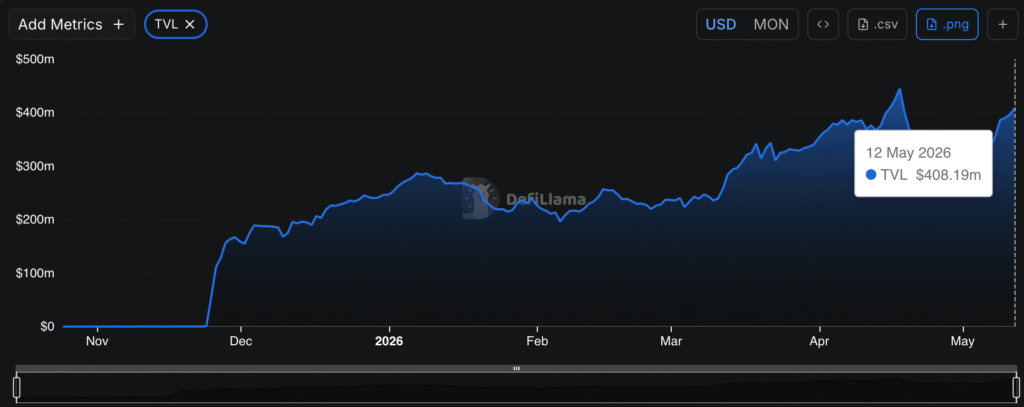
The launch produced one of the fastest TVL ramps among recent L1 networks. Monad crossed $300M in TVL within weeks and currently stabilized near $410M in DeFi deposits across lending markets, perpetual exchanges, and stablecoin vaults.
Parallel EVM execution at 10,000 TPS, sub-cent transaction fees, and full bytecode compatibility with Ethereum mean existing Solidity contracts deploy without modification.
For deeper context on the architecture buildout, see our coverage of Monad’s road to mainnet. The pre-launch testnet activity foreshadowed the speed of the post-launch ecosystem expansion.
Monad mainnet by the numbers
Monad mainnet metrics as of May 2026 show concentrated activity in DeFi and stablecoin infrastructure. The network processes a daily average of 2.1M transactions across 370,000+ active addresses.
As of May 2026, Monad’s TVL is $408M (a subject to change) with multiple lending, RWA, DEX protocols.
Top dApps on the network include native lending protocols, an order-book perpetual venue handling $1.2B in monthly volume. Several Ethereum-native projects have deployed mirror instances to capture the lower fee environment.
How parallel EVM works
Parallel EVM lets Monad process independent transactions at the same time instead of one after another. The runtime is bytecode-compatible with Ethereum, so any Solidity contract that compiles for Ethereum runs on Monad without code changes.
The technique is called speculative parallel execution. The node assumes most transactions in a block do not touch the same state, executes them in parallel, then verifies the assumption and re-runs any conflicts sequentially.
This design produces a real-world throughput target of 10,000 TPS with 1-second finality, compared to 15 TPS on Ethereum mainnet and 2-second finality on Solana. Block time on Monad is 0.5 seconds, allowing two blocks per second to clear high-frequency traffic.
Speculative execution adds complexity to the validator software, and worst-case conflicts can drop effective throughput below the headline number.
Existing Ethereum tooling, Hardhat, Foundry, MetaMask, and EVM-compatible RPC endpoints all work without changes which are well accepted by the developer community.
To learn more, check out our deep dive on Monad architecture that covers the MonadBFT consensus, the custom database layer MonadDb, and the asynchronous execution pipeline in technical detail.
Stablecoins and RWA on Monad
Stablecoin and tokenized real-world asset rails are the most prominent Monad use cases at the start of 2026.
- The network supports USD1 alongside native deployments of major stablecoins.
- The Multipli.fi vault holds tokenized exposure to short-duration US treasuries and stablecoin reserves, with on-chain proof-of-reserve updates and chain-level attestation.
- The Portal acquisition closed in 2025 and brought full-stack stablecoin infrastructure into the Monad roadmap. The integration covers issuance, redemption rails, and compliance tooling, with phased deployment continuing through 2026.
- Payments and tokenization transform raw throughput into recurring transaction demand. Real-time stablecoin settlement and tokenized asset flows generate continuous TPS load that justifies the high-performance design.
MON tokenomics and the airdrop question
The MON token is the native asset of Monad and is used for gas, staking, and governance. The genesis supply is 100B MON with a distribution split across the community, team, ecosystem fund, and validator incentives.
The unlock schedule is the most-watched element of MON tokenomics. Initial circulating supply at mainnet was approximately 10.8% of total supply, with linear and cliff-based unlocks for team and ecosystem allocations extending through 2029, while the emission is expected to continue till 2050.
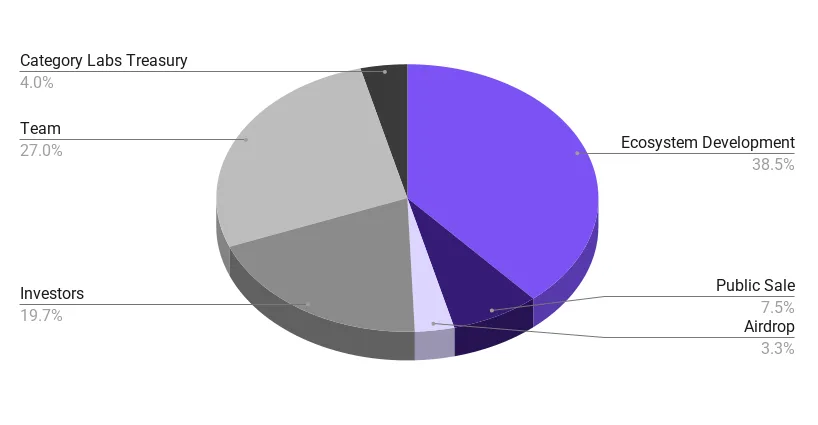
Source: Monad Tokenomics
The Monad airdrop was structured around five categories: Monad Community, Onchain Users, Crypto Community, Builders, and Crypto Contributors. The initial claim window opened October 14 – November 3, 2025 and additional retroactive distributions have been signaled for completed milestones.
Staking on Monad with Everstake
Everstake runs validator infrastructure on Monad and supports MON staking through the Everstake node. MON staking secures the network and provides delegators with rewards drawn from inflation and transaction fees.
The expected staking APR for MON sits in a band of roughly 13% (which is a subject to change) depending on total network stake and fee activity. Everstake charges a transparent commission and publishes uptime statistics.
| MON staking parameter | Value |
| Expected staking APR | 13% (subject to change) |
| Validator commission (Everstake) | Published on-chain |
| Unbonding period | ~5.5 hours |
| Minimum delegation | No current minimum |
| Slashing risk | Yes, for downtime and double-signing |
Validator economics on Monad are tied to performance. Validators run high-spec hardware to keep up with the 10,000 TPS target, and underperforming nodes lose proposer slots and reward share.
Hardware requirements for Monad validators include high-core-count CPUs, 64GB+ RAM, NVMe storage in the terabyte range, and dedicated high-bandwidth network connectivity. Running a compliant institutional-grade validator is non-trivial, which is one reason delegation through established operators is the practical path for most stakers.
Slashing risk is real. Monad penalizes validators for downtime and double-signing, so validator selection matters as much for delegators as it does for the network.
To delegate MON, you can stake MON with Everstake using Everstake validator infrastructure. Everstake operates with SOC 2 Type II and ISO 27001 certified infrastructure and a public record of validator operations across 130+ networks.
For more on the Everstake validator launch on Monad, see Everstake joins Monad.
Monad vs Ethereum, Solana, Sui, and MegaETH
Monad competes for DeFi and stablecoin flows against established and emerging high-performance chains. The comparison spans throughput, finality, fees, EVM compatibility, and ecosystem maturity.
| Metric | Monad | Ethereum | Solana | Sui | MegaETH |
| Throughput (claimed) | 10,000 TPS | 15 TPS | 65,000 TPS | 120,000 TPS | 100,000 TPS |
| Finality | 1 sec | ~13 min | ~12 sec | ~0.4 sec | ~10 ms |
| Average fee | <$0.01 | $0.50 to $5 | <$0.001 | <$0.01 | <$0.001 |
| EVM compatible | Yes (native) | Yes (native) | No | No | Yes (native) |
| Staking APR range | 8% to 13% | 2.6% to 3% | 6% to 8% | ~2% | N/A |
| Mainnet launch | Nov 2025 | 2015 | 2020 | 2023 | 2026 |
Monad vs Solana is the most-asked comparison. Solana posts higher headline throughput and lower fees, but does not support the EVM natively, while Monad combines parallel execution with full Ethereum tooling compatibility.
Monad vs Ethereum is a question of trade-offs. Ethereum has the deepest DeFi liquidity and the longest security track record, while Monad offers higher throughput and lower fees with the same developer experience.
Monad vs Sui is an EVM-vs-Move comparison. Sui uses the Move programming language and a different parallel object model, while Monad keeps full EVM compatibility for developer continuity.
Monad vs MegaETH is a comparison between two high-performance EVM approaches. MegaETH targets even lower latency through a centralized sequencer model, while Monad uses a decentralized validator set with MonadBFT consensus.
Use cases that need Monad’s performance
Several application categories specifically benefit from the Monad combination of EVM compatibility, 10,000 TPS, and sub-cent fees. The match is strongest where high transaction frequency or low latency is the binding constraint.
The headline use cases include:
- High-frequency on-chain trading: order-book perpetual venues and market-making strategies that need fast finality and low per-transaction cost.
- AI micropayments: agent-to-agent settlement at sub-cent values that would be cost-prohibitive on Ethereum mainnet.
- Real-time gaming: on-chain game state with 0.5-second block times for player actions.
- Stablecoin settlement: high-volume USD1, USDC, and USDT flows for payments and remittance.
- Tokenized asset flows: proof-of-reserve RWA updates and on-chain attestations at scale.
The pattern across these use cases is the same. The bottleneck is throughput and cost rather than developer tooling, and Monad removes the throughput bottleneck without requiring a rewrite from Solidity to Move or Rust.
Risks and reality check
The Monad thesis has real risks alongside the performance pitch. The list includes token unlock pressure, FDV concerns, validator centralization, and early-stage ecosystem dependencies.
Token unlock pressure is the most measurable risk. Scheduled vesting events for team, early backers, and ecosystem allocations will release MON supply through 2029, and price action around unlocks is a recurring source of volatility.
FDV concerns relate to the gap between circulating supply and fully diluted supply. At launch, the implied fully diluted valuation drew commentary from analysts comparing MON to other L1 launches, and the FDV-to-TVL ratio remains a metric to monitor.
Validator centralization risk applies to most new L1 networks. The active validator set on Monad is currently smaller than mature networks like Ethereum or Cosmos chains, and stake distribution may need to broaden over time.
Ecosystem dependency on a handful of flagship dApps creates concentration risk. If the top DeFi venues or vaults experienced an incident, TVL could move sharply, and depositors may consider reacting accordingly.
These are not reasons to dismiss Monad. They are the standard set of considerations that apply to any L1 in its first year of mainnet operation.
The institutional thesis on Monad
The institutional case for Monad rests on three pillars:
- EVM compatibility
- Performance
- Early stablecoin and RWA integration.
The combination makes Monad a candidate for asset managers and treasury operations evaluating high-performance EVM exposure beyond Ethereum mainnet and L2 networks.
For an asset manager, Monad offers a venue for DeFi strategies that need throughput without leaving the EVM developer environment. Existing risk models, custody integrations, and trade-execution tech built for Ethereum can extend to Monad with minimal modification.
Compliance should be covered for institutional engagement. Everstake operates Monad validator infrastructure under SOC 2 Type II and ISO 27001 attestations, and offers reporting workflows compatible with regulated counterparties through institutional staking services.
Custody options for MON are expanding. Several institutional custodians have added MON support since mainnet launch, and Everstake integrates with major custody providers for delegated staking workflows.
FAQ
When is the Monad airdrop?
The first Monad airdrop distribution occurred at mainnet launch in November 2025. Subsequent retroactive rewards may be announced through official Monad Foundation channels, so users should monitor verified communications and avoid third-party claim portals.
What is MON used for?
MON is the native token of Monad used for gas, staking, and governance. Transaction fees are paid in MON, validators stake MON to participate in consensus, and MON holders may vote on protocol parameters.
Can institutions stake MON?
Yes. Institutions can stake MON through compliant validators such as Everstake, which operates Monad validator infrastructure under SOC 2 Type II and ISO 27001 controls.
What is Monad TVL?
Monad TVL is approximately $410M as of May 2026 per Defillama. The composition skews toward lending markets, perpetual exchanges, and stablecoin and RWA vaults.
Is Monad EVM-compatible?
Yes. Monad is fully bytecode-compatible with the Ethereum Virtual Machine, so Solidity contracts deploy without modification. Hardhat, Foundry, MetaMask, and standard RPC tooling all work on Monad.
How does Monad compare to Solana for institutions?
Monad and Solana target similar high-throughput DeFi and payments use cases, but differ on developer environment. Monad uses the EVM with full Ethereum tooling compatibility, while Solana uses a different runtime that requires Rust-based contracts.
What is the expected Monad staking APR?
The expected MON staking APR is around 13%, depending on total network stake and transaction fee activity. Actual rewards vary by validator performance and commission.
What are the hardware requirements for a Monad validator?
Monad validators require high-core-count CPUs, 64GB+ RAM, NVMe storage in the terabyte range, and dedicated high-bandwidth network connectivity. The performance target of 10,000 TPS demands hardware well above typical L1 validator specs.
Disclaimer
This article is for informational purposes only and does not constitute financial, investment, legal, or tax advice. Nothing here is an endorsement or recommendation to buy, sell, hold, or stake any digital asset, or to use any platform or service mentioned. Mention of third parties does not imply affiliation or endorsement.
Digital assets and staking carry significant risks, including volatility, regulatory uncertainty, and total loss of capital. Data referenced reflects publicly available sources as of the date of publication and may change. Readers should conduct their own research and consult qualified professionals before making any decisions.
Share with your network