Institutional
web3 infrastructure
Non-Custodial vs. Managed Staking: A Risk Framework for CFOs
Non-custodial vs. managed staking. Compare custody risk, slashing exposure, reporting and compliance controls in a structured matrix.
MAR 19, 2026
Last updated JUL 10, 2026 · V1
Most CFOs evaluating staking infrastructure providers cannot quantify the difference between non-custodial vs managed staking in terms of counterparty exposure, slashing liability, or audit readiness.
Both models use the same proof-of-stake mechanics, but they allocate risk and control in fundamentally different ways with direct implications for fiduciary responsibilities and balance sheet integrity.
Four 2026 developments have sharpened the decision:
- EIP-7251 (MaxEB) concentrated slashing exposure by enabling validators to hold up to 2,048 ETH;
- Form 1099-DA raised the bar for audit-grade reward data;
- and MiCAR created a regulatory asymmetry between custodial and non-custodial staking in the EU.
How Institutional Staking Models Differ
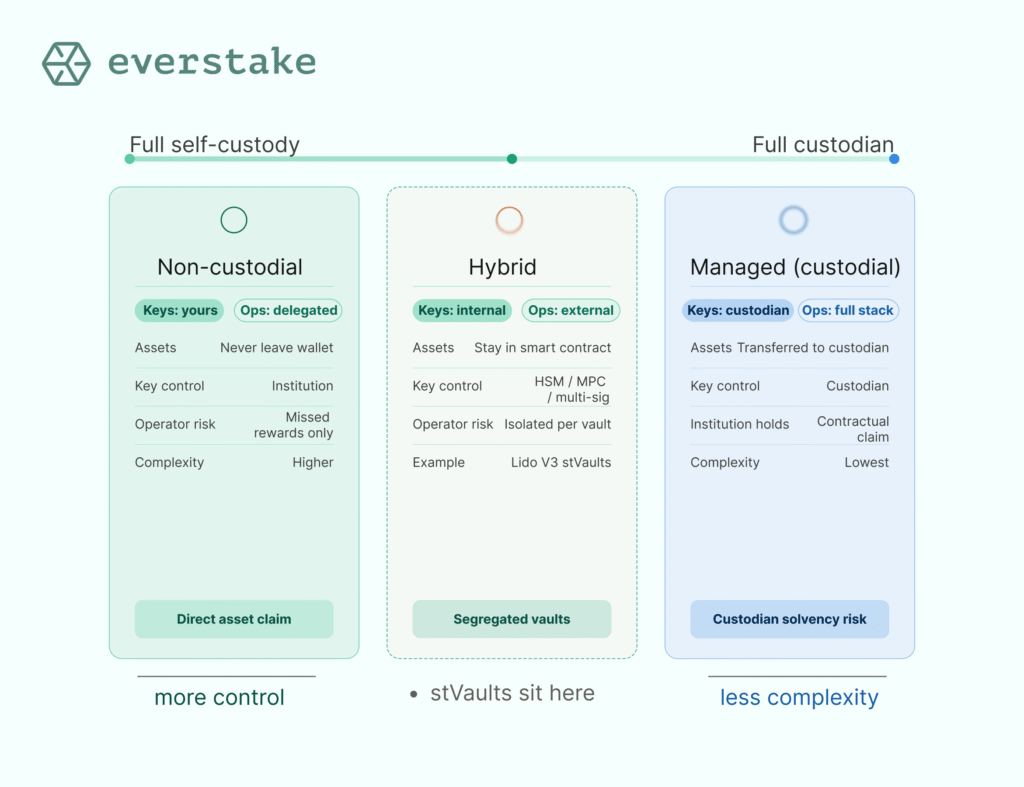
Non-custodial staking: the institution retains full private key control and delegates only validator operations to a third-party operator. Assets are never transferred, operator exposure is limited to missed rewards.
Managed (custodial) staking: the institution transfers assets and key control to a custodian, which handles the full operational stack. Simpler operationally, but the institution holds a contractual claim (not a direct asset) and is exposed to the custodian’s solvency and integrity.
Hybrid models combine external validator operations with internal key governance (HSM, MPC, multi-sig).
The CFO’s Evaluation Framework
Staking is a reliability and controls contract.
Evaluate it as you would any critical infrastructure vendor: controls quality, incident readiness, reporting fidelity, and failure-mode analysis. The central questions are: Who holds the keys? Who absorbs the loss? Can I prove it to an auditor?
Provider concentration risk is rising. Post-MaxEB slashing exposure is concentrating. MiCAR and U.S. broker rules now treat custodial and non-custodial staking differently. The suitable regulatory framework now depends on which model you choose.
Risk Dimension 1: Custody & Counterparty Risk
Counterparty risk is the defining difference between the non-custodial vs managed staking models.
Non-Custodial
- Private keys remain with the institution (HSM, MPC, cold storage).
- The operator cannot move or withdraw staked assets under any circumstance.
- Maximum loss from operator failure: missed rewards only.
Managed (Custodial)
- The custodian controls both keys and assets. The institution holds a contractual claim.
- Custodian insolvency, breach, or mismanagement can impair principal directly.
- Fees typically run on % of rewards.
- Additional quantification: Does the provider carry slashing indemnification? Third-party insurance (Chainproof, Nexus Mutual)? What is the migration notice period?
Risk Dimension 2: Slashing & Operational Risk
Slashing risk — protocol penalties for double-signing or surround voting, deducted from staked principal — exists in both non-custodial vs managed staking models. The models differ in liability allocation, not exposure.
EIP-7251 and DVT Context
- MaxEB consolidation means a single validator misconfiguration can now affect up to 2,048 ETH. Concentration with a single operator amplifies Ethereum’s correlated (quadratic) slashing penalty.
- DVT (Obol Network) distributes validator key shares to eliminate single-point-of-failure signing. Everstake’s DVT integration materially reduces double-signing probability.
Liability Allocation
- Non-custodial: penalty hits institution capital; SLA indemnification may apply; institution retains migration ability.
- Managed: custodian nominally absorbs losses, but contractual fine print frequently shifts liability back. MiCAR guidance favors intermediary accountability; enforcement is uneven.
- Beyond slashing: missed attestations, hard-fork mismanagement, and MEV relay OFAC non-compliance carry incremental operational risk.
- Everstake has maintained zero material slashing events on major networks, having operated across 130+ PoS networks, with 99.98% protocol uptime, SOC 2 Type II and ISO 27001:2022 certified key management, Obol DVT, and exclusively OFAC-compliant MEV relay usage.
Risk Dimension 3: Compliance, Reporting & Auditability
Institutional staking without audit-grade reporting is an operational liability.
Regulatory Requirements (2026)
- U.S.: Form 1099-DA: brokers must report staking reward income; Rev. Proc. 2024-28 mandates wallet-by-wallet cost-basis tracking; IRS Rev. Ruling 2023-14 treats staking rewards as ordinary income at FMV at receipt timestamp-level data is required.
- EU: MiCAR: custodial staking triggers authorization as a custody and administration service, non-custodial staking generally does not. Intermediary losses should fall on the intermediary under MiCAR guidance.
What a CFO Must Demand
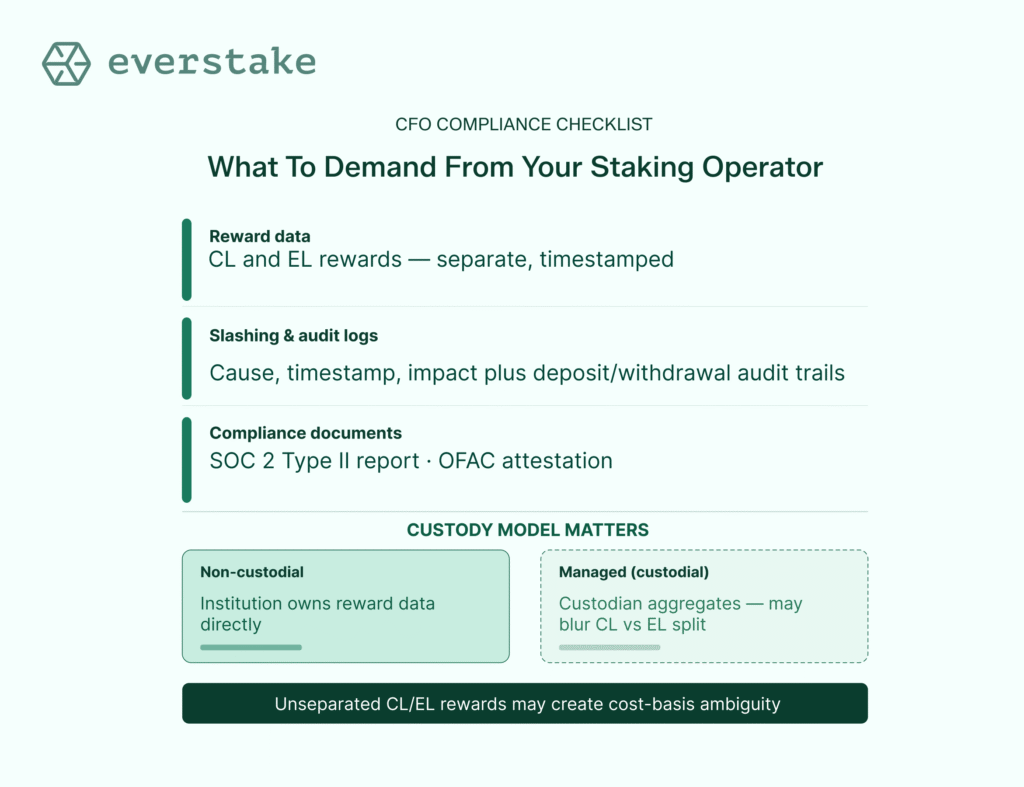
- Validator-level CL and EL reward data with timestamps and FMV snapshots at receipt.
- Slashing event logs with cause, timestamp, and impact; deposit/withdrawal audit trails.
- SOC 2 Type II operator report; OFAC attestation for MEV relay usage.
In non-custodial arrangements, the institution owns reward data directly. In managed staking, the custodian aggregates it. Some do not separate CL and EL rewards, creating cost-basis ambiguity under Rev. Proc. 2024-28.
Everstake provides reward data via API, exportable for leading crypto tax platforms.
Risk Decision Matrix Non-custodial vs Managed Staking
| Risk Dimension | Non-Custodial Staking | Managed (Custodial) Staking |
| Key Custody | Institution retains keys (HSM/MPC) | Custodian controls keys |
| Counterparty Exposure | Operator failure – missed rewards only | Custodian failure – potential loss of principal + rewards |
| Slashing Liability | Borne by institution; SLA may include indemnification | Borne by custodian (contractual clauses may shift back) |
| Max Loss from Provider Failure | Rewards only | Principal + rewards |
| Fee Structure | Lower (commission on rewards only) | Higher % of rewards |
| Reporting Granularity | Institution owns data; operator APIs supplement | Custodian aggregates; granularity varies |
| Audit Readiness | SOC 2 / ISO 27001 from operator + institution’s controls | Depends on custodian’s compliance stack |
| Regulatory Class (MiCAR) | Not classified as custody service | Triggers custody/admin authorization |
| Operational Complexity | Higher (requires key management infra) | Lower (custodian handles all) |
| DeFi Composability | High | Limited (assets locked with custodian) |
| Best For | Risk-conscious treasuries, DeFi-active funds | Small teams prioritizing operational simplicity |
Note: Reflects general market patterns as of Q1 2026.
Provider Due Diligence Checklist
| Infrastructure & Performance | Protocol uptime guarantee (99.9%+ benchmark) Geo-redundancy Historical slashing record Failover/disaster recovery procedures |
| Security & Compliance | SOC 2 Type II, ISO 27001 / NIST CSFkey management method (HSM, MPC, or remote signing) OFAC-compliant MEV relay usage GDPR/CCPA policies |
| Reporting & Auditability | Validator-level CL/EL reward data with timestamps FMV snapshots at receipt Exportable audit trail Separate CL/EL reward tracking for tax-basis compliance. |
| Contractual & Commercial | Slashing indemnification or third-party insurance (Chainproof, Nexus Mutual) SLA with incident response commitments Transparent fee schedule Exit and migration provisions. |
Everstake onboarded 130+ PoS networks to date with five pillars of compliance, featuring SOC 2 Type II, ISO 27001:2022, and NIST CSF certifications.
Frequently Asked Questions
What is non-custodial staking?
The institution retains private key control and delegates only validator operations to a third party. No asset transfer occurs; operator exposure is limited to missed rewards.
Which model is safer for institutional treasuries: non-custodial vs managed staking?
Non-custodial eliminates counterparty risk to principal. Managed staking is simpler operationally but exposes the institution to custodian solvency, security, and integrity risk.
Does non-custodial staking eliminate slashing risk?
No. Slashing exists in both models. Liability allocation differs: non-custodial penalties hit institution capital (SLA indemnification may apply); managed custodians nominally absorb losses, though contract terms vary.
What certifications should a staking provider have?
SOC 2 Type II, ISO 27001:2022, NIST CSF, OFAC-compliant MEV relay usage, and GDPR/CCPA data policies represent the institutional baseline.
What reporting data should a CFO demand?
Validator-level CL and EL reward data with timestamps. FMV snapshots at receipt, slashing event logs, deposit/withdrawal audit trails, SOC 2 Type II report, OFAC attestation.
How does Everstake support institutional compliance?
SOC 2 Type II, ISO 27001:2022, NIST CSF certifications; zero material slashing events across the main PoS networks; reward data APIs.
What is the biggest risk in managed staking?
Counterparty risk. Custodian insolvency, breach, or mismanagement can result in loss of both principal and accrued rewards — as demonstrated by Celsius, FTX, and BlockFi.
Risk Allocation
The non-custodial vs. managed staking decision is a risk allocation decision. Non-custodial preserves principal, eliminates custodian counterparty exposure, and gives institutions ownership of audit data at the cost of higher operational overhead. Managed staking suits smaller teams prioritizing simplicity, with the explicit understanding that counterparty risk to principal is structural, not incidental.
The 2026 environment: Form 1099-DA, MiCAR and post-MaxEB slashing concentration, has materially raised the stakes. Institutions that have not revisited this framework in the past 12 months should do so now.
Disclaimer:
The information provided is not intended for recipients residing in the United Kingdom.
Share with your network