Institutional
The ABCs of Crypto
Real-World Assets: How Staking Powers the Next Era of Finance
How staking powers Real World Assets? Mass crypto adoption is out of sight, while the institutional adoption is growing. TradFi is selectively choosing specific blockchain technologies: RWAs and stablecoins.
APR 01, 2026
Last updated JUN 08, 2026 · V1
TL;DR:
- Traditional finance isn’t adopting crypto as a whole, but is rather adopting what works.
- Stablecoins and tokenized real-world assets (RWAs) are already embedded in institutional finance.
- Staking might become the blockchain security layer that makes them trustworthy.
- As RWA volumes scale past $26B, the infrastructure underneath must be enterprise-grade, compliant, and proven.
Why TradFi Is Picking Blockchain Technologies Selectively
For a long time a persistent story was circulating in crypto that mass adoption might come from speculative markets, metaverses or opinion leaders.
However, in light of recent events and the rise of RWAs (with stablecoins leading) the story of blockchain in finance appears to be one of selective technology adoption.
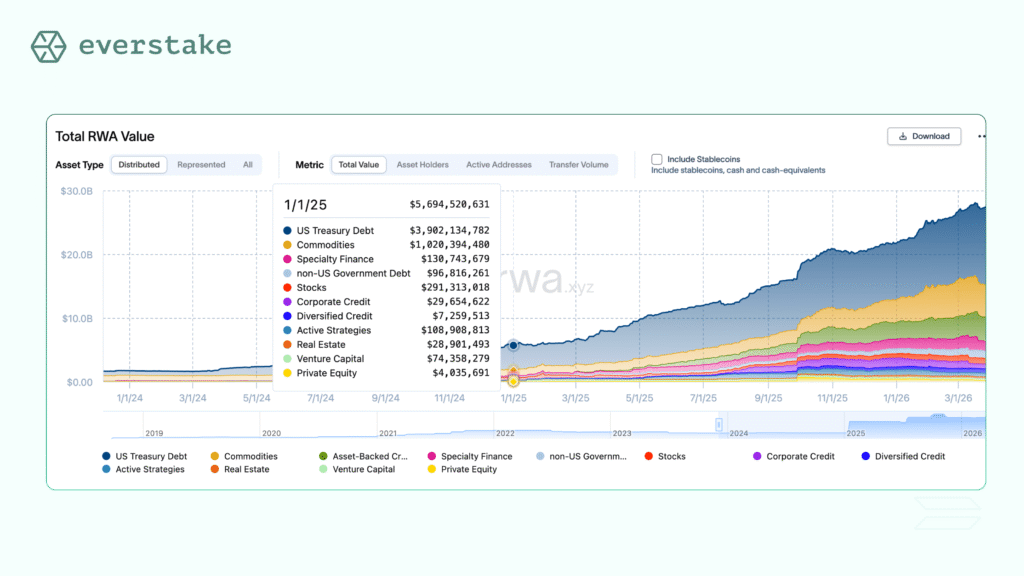
According to RWA.xyz in January 2025 the total real-world asset value was $5.6B. In March, 2026 the same metrics reached over $27B, indicating a surge into the category.
Traditional financial institutions are not pivoting to crypto culture, but rather choosing specific blockchain capabilities that solve real operational problems.
Two technologies have emerged.
- Stablecoins. Dollar-denominated value moving on blockchain rails proved that speculative value cannot limit crypto technology. Stablecoins are now embedded in settlement workflows and cross-border payment flows at institutional scale.
- Tokenized real-world assets. Bonds, treasuries, real estate, and private credit are moving on-chain. The RWA market surged over 260% in H1 2025, surpassing $23B in total valuation.
The question institutions are now asking is “who builds the infrastructure we can trust?”
What RWA Tokenization Actually Does
Tokenization converts physical or financial assets into digital tokens on a blockchain. Each token represents ownership of an underlying asset. The general process has three core stages:
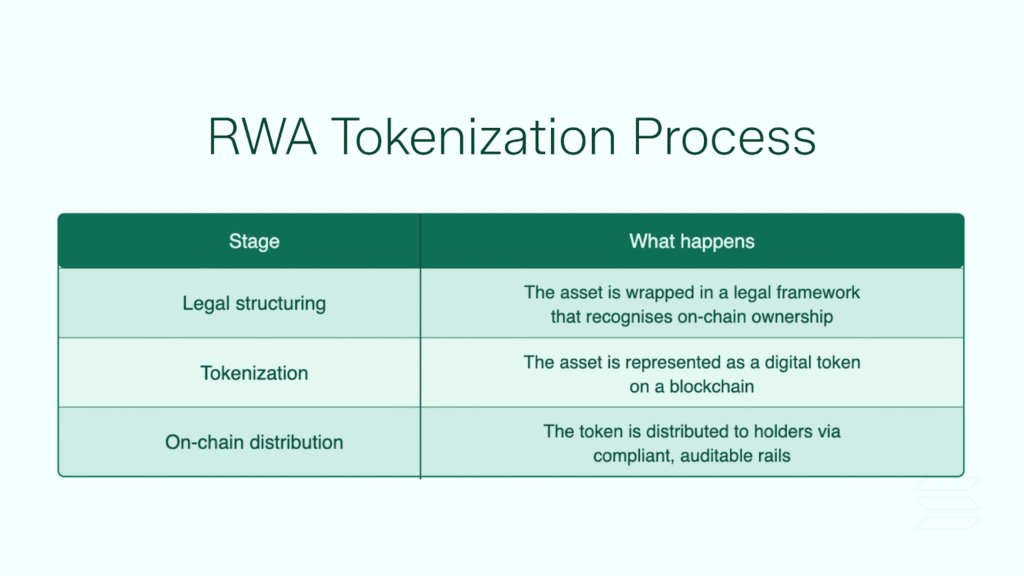
This process unlocks several structural advantages over traditional asset management.
Liquidity for illiquid assets. Private credit and real estate have historically been difficult to trade. Tokenization creates transferable representations of those assets.
Fractional ownership. High-minimum assets become accessible at smaller denominations without changing the underlying instrument.
On-chain transparency. Every transfer and ownership change is recorded immutably. Audit trails exist by default.
In 2025, tokenized private credit lead the market at approximately 58% of total RWA value. Tokenized U.S. Treasury debt accounted for around 24% to 34%. BlackRock’s BUIDL fund became the landmark institutional signal that this technology is production-ready.
How Staking Secures the RWAs
Tokenized assets only hold value if the blockchain they live on is secure. On PoS networks, staking secures the blockchain.
Validators stake assets to gain the right to validate transactions. If they adhere to the rules, they receive staking rewards. If they attempt to manipulate the ledger, their staked assets are slashed. This incentive structure is what makes the network tamper-resistant.
Why does this matter for RWAs specifically?
A tokenized Treasury or real estate deed is only as valuable as the chain it lives on. If that chain can be censored, attacked, or manipulated, the asset loses its institutional credibility. Staking is the mechanism that prevents this.
Stablecoins depend on exactly the same security layer. Every stablecoin transfer, DeFi collateral position, cross-border payment settles on a Proof-of-Stake network. Without validators maintaining consensus, none of these transactions would clear reliably.
| Asset Type | Depends on PoS Security? | Why |
| Tokenized Treasuries | Yes | Ownership records live on-chain |
| Tokenized private credit | Yes | Transfer and settlement are on-chain |
| Stablecoins | Yes | Every transaction settles on a PoS network |
| On-chain collateral | Yes | DeFi positions require validated state |
Staking has become the security layer that makes institutional-grade digital assets operationally possible.
How Regulation Is Turning From a Barrier Into a Framework
The regulatory environment for tokenized assets has recently been moving fast. TradFi decision-makers need legal clarity before committing infrastructure resources.
In the United States, the GENIUS Act is establishing federal rules specifically for stablecoins as a subset of tokenized assets.
In Hong Kong, the Stablecoins Ordinance introduces licensing requirements and reserve standards for stablecoin issuers.
In Europe, MiCA and the EU DLT Pilot Regime are enabling banks to tokenize assets with near-instant settlement and reduced counterparty risk.
These frameworks share a common structure:
- KYC and AML compliance;
- licensed issuers;
- on-chain audit trails.
They are the entry criteria for institutional participation.
The Financial Products That Now Depend on Blockchain to Function
The most useful frame for evaluating blockchain’s role in finance is this: how many real financial products now depend on blockchain rails to operate? The answer is growing fast.
Tokenized money market funds settle on-chain.
On-chain credit facilities use smart contracts to manage drawdowns and repayments.
Stablecoin settlement networks process institutional cross-border flows.
DeFi collateral markets use tokenized assets as backing for borrowing facilities.
BlackRock’s BUIDL fund illustrates how deep this integration runs. BUIDL is used as collateral within DeFi protocols to borrow stablecoins. A regulated, institutional fund product is now embedded in decentralized finance infrastructure, with real capital behind them.
We are not building experiments. We are architecting the infrastructure for the next generation of global capital markets.
What Custodians Need to Handle Institutional RWA Staking at Scale
As RWA volumes grow, the staking infrastructure supporting those networks must grow with them. Custodians adding staking to their offerings face a specific set of operational requirements.
Validator management across multiple chains is complex. Slashing risk must be actively managed. Service level agreements (SLAs) must be documented and enforceable. Compliance documentation must meet the standards of regulated financial institutions.
The security and compliance requirements are non-negotiable at institutional scale:
| Certification / Standard | What It Covers |
| SOC 2 Type II | Security, availability, and confidentiality controls |
| ISO 27001 | Information security management |
| NIST CSF | Cybersecurity risk framework |
| GDPR | Data privacy for EU-connected operations |
| CCPA / CRPA | Data privacy for California-connected operations |
The assets being staked are institutional client holdings tied to regulated financial products. The infrastructure must match that standard.
How Everstake Supports Custodians Building on Blockchain Rails
Everstake operates institutional staking infrastructure for custodians navigating the growth of RWAs and stablecoins. It is one of the major staking partners offering a full suite of institutional certifications: SOC 2 Type II, ISO 27001:2022, CCPA/CRPA, NIST CSF, GDPR, and ITGC.
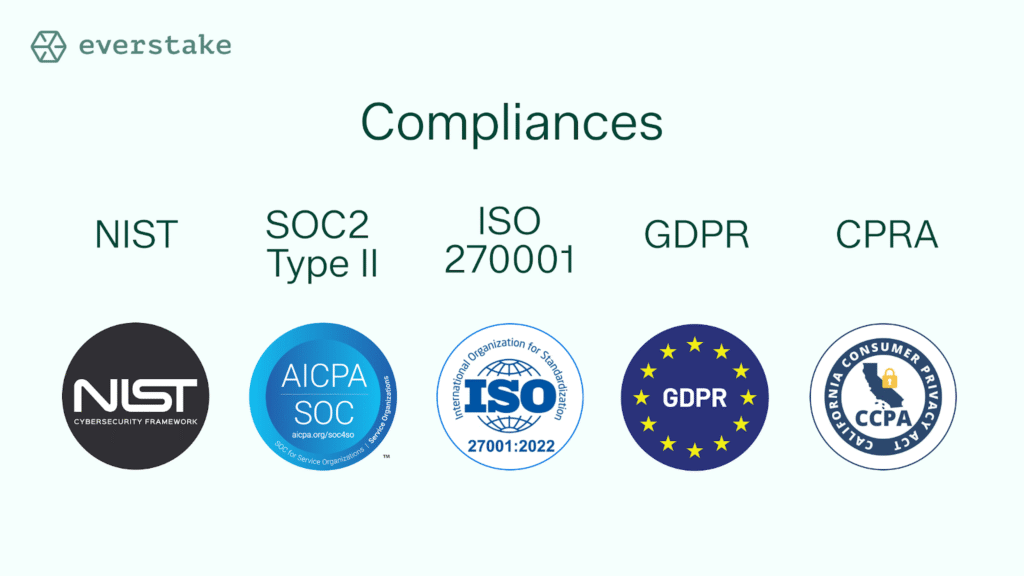
Compliance is the operational foundation that allows custodians to offer staking services to regulated financial institutions.
Staking solution. Everstake offers a secure, managed, non-custodial staking setup. Deployment is configurable for different custody architectures. The solution is built for custodians expanding client staking offerings without building validator operations from scratch.
Everstake has supported hundreds of blockchain networks and is now actively participating in 35+ networks. This breadth of coverage matters as multi-chain RWA infrastructure becomes the standard, not the exception.
Institutionals are choosing Everstake — the Paribu Custody is one example. As one of the leading custodians in its region, Paribu integrated Everstake’s infrastructure to deliver institutional staking services at scale. The integration covered validator management, compliance alignment, and streamlining staking experience for institutions.
Specific challenges Everstake addresses for custodians include:
- White-label staking for client-facing offerings
- Turnkey SLA-backed validator infrastructure across supported networks
- Rapid deployment of new staking assets as RWA markets expand
- Full regulatory and security alignment for institutional participation
RWA Infrastructure Choices Now Define Competition Later
The window for establishing infrastructure advantages in RWA tokenization is open, but won’t stay open indefinitely.
Institutions that choose compliant, proven blockchain infrastructure now will be positioned to scale as RWA markets mature.
On-chain auditability, compliance certifications, and proven validator uptime are the new trust signals for institutional finance. They hold the same weight that credit ratings and custodian audits carry in traditional markets.
Share with your network