Aptos
Institutional
Aptos in 2026: Latest News, Roadmap, and DeFi Updates
Q2 2026 for Aptos might become its most consequential quarter yet: a digital commodity ruling, privacy-layer activation, and a deflationary tokenomics overhaul. The 2026 roadmap targets framework-level CLOB infrastructure, Raptr consensus, and cross-chain account abstraction as the chain moves toward institutional-grade settlement.
MAY 19, 2026
Last updated MAY 19, 2026 · V1
Key Takeaways
- Aptos activated Confidential APT on Apr 24, 2026, using zero-knowledge proofs to encrypt balances and transfer amounts while keeping addresses public for compliance.
- A joint SEC/CFTC rule, effective March 17, 2026, classified APT as a digital commodity, placing it under CFTC oversight.
- Proposal 183, passed in March 2026, introduced a 2.1 billion APT hard supply cap, 100% gas-fee burns, and reduced staking rewards from 5.19% to roughly 2.6% annual rate.
- Aptos achieved sub-50-millisecond mainnet block times in December 2025, the fastest among major Layer 1 chains.
- Stablecoin market cap on Aptos reached an all-time high of $1.8 billion in late 2025, while BlackRock’s BUIDL deployed an additional $500 million in tokenized assets.
- The 2026 roadmap focuses on a framework-level Central Limit Order Book (CLOB), Raptr consensus, Block-STM V2, and X-Chain Accounts.
The latest entry in Everstake’s Aptos News series points to a chain transitioning from generalist Layer 1 to specialized infrastructure for high-throughput consumer apps and institutional payment rails. Q2 2026 brought new DeFi protocol launches, the Confidential APT rollout, Move language updates, partnerships with Mastercard and others, and the APT digital commodity ruling. This quarterly roundup covers the headline numbers, roadmap progress, ecosystem activity, and validator performance.
Aptos News at a Glance (Q2 2026)
The biggest Aptos news this quarter combines regulatory clarity, institutional payment partnerships, and a sharp pivot toward privacy-preserving infrastructure. Below are the headline updates:
- Confidential APT activated on mainnet April 24, 2026, following a near-unanimous governance vote.
- Mastercard’s partnership was announced on March 11, 2026, for real-world payment rails.
- Scheduled token unlock of 0.54% of the supply on May 12, 2026.
- APT was classified as a digital commodity by the joint SEC/CFTC rule on March 17, 2026.
- Daily transactions hover near 10 million, with the stablecoin market cap around $1.66 billion as of April 2026.
- Bitwise continues active APT spot ETF filing following the commodity classification.
Network activity Aptos processed close to 10 million daily transactions in April 2026, with the stablecoin market cap on the network reaching $1.64 billion by the time of writing.
The combination of regulatory clarity and privacy infrastructure is meaningful. Both barriers had previously kept large enterprises from deploying real-money flows on the network. This quarter, both were addressed.
Aptos Roadmap and Recent Network Upgrades
The Aptos roadmap for 2026 is structured around what Delphi Digital calls the “Global Trading Engine” thesis. The narrowing focus covers four priorities:
- Deeper liquidity infrastructure
- Faster consensus
- Parallel execution refinement
- Cross-chain accessibility
Raptr and Block-STM V2
Raptr is a next-generation consensus protocol designed to push finality below current sub-second levels even under network stress. Block-STM V2 upgrades the parallel execution engine, scaling throughput linearly with the number of validator processor cores rather than plateauing.
These upgrades align with the December 2025 milestone of sub-50-millisecond mainnet block times, which already make Aptos the fastest major Layer 1 by block production speed. Aptos parallel execution through Block-STM uses optimistic concurrency, checking for conflicts after execution.
Framework-Level Central Limit Order Book
Through the Aptos Improvement Proposal (AIP) process, Aptos Labs is advancing an open-source on-chain CLOB built directly into the network. The aim is to achieve a matches-per-second performance that rivals that of centralized venues.
If adopted, this directly benefits Decibel, the unified spot and perpetuals execution layer that opened public testnet in November 2025 and is currently live.
Move language updates and X-Chain Accounts
The Aptos Move language introduced modern token standards, including FA (Fungible Asset) and DFA (Dispatchable Fungible Asset). DFA enables tokens to automatically perform operations such as distributing staking rewards or enforcing compliance rules at the token layer.
A February 2026 governance proposal also enabled Sui wallets to interact with Aptos natively. X-Chain Accounts extend that interoperability to Solana, Ethereum, and other ecosystems via Derived Account Abstraction and Circle’s CCTP.
New DeFi Protocols on Aptos
Aptos DeFi crossed $1 billion in TVL in late 2025, but it fell to $280 million afterward. Lending and DeFi dominate composition, with newer protocols expanding into BTC and tokenized real-world assets.
The current top protocols by TVL include:
- Decibel: onchain trading engine has the TVL of $42 million.
- Thala Labs: staking, AMM, and CDP suite responsible for over $1.03 million market cap.
- Echelon Market: just shy of $1 million in market cap and $50.75 million in supplied sUSDe.
- Amnis Finance has a market cap of $1.98 million.
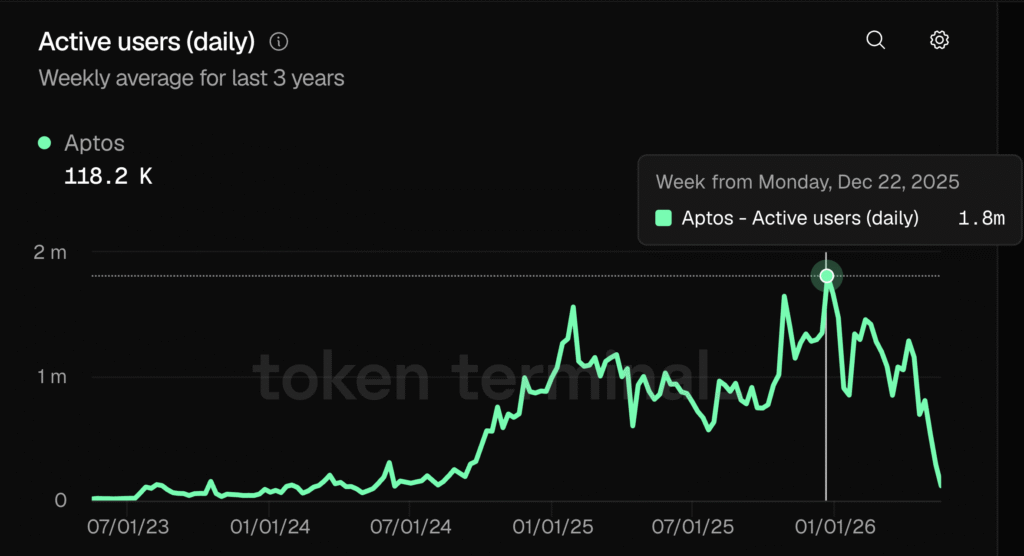
DeFi growth Aptos DeFi TVL crossed $1 billion in late 2025, a 19x year-over-year increase. Daily active addresses grew from 70,000 in January 2024 to a peak of 1.8 million in December 2025.
Aptos Connect and Consumer Onboarding
Aptos Connect is the keyless wallet that has progressively replaced traditional seed-phrase onboarding for consumer apps. It uses OpenID Connect (OIDC) combined with zero-knowledge proofs (per AIP-61) to link a Google or Apple sign-in to a self-custodial blockchain account.
Users do not download anything. They click “Continue with Google,” and the resulting account is cryptographically linked to that social login while remaining self-custodial.
For developers, Aptos Connect integrates through the Aptos Wallet Adapter. Adding the AptosConnect plugin enables a Web2-style login flow within any dApp, removing the highest-friction step in onboarding new users.
The tradeoff is account-level dependency. If the underlying Google or Apple account is compromised, the linked Aptos accounts are exposed. Aptos Labs documentation makes this risk explicit so apps can advise users accordingly.
Petra Wallet Updates
Petra Wallet, developed by Aptos Labs, remains the most widely used Aptos wallet and is often treated as the official entry point. Recent updates focus on dApp connectivity, mobile parity, and hardware integration.
The Petra Wallet feature set currently includes:
- Integration with over 160 dApps, including Mercato, Thala, and Pontem.
- Ledger hardware wallet support for cold storage with active dApp use.
- Independent security audit by Halborn, plus built-in transaction simulation and gas customization.
- Mobile apps for both iOS and Android, with feature parity catching up to the browser extension.
- Google and Apple social login alongside standard seed-phrase setup.
The browser extension is available for Chrome, Brave, and Edge. APT staking is supported directly inside the wallet, though some staking features remain unavailable to US users due to ongoing regulatory scoping.
Aptos vs Solana: Where Each Wins in 2026
The Aptos vs Solana picture has shifted in 2026. Solana’s Alpenglow upgrade targets 150 millisecond finality, and the Firedancer validator client increases theoretical capacity. Aptos counters with sub-50ms block times, 0-second finality, and Block-STM V2.
Both networks now compete for the same use cases:
- High-frequency trading
- Payments and stablecoin rails
- Consumer-scale dApps and gaming
The differentiation comes down to architecture, ecosystem maturity, and developer preference. The table below summarizes the current 2026 metrics.
Comparison table
| Metric | Aptos | Solana |
| Smart contract language | Move, MoveVM | Rust, SVM |
| Parallelization model | Optimistic (Block-STM) | Pessimistic (declared accounts) |
| Block time (1H avg) | 0.06s | 0.39s |
| Finality | ~0s (instant) | 12.8s (pre-Alpenglow) |
| Max theoretical TPS | 160,000 | 65,000 (1M+ with Firedancer) |
| Real-time TPS (1H avg) | ~34 | ~1,140 |
| Median transaction fee | $0.00001 | $0.00047 |
| DeFi TVL (early 2026) | ~$274 million | ~$5.8 billion |
| Governance | On-chain | Off-chain |
| Active developers | 1,177 | 10,775 |
Where Aptos wins in 2026:
- Faster block times and instant finality on the Move side.
- Lower transaction fees by an order of magnitude.
- Stronger formal verification through the Move Prover for high-value contracts.
- On-chain governance with a tighter feedback loop.
Where Solana wins:
- Far larger developer base and dApp ecosystem maturity.
- Higher real-time throughput and far more sustained user activity.
- Deeper liquidity in DeFi and consumer applications.
For staking-specific comparisons across Aptos, Sui, and other Move-based chains, see the Sui vs Aptos staking rewards comparison for 2026.
Regulatory and Institutional Updates
The APT classification as a digital commodity on March 17, 2026, removed the largest regulatory overhang the token faced. The joint SEC/CFTC rule places APT under CFTC oversight, reducing compliance friction for institutions and unlocking access to regulated derivative products.
Concrete near-term effects already visible include:
- Bitnomial launched US-regulated APT futures.
- Bitwise continues active APT spot ETF filing.
- Avery Ching, CEO of Aptos Labs, joined a CFTC advisory subcommittee.
On March 17, 2026, the joint SEC/CFTC rule classified APT as a digital commodity. This places APT under CFTC oversight and clears the path for regulated futures and ETF products.
On the institutional side, BlackRock’s BUIDL deployed an additional $500 million in tokenized assets on Aptos in October 2025. That brought the network’s total real-world asset (RWA) value to $1.2 billion.
Franklin Templeton chose Aptos for its Benji record-keeping system, and PACT brought private credit lending fully on-chain. For more on how these changes interact with APT supply mechanics, see the analysis on APT tokenomics and inflation dynamics.
Validator Performance and Staking
Aptos validator performance held steady through the recent network upgrades, with no extended outages reported in Q1 or Q2 2026. Proposal 183 reduced staking rewards from 5.19% annual rate down to roughly 2.6%, as part of the broader deflationary tokenomics overhaul.
The proposal also locked 210 million APT (around 18% of the circulating supply) in the Aptos Foundation treasury. It permanently burns 100% of gas fees, reducing inflation but raising the bar for stakers seeking rewards.
Gas fees were also increased 10x as part of the overhaul, with all fees permanently burned.
For users running through a professional validator, Everstake offers Aptos staking with no minimum amount and full self-custody.
For broader analysis of staking trends and validator economics, see the Aptos staking insights and analysis report for the first half of 2025.
FAQ
What is the latest Aptos news?
The biggest Aptos news in Q2 2026 is the Confidential APT activation on Apr 24th, 2026, the Mastercard payments partnership announced on March 11, 2026, and the digital commodity classification under a joint SEC/CFTC rule on March 17, 2026.
What is confidential APT?
Confidential APT is a protocol-level privacy feature on Aptos, launched via Proposal 188 on April 24, 2026. It uses zero-knowledge proofs and Twisted ElGamal encryption to hide wallet balances and transfer amounts while keeping sender and receiver addresses publicly visible on-chain.
What is Aptos Connect?
Aptos Connect is a self-custodial, keyless wallet that lets users create blockchain accounts via Google or Apple social logins. It uses zero-knowledge proofs and the OpenID Connect standard (via AIP-61) to cryptographically link the social account to a self-custodial Aptos address with no seed phrase required.
Is Aptos better than Solana?
Neither is universally better. Aptos has faster block times, instant finality, and lower fees. Solana has a far larger developer base, more dApps, and deeper liquidity. The right choice depends on use case: Aptos suits formal-verification-heavy financial apps, while Solana fits high-volume consumer and trading activity.
How does Aptos staking work in 2026?
After Proposal 183, the staking rewards rate has nearly halved, which needs to be taken into account.
What is the Aptos 2026 roadmap focused on?
The Aptos roadmap centers on becoming the infrastructure layer for global financial activity. Key items include:
- Framework-level CLOB implementation through the AIP process.
- Raptr consensus for sub-second finality.
- Block-STM V2 for parallel execution scaling.
- X-Chain Accounts for cross-chain interoperability.
- Confidential APT for institutional privacy.
Disclaimer
This article is for informational purposes only and does not constitute financial, investment, legal, or tax advice. Nothing here is an endorsement or recommendation to buy, sell, hold, or stake any digital asset, or to use any platform or service mentioned. Mention of third parties does not imply affiliation or endorsement.
Digital assets and staking carry significant risks, including volatility, regulatory uncertainty, and total loss of capital. Data referenced reflects publicly available sources as of the date of publication and may change. Readers should conduct their own research and consult qualified professionals before making any decisions.
Share with your network