Aptos
Is Aptos Inflationary? Understanding APT Staking Rewards & Tokenomics
Our guide breaks down the new Aptos tokenomics, from performance-driven supply to the fee burns reshaping long-term network positioning.
FEB 23, 2026
Last updated APR 28, 2026 · V1
The world of layer-1 blockchains is highly competitive, and understanding the financial mechanics of a network is essential for anyone looking to participate in whatever capacity. One of the most common questions from delegators and network participants revolves around Aptos tokenomics. Specifically, users want to know how the network balances ecosystem growth, validator incentives, and long-term asset value.
As the blockchain progresses and evolves, especially with the massive structural overhauls introduced in early 2026, understanding the dynamics of token supply, emissions, and burns is more critical than ever.
This comprehensive guide explores the core of the network’s financial model, provides definitive answers on inflation, and offers a detailed breakdown of how you can benefit from participating in consensus.
What Are Aptos (APT) Tokenomics?
Understanding Aptos tokenomics requires a look back at its origins and architectural goals. The network was designed from the ground up with a performance-driven mindset, using the Move programming language to enable rapid parallel execution and high throughput. That said, a blockchain’s technological prowess must be matched by a sustainable economic framework.
The original structure was formulated to bootstrap the network, heavily subsidizing early validators, developers, and community initiatives to ensure top-tier security and rapid market adoption.
As the network matures, the economic model transitions from this aggressive growth phase to a disciplined, performance-driven ecosystem in which supply is tightly aligned with actual network usage.
Initial Genesis Supply and Distribution
When the network officially entered its mainnet genesis in October 2022, the genesis supply was minted at exactly 1 billion APT tokens. The cryptocurrency community heavily scrutinized the distribution of this initial supply but ultimately found it structured to support long-term ecosystem development, community grants, and the core development team.
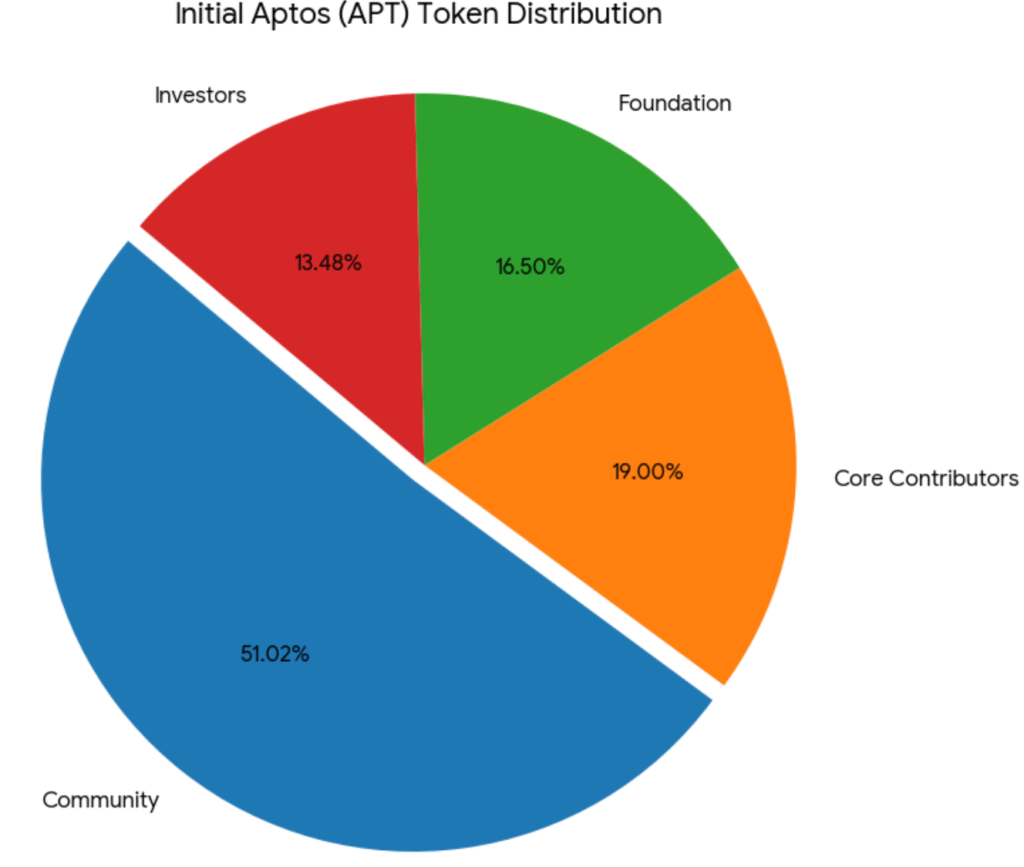
The initial 1 billion APT was distributed across four primary groups.
- Community (51.02%): A massive portion reserved for ecosystem growth, developer grants, and community initiatives. These funds are largely managed by the Aptos Foundation and Aptos Labs to ensure the network has the capital required to attract top-tier decentralized applications (dApps).
- Core Contributors (19.00%): Allocated to the developers, engineers, and researchers who built the foundational architecture of the blockchain.
- Foundation (16.50%): Reserved for the Aptos Foundation to fund ongoing protocol development, strategic partnerships, and enterprise-level operations.
- Backers (13.48%): Allocated to early financial backers and venture capital funds that provided the initial capital required to launch the project.
It is important to note that these tokens were not all immediately liquid at launch. A strict vesting schedule was implemented to prevent sudden market flooding. The vesting model utilized a cliff mechanism, followed by linear monthly unfastening. As time progresses, these unlocked tokens gradually enter active circulation, shifting the dynamic between liquid supply and staked assets.
A major turning point in this cycle occurs in October 2026, when the four-year unlock cycle for early investors and core contributors concludes, leading to an estimated 60% drop in annual supply unlocks.
Is Aptos Inflationary or Deflationary?
To answer whether Aptos is inflationary, one must examine both the original bootstrap design and the aggressive structural reforms introduced in February 2026.
Initially, “is Aptos inflationary?” was an easy question to answer, and the answer was yes. The network relied heavily on minting new tokens to reward validators for securing the chain. Still, a massive tokenomics overhaul proposed by the Aptos Foundation has fundamentally shifted this trajectory, positioning the network on a deflationary path.
Originally, the network operated with an infinite supply, meaning there was no hard cap on the Aptos max supply. The 2026 upgrade proposals introduced a strict, protocol-level cap of exactly 2.1 billion tokens. Once this ceiling is reached, no new tokens can ever be minted. By imposing this hard cap, slashing emissions, and simultaneously ramping up token burning, the network will transition from an inflationary bootstrap model to a performance-driven, deflationary ecosystem.
The Current APT Inflation Rate
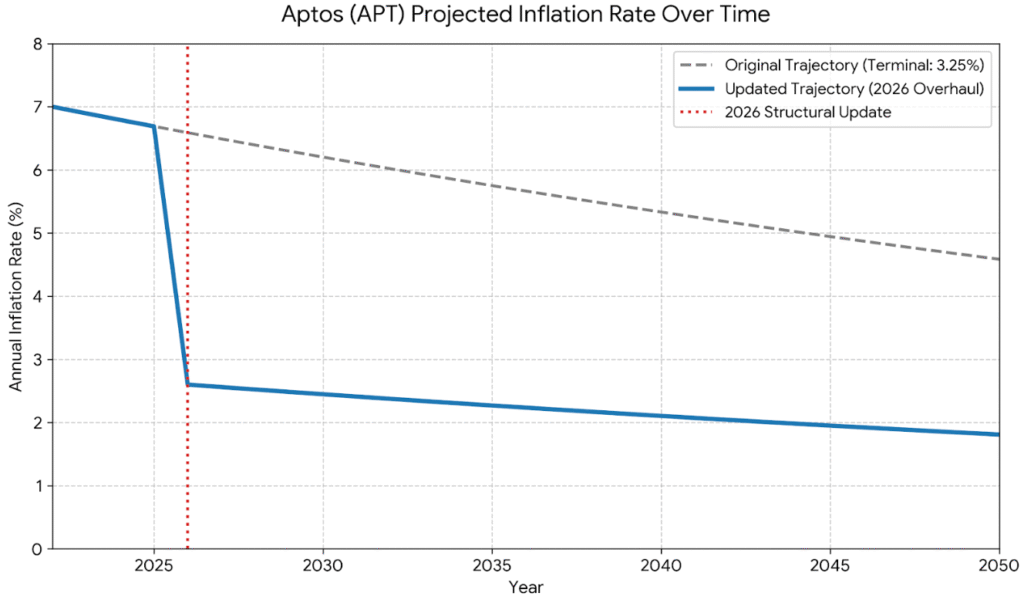
The Aptos inflation rate has historically been tied directly to its staking emissions. At mainnet launch, the maximum annualized reward rate was set at 7%. The protocol was mathematically designed so that this reward rate would decrease by 1.5% annually until it reached a lower bound, known as the terminal rate, which was originally projected to be 3.25%.
However, the 2026 governance proposals radically altered this timeline to curb overarching Aptos inflation. The foundation proposed halving staking rewards, reducing the annual percentage rate (APR) from 5.19% to 2.60%. This drastic cut will significantly reduce the issuance of new tokens, slowing the expansion of the circulating supply while aiming to preserve validator incentives and network security.
Deflationary Mechanics: Transaction Fee Burns
To offset newly minted staking rewards, the protocol employs an expansive transaction-fee-burning mechanism. Every time a user pays gas for a transaction, 100% of the base fee is permanently removed from circulation.
The 2026 tokenomics updates have supercharged this deflationary engine through several key initiatives:
- 10x Gas Fee Increase: Gas fees were structurally increased tenfold at the protocol level. Because the network is highly efficient, stablecoin transfers and standard DeFi transactions remain incredibly cheap (costing fractions of a cent), but the aggregate volume of burned tokens increases exponentially for the network as a whole.
- High-Frequency On-Chain Trading: The introduction of Decibel, a fully on-chain decentralized exchange (DEX), acts as a massive catalyst for throughput. Unlike off-chain order books, every single order, match, and cancellation on Decibel happens directly on-chain. As the DEX approaches hundreds of active markets, it is projected to burn tens of millions of APT annually.
- Permanent Foundation Lock: The Aptos Foundation is committed to permanently locking and staking 210 million APT (roughly 18% of the current circulating supply). These tokens will never be sold or distributed, effectively removing them from liquid circulation while their staking weight continues to secure the network natively.
How APT Staking Rewards Work
To fully grasp APT tokenomics, one must understand its consensus mechanism. The network utilizes a Delegated Proof-of-Stake (DPoS) model. In this system, token holders lock their assets to secure the network and, in exchange, receive Aptos staking rewards.
Validators are high-performance nodes that actively process transactions, maintain the ledger state, and propose new blocks. Since running a validator requires significant technical expertise, enterprise-grade server hardware, and a minimum stake of 1 million tokens, everyday users can participate by delegating their tokens to an existing validator. At the end of every epoch, the system calculates and distributes epoch rewards.
Validator and Delegator Rewards
When an epoch concludes, newly minted tokens (based on the updated 2.60% inflation curve) are distributed proportionately to the nodes that successfully proposed blocks. Still, delegators do not receive 100% of the rewards generated by their tokens. Validators charge a validator commission to cover the operational costs of running bare-metal servers, monitoring nodes 24/7, and maintaining flawless uptime.
Here is a simplified mathematical breakdown of how rewards work:
- Assume a user stakes 1,000 APT at the new 2.60% APR.
- Over the course of a year, those tokens generate 26 APT in gross rewards.
- If the chosen validator charges a typical 5% commission, the validator takes 1.3 APT as an operational fee.
- The delegator receives the remaining 24.7 APT.
Because rewards are distributed directly on-chain every two hours and automatically compound into the user’s active stake, delegators benefit from a frictionless compounding effect that maximizes their holdings over time without requiring manual restaking or incurring additional transaction fees.
How to Maximize APT Staking Rewards
Potential delegators researching the ecosystem often seek the best strategies to maximize rewards. While the baseline emission rate is hardcoded by the protocol, the actual take-home rewards depend on a few critical variables.
- Validator Uptime and Performance. The blockchain only rewards validators who actively and accurately participate in consensus. If a validator’s server goes offline or they miss block proposals, they miss out on rewards, and so do their delegators. Choosing a highly reliable, enterprise-grade validator is the single most important step in maximizing your yield.
- Validator Commission Rates. Look for a sustainable balance. A validator offering a 0% commission might not have the financial runway to maintain enterprise hardware, risking downtime. Conversely, a validator with a 15% or 20% commission eats heavily into your net rewards. Validators operate within a mid-range commission structure (often around 5%), balancing sustainability with competitive returns.
- Compounding Mechanics. Because the network auto-compounds, the longer you leave your tokens delegated, the higher your effective Annual Percentage Yield (APY) will be.
- Monitor Governance. With the shift toward a capped supply and performance-linked grants, staying updated on governance proposals ensures you are never caught off guard by changing protocol mechanics.
Why Stake APT with Everstake?
When it comes to securing one’s digital assets and ensuring consistent, maximum yields, choosing the right validator is paramount. Everstake is one of the most trusted, experienced, and widely utilized blockchain infrastructure providers in the world, with a historical track record spanning over 1,600,000 users and more than 130 different blockchain networks.
Here is why delegating to Everstake is the premier choice.
- Enterprise-Grade Infrastructure. Everstake employs highly secure, bare-metal servers strategically distributed across multiple geographic regions. This strategy prevents single points of failure, ensuring 99.98% uptime. High uptime directly translates into consistent, maximized epoch rewards for delegators.
- Flawless Security Record. Everstake’s flawless track record across dozens of Proof-of-Stake networks guarantees that the delegator’s voting power is managed by industry veterans who prioritize strict security protocols above all else.
- Non-Custodial Staking. When staking with Everstake, one never relinquishes ownership of their tokens. Your assets remain safely in your personal wallet (such as Petra, Martian, or Exodus), secured entirely by your private keys.
- Transparent and Fair Commission. Everstake operates with a highly competitive and transparent 5% validator commission on this network. This nominal fee goes directly toward maintaining the high-performance nodes that generate your rewards, striking the perfect balance between premium infrastructure and high delegator payouts.
- Ecosystem Commitment. Everstake is an active builder, tool developer, and educator within the Web3 space. By delegating to Everstake, one is directly supporting a team that contributes to the long-term health, security, and decentralization of the broader blockchain ecosystem.
Frequently Asked Questions (FAQ)
What is the lockup period for staked APT?
When you stake your tokens, they are subject to a lockup period tied to the validator’s unbonding cycle. When you initiate the unstaking process, it can take up to 14 days for your tokens to become fully liquid and withdrawable to your main wallet balance. During this unbonding phase, your tokens will continue to earn proportional rewards until the final unlock occurs.
Do I lose custody of my tokens when I stake?
No. Staking on this network is entirely non-custodial. When you delegate your tokens to a validator like Everstake, the actual assets never leave your wallet. You are merely assigning the cryptographic voting weight of those tokens to the validator to help secure the network. You maintain full control over your private keys at all times.
How often are staking rewards paid out?
Rewards are calculated and distributed at the conclusion of every epoch. An epoch on this network lasts exactly 2 hours. Because the protocol features native auto-compounding, these bi-hourly rewards are added to the active staked balance immediately.
What happens to the gas fees paid on the network?
Currently, 100% of the base gas fees paid by users and dApps are permanently burned and removed from circulation. With the recent 10x structural increase in gas fees and the launch of high-frequency on-chain applications, the aggregate rate of token burning has accelerated significantly, acting as a powerful deflationary force against the network’s staking emissions.
***
All metrics displayed on the website, including without limitations value of staked assets, total number of active users, rewards rates, and networks supported, are historical figures and may not represent the actual real-time data.
Share with your network