Aptos
How to Choose an Aptos Validator: APT Staking Guide 2026
Aptos secures its network through AptosBFT consensus and Block-STM execution, with delegators selecting validators based on performance, commission, and uptime. The guide walks through delegation steps, common mistakes, lockup rules, and the criteria that separate reliable operators from underperforming ones.
MAY 14, 2026
Last updated MAY 14, 2026 · V1
TL:DR
Aptos runs on AptosBFT consensus (currently v4, with v5 and Raptr in active development) and the Block-STM parallel execution engine, with epochs lasting roughly 2 hours.
Key staking facts:
- The protocol minimum delegation is 10 APT, though many UIs use 11 APT as a round-number minimum.
- Rewards are auto-compounded each epoch.
- Validator quality is measured through performance score, commission rate, uptime, governance participation, and operator track record.
- Aptos does not currently implement slashing, but underperforming validators reduce delegator rewards.
- The unbonding period can stretch up to 14 days, depending on validator lockup configuration.
- Everstake has supported Aptos since the 2022 mainnet launch and operates infrastructure aligned with SOC 2 Type II, ISO 27001:2022, NIST CSF 2.0, and GDPR standards.
How does Aptos staking work?
Aptos secures its network through a delegated proof-of-stake model built on the AptosBFT consensus protocol, currently running v4 with v5 and the Raptr protocol in active development. Validators stake APT tokens, propose blocks, and vote on transaction ordering.
The network reaches finality once a supermajority of validators agree, typically in around 1 second.
The execution layer relies on Block-STM, a multi-threaded parallel execution engine developed by Aptos Labs. Block-STM processes transactions optimistically and re-executes any that conflict, achieving over 160,000 TPS in benchmark testing, while real-world mainnet throughput typically runs much lower with peaks around 13,000 TPS.
This design rewards validators that keep their hardware and networking aligned with the protocol’s pace.
Each epoch on Aptos lasts approximately 2 hours, during which validators rotate as block leaders based on a deterministic formula tied to performance and stake. Rewards are distributed at the end of every epoch and automatically compounded into the active stake.
Voter selection happens through reputation weighting rather than direct elections.
The owner-operator-voter model separates concerns across three roles:
- The owner controls the funds.
- The operator runs the validator node.
- The voter signs governance proposals.
This structure allows delegation services to function without giving operators custody of user APT.
It is possible to enter the active validator set once the cumulative stake reaches 1,000,000 APT. Pools below this threshold do not validate and do not produce rewards, making this the first check before delegating.
| Parameter | Value |
| Consensus | AptosBFT v4 (BFT-PoS) |
| Execution engine | Block-STM |
| Epoch length | ~2 hours |
| Protocol minimum delegation | 10 APT (UIs often show 11 APT) |
| Minimum unstake | 10 APT |
| Validator set minimum | 1,000,000 APT |
| Unbonding window | 0 to 14 days |
| Slashing | Not currently implemented |
| Rewards | Auto-compounded per epoch |
What criteria should delegators use to choose an Aptos validator?
Selecting an Aptos validator is less about chasing rates and more about identifying operators that maintain consistent performance over time. Because Aptos lacks slashing, the practical risk for delegators is missed rewards from underperformance, not loss of principal.
Five concrete metrics determine whether a validator is worth delegating to.
Performance score measures how often a validator successfully proposes blocks and votes on others. The Aptos Explorer displays a per-epoch performance figure, and a top-tier operator should score close to 100%.
Sustained scores below this level indicate hardware issues, networking problems, or weak operational discipline.
Commission rate is the percentage that the validator deducts from delegator rewards before distribution. Commissions on Aptos typically range between 3% and 12%.
Uptime reflects whether the validator stays online across epochs. Validators that drop offline miss block proposals and vote attestations, dragging down their performance score.
Look for operators publishing audited uptime statistics, ideally near 99.9% over a multi-month window.
Governance participation signals whether an operator engages actively with the network. Aptos governance proposals shape staking parameters, supply caps, and protocol upgrades.
Validators that consistently vote demonstrate commitment beyond block production.
Operator track record captures the harder-to-quantify dimension of trust. Consider:
- how long the operator has run validators across multiple networks,
- whether they have audited compliance certifications,
- whether they have ever experienced material slashing on chains where slashing exists.
| Criterion | What to look for |
| Performance score | Close to 100% across multiple epochs |
| Commission | Between 3% and 12%, balanced against operator quality |
| Uptime | 99.9% or higher over the trailing 90 days |
| Governance | Consistent voting on Aptos proposals |
| Track record | Multi-year operation, SOC 2 or ISO 27001 certifications |
How do you stake APT step by step?
Delegating APT takes only a few minutes once your wallet is set up. The process below uses Petra, the wallet built by Aptos Labs, but the same flow applies to Pontem, Martian, OKX Wallet, Trust Wallet, and other compatible options.
Make sure you have APT to stake. Minimum staking amount is 11 APT plus a small buffer for transaction fees.
Open the Aptos Explorer. Navigate to explorer.aptoslabs.com and switch to the Validators view.
The dashboard lists every active operator with their performance score, commission, and total delegated stake.
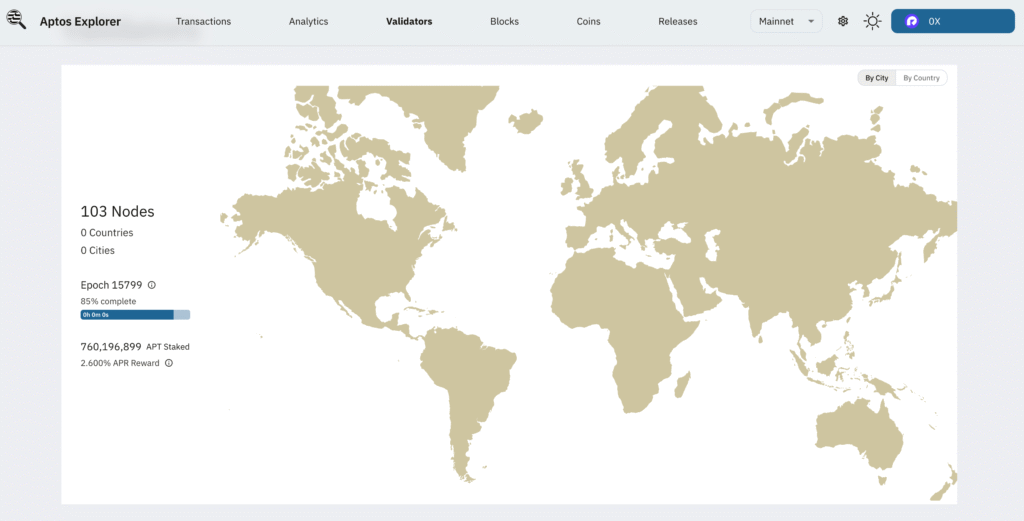
Compare validators. Sort by performance score. Cross-check uptime, governance history, and confirm the pool has reached the 1,000,000 APT validator-set minimum before shortlisting.
Connect your wallet. Click the Connect Wallet button and authorize Petra. Confirm that the network shows as Mainnet.
Select your validator and delegate. Enter the amount of APT you want to delegate, review the transaction details, and confirm the signature in Petra. The protocol minimum is 10 APT, though most UIs round up to 11 APT.
Monitor rewards. Rewards begin accruing from the next epoch and compound automatically. The Aptos Explorer delegation dashboard shows your active stake, accrued rewards, and unlock schedule.
To unstake, return to the same dashboard, click Unlock, and specify the amount. Unlocked APT continues accruing rewards until the lockup window closes, after which the tokens become withdrawable.
The lockup window varies by validator and can range from 0 to 14 days, and lockups auto-renew at expiration if unlocking is not initiated in time.
What common mistakes do APT delegators make?
Delegators often make a handful of avoidable errors when selecting an Aptos validator. Avoiding these traps protects your rewards and keeps your stake productive.
- Delegating to a pool below 1M APT. Pools that have not reached the 1,000,000 APT validator-set threshold do not validate and produce no rewards. Always confirm the pool is in the active set before delegating.
- Ignoring performance score. A validator with 5% commission but a 70% performance score will deliver less than a validator with 8% commission and 99% performance. Performance compounds across every epoch.
- Staking with inactive validators. Some validators on the leaderboard are technically registered but no longer producing blocks. Always confirm recent epoch activity before delegating.
- Chasing the lowest commission. Sustainable operators charge enough to fund redundant hardware, monitoring, and security audits.
- Overlooking lockup windows. Some validators set lockup periods near the 30-day maximum, which delays withdrawal flexibility. Check the lockup configuration before committing, and note that lockups auto-renew if not actioned.
- Neglecting governance behavior. Validators that skip governance votes signal disengagement from the network’s evolution and may underinvest in upgrades.
- Forgetting the minimum balance rule. Aptos requires at least 10.01 APT to remain in active stake after a partial unstake. Plan unstaking transactions around this constraint.
Why does Everstake operate as an Aptos validator?
Everstake has operated as a validator on Aptos since the network’s mainnet launch in October 2022, making it one of the longest-running operators on the chain. The team supported Aptos during the early testnet phases and continues to maintain validator infrastructure across mainnet today.
Everstake is a non-custodial staking provider founded in 2018, historically supporting more than 130 proof-of-stake networks. The company holds certified compliance across:
- SOC 2 Type II,
- ISO/IEC 27001:2022,
- NIST CSF 2.0,
- GDPR,
- CCPA frameworks.
Reported infrastructure metrics include 99.98% uptime and zero material slashing events since inception.
| Everstake Aptos parameters | Value |
| Commission | 5% |
| Minimum delegation | 11 APT |
| Minimum unstake | 10 APT |
| Reward frequency | Per epoch (~2 hours) |
| Lockup window | 14 days |
| Compliance | SOC 2 Type II, ISO 27001:2022, NIST CSF 2.0, GDPR, CCPA |
For delegators evaluating operators on long-term reliability rather than headline rates, Everstake publishes performance data and a delegation interface at its Everstake Aptos staking page.
FAQ
Does Aptos have slashing?
No. Slashing is not currently implemented on Aptos.
The practical penalty for choosing a poor validator is reduced rewards, not lost stake. Future protocol upgrades may introduce slashing, so monitoring governance activity remains relevant for Everstake delegators.
How long does it take to unstake APT?
Unlocking on Aptos is immediate, but the unlocked APT only becomes withdrawable after the validator’s lockup window expires. This window can range from 0 to 14 days depending on the time the stake entered.
What is the minimum amount needed to delegate?
The protocol minimum delegation on Aptos is 10 APT, though many staking UIs (including Everstake) round up to 11 APT for simplicity. The minimum partial unstake is 10 APT, and at least 10.01 APT must remain in active stake after a partial withdrawal.
Delegators below the threshold must unstake their full position.
Can I switch validators without unstaking?
Not directly. To move stake from one operator to another (for example, from another validator to Everstake), you must unlock your APT, wait for the lockup period to clear, withdraw, and then redelegate.
This makes the initial validator choice meaningful, since switching has a multi-week opportunity cost.
How are staking rewards calculated on Aptos?
Staking rewards on Aptos depend on the current network reward rate, your staked balance, and your validator’s success rate at proposing and voting on blocks. Following governance approval of Proposal #183 in early 2026, the network adopted a hard supply cap of 2.1 billion APT and is reducing reward rates from 5.19% toward 2.60%.
Rewards are auto-compounded each epoch on Everstake and other operators.
What happens if my validator goes offline?
If your validator on Aptos stops producing blocks, you stop accruing rewards for the affected epochs but retain your initially staked amount. Sustained outages may eventually drop the validator from the active set entirely.
Monitoring tools and the Aptos Explorer dashboard help delegators detect issues early and migrate stake to operators like Everstake if needed.
Disclaimer:
This guide is provided for informational purposes only and does not constitute legal, financial, tax, or investment advice. The information contained herein reflects the state of applicable regulations and market practices as of the date of publication and is subject to change without notice. Readers should not rely on this material as a substitute for independent professional advice tailored to their specific circumstances.
Institutions should consult qualified legal and compliance counsel before making any decisions relating to staking arrangements, custody models, or regulatory status.
The information provided is not intended for recipients residing in the United Kingdom.
Share with your network