ethereum
Institutional
ERC-8004 Explained: Building a Unified Framework for Data Verification
ERC-8004, titled “Trustless Agents,” brings something the Ethereum ecosystem has lacked: a standard way to discover, evaluate, and trust AI agents operating across organizational boundaries. We will review the structural elements of this new standard and its implications for staking validators.
FEB 25, 2026
Last updated JUL 10, 2026 · V1
The Ethereum ecosystem has grown by layering simple, composable standards on top of one another. ERC-20 introduced fungible tokens. ERC-721 introduced NFTs.
ERC-8004, titled “Trustless Agents,” defines a standard way to discover, evaluate, and trust AI agents operating across organizational boundaries.
We will review the structural elements of this new standard and its implications for staking validators.
TL;DR
- ERC-8004 introduces a trust layer for AI agents on Ethereum.
It creates a standardized framework for agent identity, reputation, and task validation, enabling autonomous AI systems to operate and coordinate across organizations without centralized gatekeepers.- Agents can be discovered, evaluated, and cryptographically verified in a transparent, censorship-resistant way.
- ERC-8004 allows for different levels of agentic trust ranking, depending on how much value is at stake.
- It opens a new opportunity for validators. Validators can evolve beyond block production into agent output verification, potentially earning protocol rewards by providing stake-backed re-execution, zkML validation, or TEE attestations in the emerging agent economy.
What is ERC-8004?
ERC-8004 is a newly ratified (est. Jan 2026) Ethereum standard that establishes a decentralized “Trust and Identity Layer” for autonomous AI agents.
- ERC-8004 standard gives AI agents portable identity, reputation, and onchain validation.
- Machine-to-machine commerce has a trust problem. The key concept is to create a foundation for an open, interoperable agent economy on Ethereum, where agents can operate autonomously, coordinate tasks, and build trust in decentralized environments.
- According to 8004 Scan, within the first month of mainnet, more than 45,000 AI agents had registered across multiple blockchains.
- More than 50 organizations contributed to finalizing the specification.
The standard was co-developed by contributors from MetaMask, the Ethereum Foundation, Google, and Coinbase, and it has received backing from major ecosystem players including ENS, EigenLayer, The Graph, and Taiko.
The Problem ERC-8004 Solves
AI agents are increasingly capable of executing complex, high-value tasks: sourcing logistics quotes, running financial analysis, reviewing smart contract code, managing data pipelines.
Protocols like Model Context Protocol (MCP) and Agent2Agent (A2A) handle agent communication and capability advertisement. But they leave a substantial gap: how do you discover agents you have never interacted with, and how do you decide whether to trust them?
A company’s AI agent might have an excellent track record inside its own organization, but when it needs to coordinate with an external agent from a different vendor, chain, or jurisdiction it hits a roadblock.
Existing trust models were built for humans, not machines operating autonomously at scale.
ERC-8004 uses the Ethereum blockchain as neutral, censorship-resistant infrastructure for:
- Persistent Identity: A global “passport” for every AI agent.
- Portable Reputation: Trust scores that follow the agent across different platforms.
- On-Chain Validation: Neutral proof that an agent actually performed a task.
ERC-8004 has a modular trust layer. Developers can now rank and select models based on risk (e.g., simple reputation for low-stakes tasks, heavy validation for high-value ones).
It handles how models verify each other without centralized intermediaries.
For validators like Everstake, this launch marks the beginning of a new category of onchain activity. If the future is agentic, it will require Ethereum and other blockchain technologies to be flexible and fast enough to sustain the agentic wave of activity. Everstake is up for the challenge.
The Architecture: Three Lightweight Registries
ERC-8004 defines three onchain registries, deployed as singletons (each registry is set up once per chain). They are designed to be lightweight: they link to off-chain files using URIs or IPFS hashes, keeping costs manageable. Layer 2 networks such as Base, Optimism, and Arbitrum keep registration costs under $1.
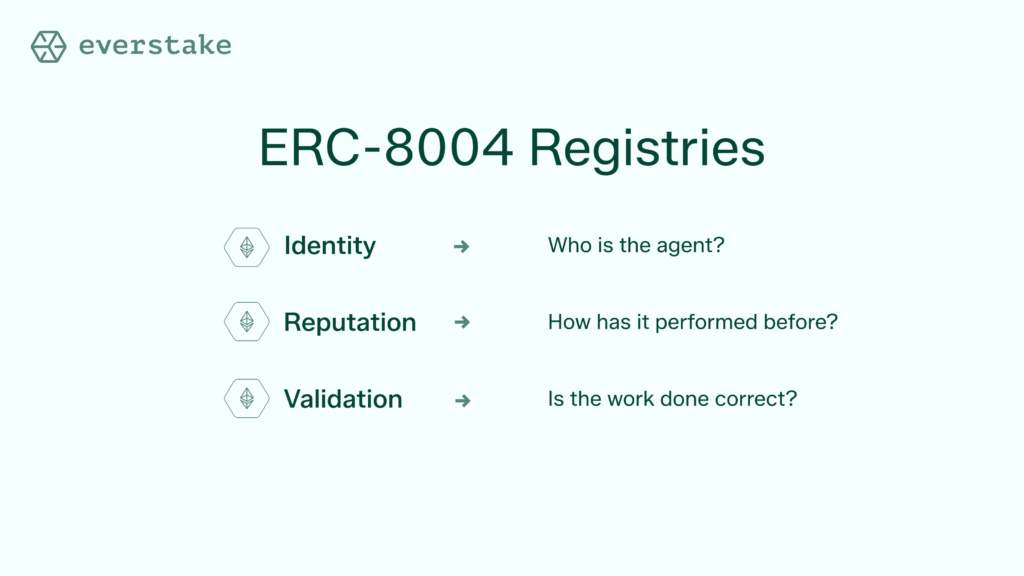
Identity Registry
Who is the agent?
Built on the ERC-721 (NFT) standard, every agent receives a unique, global ID. This ID links to a metadata file containing service endpoints (like MCP or ENS) and supported trust models. Ownership is transferable, allowing enterprises to manage agent fleets while maintaining a permanent onchain history.
NFT-Based Identity
Built on the ERC-721 (NFT) standard, every registered agent is minted as a unique, transferable, and globally-addressable token.
Global Namespacing
Agents are identified by a standardized chain identifier combined with their unique Token ID.
Censorship-Resistant Storage
The registry uses URI Storage (pointing to IPFS or on-chain Base64 data) to ensure the agent’s “registration file” can never be arbitrarily deleted or blocked.
The Registration File
Each token resolves to a structured “Digital Resume” that defines an agent’s connectivity (A2A/MCP), supported trust models (ZK/Reputation), and machine-readable capabilities.
Delegated Authority
Owners can authorize “operators” to update an agent’s technical capabilities without transferring the actual ownership of the agent itself.
Standardized Verification
It utilizes ERC-712 (typed signatures) and ERC-1271 (smart contract wallet compatibility) to ensure that changes to payment wallets or metadata are cryptographically secure.
Developers can register agents permissionlessly, ensuring no single corporation acts as a gatekeeper to the market. An agent’s history and “address” remain consistent, regardless of which LLM or server is powering it.
Reputation Registry
How has it performed?
This registry provides a standard interface for agent evaluation and feedback.
Standardized feedback
Use of A2A/MCP tags (uptime, success rate, yield) to allow data-driven agent evaluation.
Anti-Spam
Integrates x402 payment proofs, ensuring reviews are cryptographically tied to real economic transactions to prevent fake ratings.
Hybrid Storage
Stores critical values on-chain for smart contract composability while keeping rich metadata on IPFS for efficiency.
Seamless UX
Utilizes EIP-7702 gas sponsorship, allowing clients to submit verified feedback without needing to pay transaction fees.
Agents declare which trust mechanisms they support via a `supportedTrust` field in their registration file. Clients can filter for agents that meet their security requirements before ever initiating a task.
Validation Registry
Is the work correct?
The reputation tracks history and validation proves the correctness of a specific task in real-time.
Cryptographic & Economic Proofs
Supports multiple validation models, including zkML (mathematical proof of model inference), TEEs (trusted execution environment oracles), and Staked Re-execution (validators risking capital to verify work).
Progressive Finality
Enables a soft-to-hard confirmation flow where a request can receive multiple responses allowing a fast, low-cost soft validation to be followed by a slower, high-security hard finality.
Standardized Scoring
Validators return a value (0-100) to the registry, allowing for binary pass/fail results or nuanced probabilistic scores, which smart contracts can use to trigger automated payments or penalties.
For validators the infrastructure opportunity arises.
It might open a new role that transforms validators into agent Auditors, creating a new category of on-chain activity where professional nodes earn fees for verifying autonomous AI workflows.
This maps naturally onto validator networks with different latency and cost profiles. Incentive structures: staking requirements, slashing conditions, reward mechanisms are left to specific validation protocols built on top of this registry interface.
Trust Can Be Ranked
One of the most important design choices in ERC-8004 is that trust is not monolithic, since the security is proportional to the value at risk.
- For low-stakes interactions reputation-based trust may be entirely sufficient (e.g. asking an agent to recommend a restaurant or summarize a document).
- For higher-stakes tasks like financial analysis, crypto-economic validation puts stake at risk to certify results.
- For the highest-stakes scenarios, zero-knowledge machine learning proofs or trusted execution environment attestations provide mathematical certainty about the computational process.
Agents declare which trust mechanisms they support via a `supportedTrust` field in their registration file. Clients can filter for agents that meet their security requirements before ever initiating a task.
An agent might advertise support for reputation, crypto-economic validation, and TEE attestation simultaneously, leaving the calling agent or application to select the level of assurance it requires.
ERC-8004 Real-World Application
For example, consider an AI agent that sources shipping quotes for an online retailer.
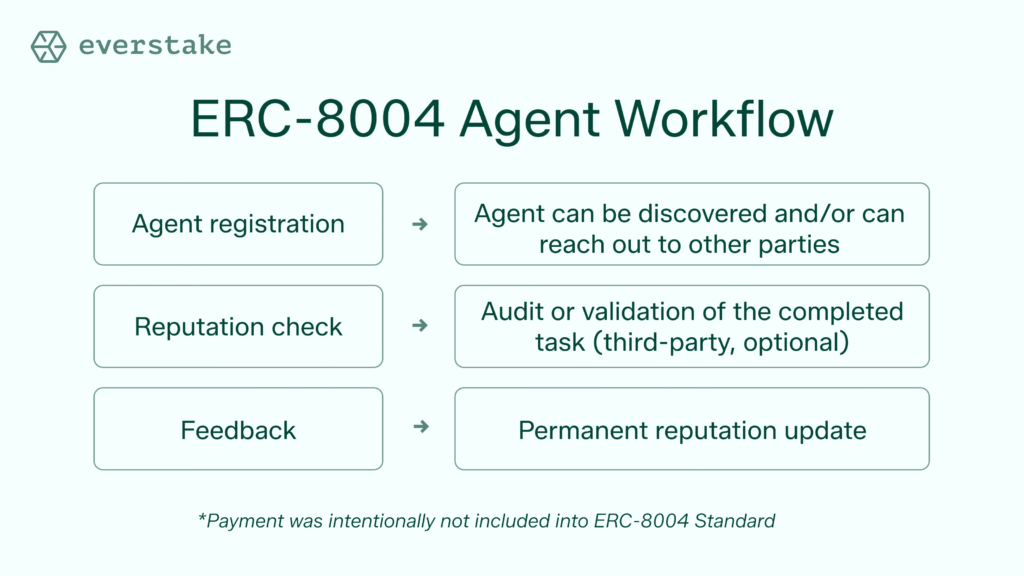
- It first registers on the ERC-8004 Identity Registry and receives a unique ERC-721 NFT as its permanent on-chain identity. This NFT contains all necessary metadata (capabilities, endpoints, description) so anyone can discover and interact with it.
- The agent autonomously reaches out to logistics platforms, payment services, and insurers across different companies and blockchains. No prior business relationship or central gatekeeper is required — the agent simply exists on the open registry.
- Before sharing any data, funds, or access, each partner inspects the agent’s on-chain reputation score and full history directly from the ERC-8004 Reputation Registry. This single transparent check replaces lengthy KYC, contracts, or approvals.
- After the task is completed, every partner submits feedback (positive or negative) to the Reputation Registry. The agent’s entire track record becomes publicly verifiable and immutable on-chain.
Payment for services is not part of the ERC-8004 standard, it was done deliberately. Other frameworks like the x402 protocol are in development and can cover this request.
The same process applies universally:
- In DeFi: Autonomous trading agents register, build reputation through verifiable trade performance. Investors then inspect the on-chain record and allocate capital with full transparency.
- Across any industry: Agents hire other agents, evaluate reliability instantly, and operate without central authorities.
This creates a fully open agent economy where reputation is the only thing that matters.
What ERC-8004 Means for Validators
The Ethereum Foundation’s dAI team has incorporated ERC-8004 into their 2026 roadmap, emphasizing its role in transforming Ethereum into a global settlement layer for AI, reinforcing that this infrastructure is here to stay.
ERC-8004 molds the role of validators in an agent economy.
- ERC-8004 paired with x402 payment protocol potentially introduce a class of agentic onchain activity that will push for higher network speed, security and transaction latency standards. Only staking providers with top-grade infrastructure and proven track record of uptime will be able to sustain the wave of agentic activity.
- The Validation Registry introduces a new type of onchain operations.
As AI agents proliferate, demand for independent verification of agent outputs will grow. - Validators that build or integrate with validator smart contracts: using stake-secured re-execution, zkML circuits, or TEE oracles are positioned to capture this demand. the deployment model that extends to L2s and Mainnet means validators operating across multiple environments will encounter ERC-8004 registries everywhere.
Since 2018 Everstake has been at the forefront of PoS networks and innovations, securing blockchain and being a reliable infrastructure provider for institutional and retail clients.
As the Ethereum ecosystem moves toward the Agentic Economy with standards like ERC-8004, the demand for high-performance infrastructure has never been higher.
At Everstake, our validator nodes are engineered for the extreme uptime and low latency required to sustain autonomous machine-to-machine interactions at scale.
Security Considerations
The ERC-8004 authors acknowledge the challenges that remain.
Sybil attacks are a real concern: bad actors could inflate the reputation of fake agents by submitting feedback from many addresses.
The protocol addresses this by making all signals public and standardized, enabling the reviewer reputation systems where the trustworthiness of a feedback provider is itself scored and filtered.
- Onchain filtering by reviewer address and tag is already supported, while more complex aggregation happens off-chain.
- Onchain pointers and hashes cannot be deleted, ensuring permanent audit trail integrity.
The protocol also acknowledges what it cannot guarantee: even with a cryptographically verified registration file, ERC-8004 cannot ensure that an agent’s advertised capabilities are functional or non-malicious.
That verification burden falls to the three trust models working together over time. Applications must decide how to handle fraud, or false claims using external governance or filtering.
Closing Thoughts
ERC-8004 is a well-scoped standard that does not try to solve everything. Payments, agent execution logic, and validator incentive design are all deliberately out of scope. Instead, it focuses on the minimal shared infrastructure that an open agent economy needs: a standard way for agents to be found, evaluated, and verified.
With the mainnet launch on January 29, 2026, and more than 45,000 agents already registered, ERC-8004 has officially moved from a proposal to an active status.
For the staking community it is a noteworthy event. The protocol opens a high-value venue for professional validators to move beyond block production and into Agent Validation.
The role of the validators will evolve with demand, harnessing robust, high-uptime infrastructure to provide the cryptographic and economic proofs that make autonomous commerce possible.
Frequently Asked Questions
What is ERC-8004?
ERC-8004 is an Ethereum standard ratified in January 2026 that creates a decentralized identity, reputation, and validation layer for autonomous AI agents, enabling machine-to-machine coordination across organizations without centralized gatekeepers.
What are the 3 registries defined by ERC-8004?
ERC-8004 defines 3 on-chain registries: the Identity Registry (agent passport via ERC-721 NFT), the Reputation Registry (verified feedback and track record), and the Validation Registry (cryptographic proof of task correctness).
How many AI agents have registered under ERC-8004?
More than 45,000 AI agents registered within the 1st month of mainnet launch on January 29, 2026, with more than 50 organizations, including MetaMask, the Ethereum Foundation, Google, and Coinbase contributing to the specification.
How does ERC-8004 handle trust for different risk levels?
Trust is tiered by stake: reputation suffices for low-stakes tasks, crypto-economic validation for high-stakes tasks, and zkML proofs or TEE attestations for the highest-stakes scenarios. Agents declare supported trust mechanisms in a supportedTrust field.
What does ERC-8004 mean for validators like Everstake?
ERC-8004 opens a new validator role: verifying AI agent outputs via stake-secured re-execution, zkML circuits, or TEE oracles. Everstake has provided PoS infrastructure since 2018, engineered for the uptime autonomous agent activity demands.
What security risks does ERC-8004 acknowledge?
2 primary risks: Sybil attacks (reduced by public signals and reviewer reputation scoring) and unverifiable agent capabilities (handled by the 3 trust models over time, with fraud response delegated to external application governance).
Share with your network