Institutional
web3 infrastructure
How Surging Stablecoin Volumes Boost Validator Staking Rewards
Discover how surging stablecoin volumes boost validator staking rewards and what infrastructure separates top performers.
MAR 20, 2026
Last updated JUL 07, 2026 · V1
The prevailing assumption is that as Layer 2 solutions and high-throughput chains like Solana drive transaction costs toward zero, validators face a structural squeeze on fee revenue. Lower fees mean lower validator staking rewards.
It is an intuitive argument. In practice, it is not true. The reality is more nuanced and, for staking providers, far more interesting.
As transaction costs fall, on-chain activity expands. Volume more than compensates for compressed per-transaction fees. At Everstake, we have watched this play out across multiple networks and market cycles. Surging transaction volumes are not a threat to validator staking rewards. They are the mechanism that drives them higher.
Network Activity and Validator Staking Rewards
How Transaction Fees Flow to Validators
On any Proof-of-Stake network, validators earn through two channels: protocol-issued block rewards and transaction fees.
Block rewards provide a predictable baseline.
Transaction fees are the variable component, and they are where volume becomes decisive.
On Solana, each transaction incurs a base fee of 5,000 lamports per signature, split 50% burn and 50% to the validator. The priority fee layer is separate: the February 2025 implementation of SIMD-0096 redirected 100% of priority fees directly to validators, eliminating incentives for off-chain side deals.
On Ethereum, EIP-1559 burns the base fee while the priority tip goes to the validator, with L2 rollups adding a third stream: fees from batched data submissions to the mainnet.
Validator revenue is a function of two variables: average fee per transaction and total transaction count. Compress the first through technical scaling, and the second must grow to compensate. On the most active chains today, it does.
Why Stablecoin Volume Spikes Translate Into Higher Validator Staking Rewards
When on-chain activity surges, users compete for block space and bid up priority fees.
A validator processing 500 transactions at 0.001 SOL earns the same gross fee revenue as one processing 50 at 0.01 SOL. High volume at low unit cost is precisely what optimized L1s and Layer 2s are engineered to create. In early 2025, Solana network revenue peaked at over $200 million in a single week. That is why validator economics on high-throughput chains are more attractive than lower-volume networks: not in spite of lower fees, but because of what low fees enable.
These dynamics flow directly to delegators. During high-activity periods, the share of a validator’s revenue derived from priority fees and MEV tips can rise to multiples of baseline inflationary rewards, translating into meaningfully higher annualized returns for stakers.
The validators positioned to capture those windows consistently are those who have done the infrastructure work in advance.
The performance disparity between validators widens during surges. A validator maintaining 99.98% uptime, like Everstake, is set to capture every premium block. One that goes offline forfeits that fee premium entirely. Infrastructure quality is invisible during calm markets and integral during the rush hour.
Stablecoins as a Catalyst for On-Chain Activity
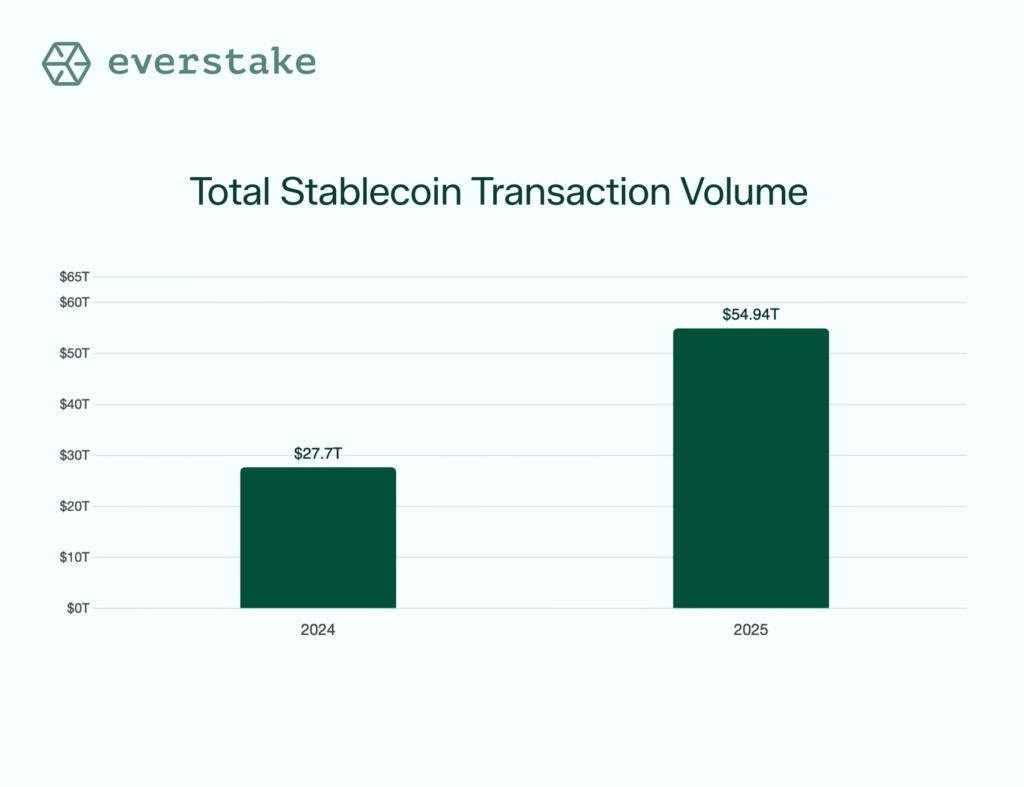
According to data from Visa and Allium, in 2024, total (adjusted and unadjusted) stablecoin transaction volume reached $27.7 trillion, surpassing the combined transaction volume of Visa and Mastercard. In 2025, that figure grew to $54.94 trillion.
The stablecoin marketcap approached $300 billion by year-end, up nearly $150 billion from 2024.
The drivers are structural:
- Cross-border remittances, B2B settlement
- DeFi collateralization
- Institutional treasury operations
- Major financial institutions including Standard Chartered, Stripe, PayPal, and Revolut have launched stablecoins or deepened stablecoin payment capabilities in 2025.
- The US GENIUS Act, passed in July 2025, established the first comprehensive regulatory framework for payment stablecoins. Bloomberg Intelligence projects stablecoin payment flows could reach $56 trillion by 2030.
How Stablecoin Demand Creates Sustained Fee Pressure
Stablecoin-driven volume is structurally more stable than speculative flows. Real-economy use cases follow business cycles rather than sentiment swings, providing a more consistent validator staking rewards.
Stablecoin demand also tends to rise during market stress, exactly when speculative volumes fall, giving stablecoin-heavy networks a degree of returns resilience that purely speculative chains cannot match. Validators with early, deep presence on stablecoin-active networks benefit from a compounding effect: more integrations attract more institutional counterparties, which drives more volume, which raises the fee floor further.
Because stablecoins are ubiquitous in most DeFi operations, liquidation events trigger cascades of competing transactions. Bots pay significant priority fees to jump the queue, which is positively reflected on validator staking rewards.
On Solana, users set their own bid through a compute unit price mechanism, creating a granular fee market where complex DeFi operations consistently generate elevated tips.
As stablecoin use expands into merchant payments and tokenized real-world assets, this source of rewards sustainability pressure will only deepen.
What Makes a Validator Stablecoin-Ready
Infrastructure Requirements: Uptime, Latency, and Throughput
Uptime is the baseline. A validator that goes offline during a high-activity period forfeits the fee premium on those blocks. Enterprise-grade validators target 99.9% or better through redundant infrastructure, automated failover, and continuous monitoring.
Latency is the differentiator. Solana’s slot time is 400 milliseconds, the window in which a block must be produced, while full network finality operates across multiple voting rounds. Competing effectively in this environment requires CPU clock speeds of 4.0GHz or higher, 512GB or more of DDR5 ECC RAM, enterprise-grade NVMe storage, and 10Gbps symmetric bandwidth.
Multi-Chain Support and MEV Capture
Stablecoin activity spans Ethereum, Solana, Avalanche, Cosmos chains, Base, Arbitrum, and more. A multi-chain validator can allocate delegator capital toward the networks generating the strongest fee-adjusted returns at any given time. Asia-Pacific already accounts for the largest regional concentration of stablecoin volume, creating 24/7 demand for block space across time zones.
Validators with geo-distributed infrastructure across Europe, North America, and Asia reduce packet hop counts, receive blocks faster, and maintain consistent performance regardless of where demand originates.
MEV capture share is gradually growing for optimized validators. On Solana, the Jito-Solana client enables an out-of-protocol auction for transaction bundles, while ShredStream delivers raw block data directly from leaders and Stake-Weighted Quality of Service ensures prioritized access to network leaders proportional to stake. They separate top-tier annual returns from average performance.
Everstake: Built for High-Volume Environments
Infrastructure and Network Coverage
Everstake has been building validator infrastructure since 2018. Over that period, we have onboarded and supported 130+ networks and today actively operate across 35+ Proof-of-Stake networks, always evolving our footprint to be present where on-chain activity is concentrated. We have supported $7 billion in total staked assets with zero material slashing events on Ethereum or Solana.
Our globally distributed bare-metal infrastructure is certified across SOC 2 Type II, ISO 27001:2022, and NIST CSF, with GDPR and CCPA compliance and regular smart contract audits. This is what institutions require alongside annual returns, and it is why Everstake has become the staking infrastructure layer for regulated firms across custody, asset management, and treasury.
Unlike cloud-dependent operators, our multi-vendor, multi-region bare-metal approach means no single point of failure, and no exposure to the outages that have taken down cloud-hosted validators during peak activity.
Institutional Trust and Track Record
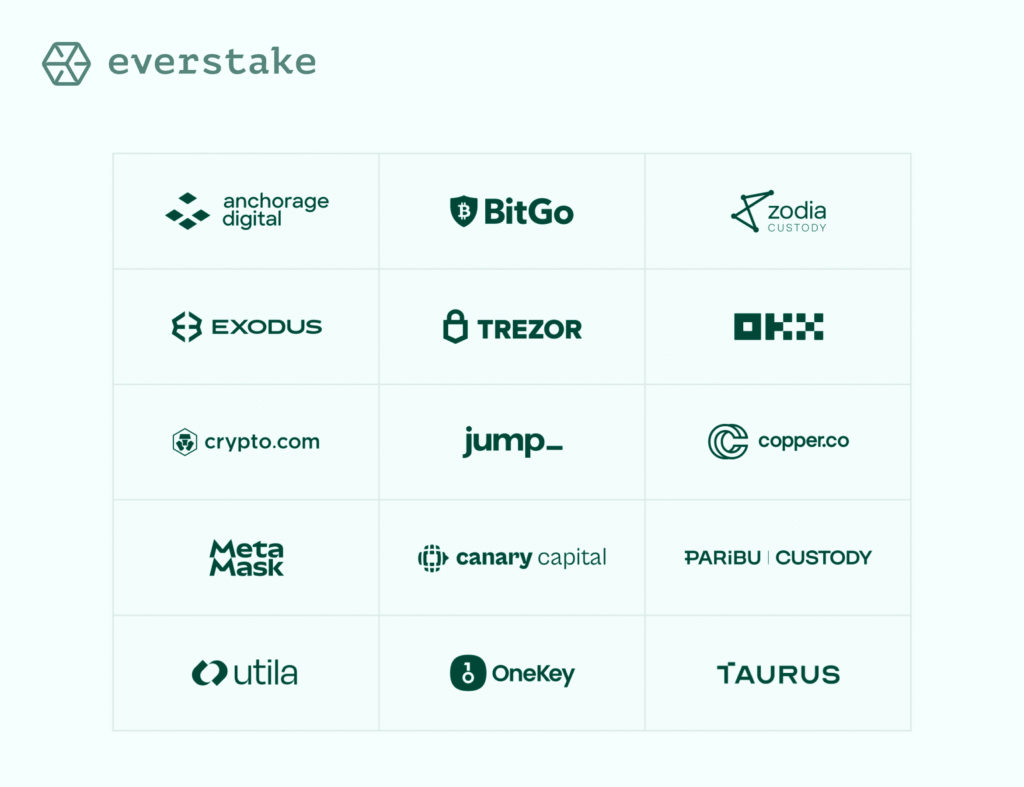
- Taurus, whose custody platform serves 25+ global banks, selected Everstake to power staking across Solana, NEAR, Cardano, and Tezos for its regulated client base.
- Utila, trusted by 200+ institutional firms processing $15 billion in monthly volume, integrated Everstake validators directly into its enterprise treasury platform.
- Colossus Digital embedded Everstake’s infrastructure into its Institutional Hub, enabling banks and asset managers using Fireblocks, Ledger Enterprise, and Dfns to stake 20+ PoS networks without leaving their existing custody environment.
- Paribu Custody, one of Turkey’s largest regulated exchanges, also runs on Everstake’s validator infrastructure.
Through Solana’s memecoin surges of late 2024 and 2025, with active addresses peaking at 7 million and six-month transaction fees reaching $260 million, Everstake maintained 99.98% uptime, supporting scaling of the network in real time.
Following the May 2025 Pectra upgrade, Everstake was an early adopter of EIP-7251, consolidating stakes into more efficient validator nodes as total staked ETH reached a record 35.3 million.
The March 2025 passage of SIMD-0123 established a protocol-level framework for programmatic priority fee and MEV sharing with delegators at the end of each epoch. Once fully activated, it makes Everstake’s high block-level capture directly visible in delegator rewards.
Follow the Volume
Stablecoin volume tells the story plainly: $27.6 trillion in 2024, $33 trillion in 2025, and $56 trillion projected by 2030. Each of those trillions represents transactions that generate fees, and fees that flow to the validators securing the networks that process them. Solana’s Alpenglow upgrade, which passed its governance vote in September 2025 with 98% approval, will reduce block finality from roughly 12 seconds to 100 to 150 milliseconds upon mainnet activation, removing another barrier for financial applications moving operations on-chain. The direction of travel is unambiguous.
The transition from inflationary subsidies to transactional revenue is how a blockchain economy matures into something durable.
For delegators, the framework is straightforward: identify networks where volume is growing and structurally sustained, and stake with validators that have the infrastructure to capture it. Everstake has been building for this environment since 2018.
Disclaimer
The information provided is not intended for recipients residing in the United Kingdom.
Share with your network