solana
SWQoS vs. Priority Fees: Which is Better for Transaction Success on Solana?
While priority fees incentivize block inclusion through economic bidding, Stake-weighted Quality of Service (SWQoS) ensures transactions actually reach the validator during high congestion by providing a dedicated, stake-backed network lane.
MAR 04, 2026
Last updated JUL 10, 2026 · V1
SWQoS (Stake-weighted Quality of Service) and priority fees are two complementary but distinct mechanisms on Solana that both help transactions land faster and more reliably, especially during network congestion. They operate at different stages of the transaction lifecycle.
Priority fees get most of the attention. They’re visible, adjustable, and intuitive: pay more, get faster inclusion. For most Solana users, that’s the entire conversation around transaction success.
But there’s a class of users for whom that framing no longer works: institutions, high-frequency traders, MEV operators, liquidation bots, and any system where being a few milliseconds late has real consequences. In this case, stake-weighted Quality of Service becomes indispensable.
Why This Matters in Practice
For most retail users, this distinction is invisible. A standard wallet or RPC will handle both reasonably well under normal network conditions.
But for latency-sensitive applications like arbitrage bots, trading platforms, wallets, terminals, NFT minting infrastructure, and high-frequency traders the separation is vital.
Under heavy congestion during any market moving event the leader’s ingress gets overwhelmed. At that point, low-stake connections start dropping packets before any fee comparison even happens. Users can be paying 10x the average priority fee and still lose if the transaction never makes it through the network layer. This is where SWQoS starts to matter a lot.
Priority Fees: Paying More to Get Ahead
Priority fees are a tip attached to the transaction in order to incentivize validators to include it sooner.
On Solana, every transaction can optionally include a SetComputeUnitPrice instruction. This sets the price (in micro-lamports) per compute unit the transaction consumes. The higher the price users are willing to pay, the more attractive their transaction is to the leader (the validator whose turn it is to produce the next block.)
The fee scheduler on the leader side collects incoming transactions and, broadly speaking, prioritizes those with higher compute unit prices.
During high-demand periods priority fees can spike significantly as users bid against each other for blockspace.
Priority fees are a market mechanism. It’s an economical competition for inclusion in the next block.
One important nuance: fees are constrained at the account level by local fee markets. Solana introduced this to prevent a hot account (like a popular DEX) from causing a fee spiral that punishes unrelated transactions. The priority fee matters most relative to other transactions touching the same accounts.
SWQoS: Access Before the Auction
Stake-weighted Quality of Service operates at network ingress, not block inclusion. It is a validator software feature (enabled since Solana v1.14 / Agave) that gives stake-weighted priority to incoming transaction traffic.
In SWQoS, the Solana leader receives transactions via stake-weighted QUIC connections on its TPU port. RPC nodes get peered with a staked validator and receive virtual stake that reserves it a proportional share (~80% of total incoming bandwidth) for prioritized packet delivery ahead of non-staked traffic.
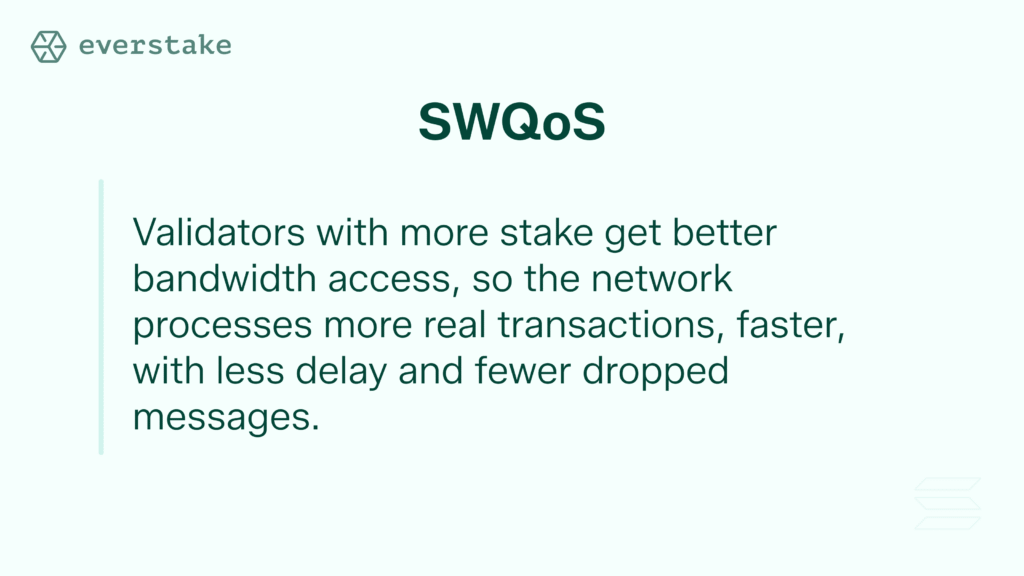
The leader validator allocates its incoming transaction bandwidth proportionally to how much stake each validator (or node) forwarding transactions to it holds on the network.
With SWQoS the transactions are more likely to even reach the leader in the first place, especially when the network is under load.
Transactions from unstaked or low-stake sources may simply get dropped at the network layer before any fee auction even takes place.
SWQoS is a capacity reservation mechanism. It determines whether the transaction gets in the door.
This is why advanced traders and MEV bots often route transactions through staked infrastructure services like Everstake’s SWQOS that maintain high-stake connections to leaders. Under congestion, an unstaked RPC can be a bottleneck regardless of how high the priority fee is.
The Problem With Fees Under Load
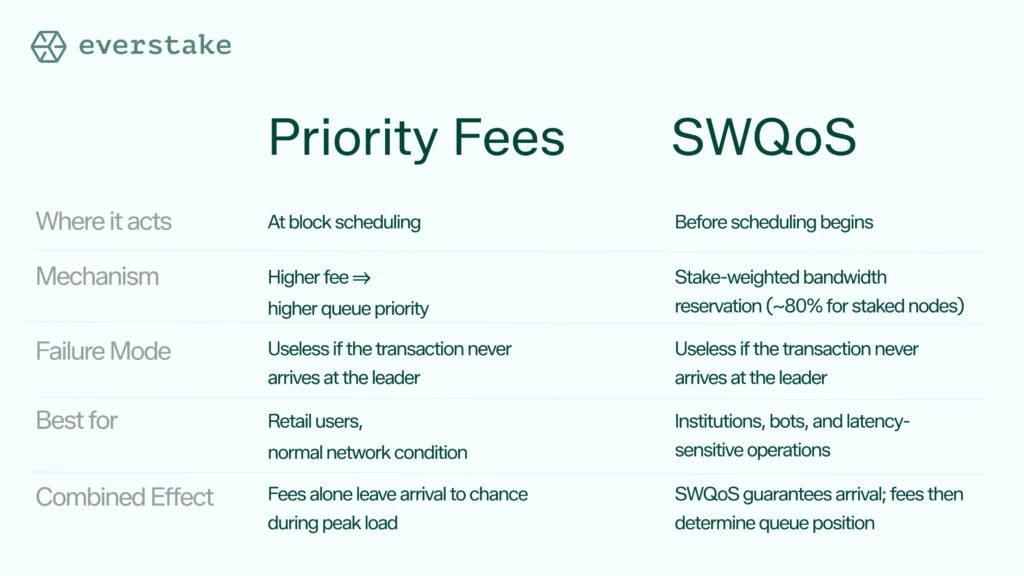
Priority fees are an economic mechanism. They work on the assumption that the transaction has already reached the leader and that might be a costly assumption for institutions when the network is congested.
Solana’s Transaction Processing Unit (TPU) on the leader validator allocates its incoming bandwidth based on the stake weight of forwarding nodes. When transaction volume spikes and that bandwidth fills up, the leader starts dropping traffic from low-stake paths. It never reaches a point of actually detecting and evaluating fees on those dropped transactions. In such instances the fees become irrelevant.
Teams implement dynamic fee estimation, robust retry logic, and multi-RPC fanout, yet transactions are still dropped during the most critical moments. The root cause is frequently not the fee level itself, but that the transactions are arriving via a low-stake path to a saturated leader.
Under load, fee competition occurs only among transactions that have successfully arrived. If a transaction never reaches the leader, it is not in the competition.
Latency Is Compounding, Not Linear
The advantage of SWQoS is that it compounds with other timing factors.
Solana slots take approximately 400ms. Within that window, transactions arriving earlier have more time to be scheduled, and included before the block closes. For instance, a transaction that reaches the leader at 50 ms into the slot still has ~350 ms of processing window, whereas one arriving at 300 ms or retried into the next slot has far less time and is much more likely to miss inclusion entirely.
Under congestion, the reliability of the network path determines not only whether a transaction arrives, but also when within the slot it arrives. SWQoS gives high-stake paths a structural edge: they are less likely to experience queuing delays or retries at the ingress layer, so they tend to arrive earlier in the slot window on average.
For operations measured in milliseconds and slots, this compounding effect is significant. SWQoS therefore improves not only worst-case outcomes but also shifts average-case performance.
SWQoS for Institutions
For institutional participants, the case for SWQoS touches on risk management, since any institution requires deterministic performance.
Use Case: DeFi Platform or Market Makers
Consider a market maker running two-sided quotes on a Solana DEX. During a volatility spike, they need to update or cancel positions quickly. A delay of even one or two slots can mean the difference between a clean position update and an adverse fill.
Paying higher priority fees helps at the scheduling stage, but if the update transaction never reaches the network layer first, the fee is irrelevant.
Use Case: Liquidations
Or consider a liquidation engine. Liquidations are competitive and multiple bots are simultaneously trying to claim the same undercollateralized position. The winner is often determined not by who offered the highest fee, but by whose transaction arrived at the leader first and got into the scheduling queue earliest.
Use Case: Real-time Games & dApps
By utilizing a stake-based priority lane, Everstake can offer real-time games a seamless gaming experience with guaranteed blockspace that prevents lag during high-traffic events. Relying on SWQoS ensures that in-game actions remain fluid and responsive, bypassing public congestion through SLA-backed throughput.
SWQoS determines arrival time. Priority fees determine queue position after arrival.
Optimizing both SWQoS and priority fees allows users to be competitive on both arrival and queue placement. Focusing solely on optimizing priority fees means sacrificing the advantage in the arrival race.
Institutional-grade Solana Infrastructure Powered by Everstake
SWQoS is now available as a self-serve product through Blockspace, Everstake‘s Solana infrastructure stack. Running SWQoS at the protocol level requires roughly 15,000 SOL, so Blockspace offers Everstake‘s existing validator stake instead, routing whitelisted wallets through validator-grade priority into the leader’s TPU window with no SOL minimum of their own.
With Everstake’s SWQoS Solana RPC, infrastructure teams gain a direct, stake-powered gateway to Solana blockspace. This priority lane ensures guaranteed throughput and deterministic performance, allowing your traffic to bypass public queues even during peak network load.
Key Benefits of SWQoS with Everstake
| Benefit | Description |
| Lowest Rates | A minimum SOL tip of 0.0005 per transaction or starting from 500$/month. |
| Guaranteed Blockspace | Provides consistent compute access even during periods of network congestion. |
| High TPS Limits | Offers custom throughput tailored to your specific plan and needs. |
| Transparent Fairness | Uses priority earned through stake, which preserves Solana’s permissionless ethos. |
| Deterministic Performance | Features a stake-based priority lane that bypasses public queues. |
| Geo-Distributed Infrastructure | Delivers optimal latency through multiple locations worldwide. |
| Zero Congestion Penalties | Provides SLA-backed throughput even during peak load times. |
| Flexibility | From pay-as-you-go to Enterprise grade coverage, depending on the scale of your request. |
For high-performance applications, contact us for tailored benchmarking and performance metrics. We ensure the highest efficiency through our SWQoS infrastructure and client-specific optimizations, providing deterministic performance that bypasses public queues.
Since 2018 Everstake has established itself as a leading global non-custodial staking provider serving institutional and retail clients, trusted by over 1,600,000 users to date with expertise across 130+ Proof-of-Stake networks. The company has supported $7 billion in staked assets, delivering institutional-grade infrastructure with 99.98% uptime and zero material slashing events on Solana since inception.
Conclusion
Priority fees are an excellent tool for retail users in a network that’s behaving normally. They’re market-efficient, flexible, and easy to optimize with good fee estimation.
But Solana under load becomes a congested, high-competition environment where the network ingress layer becomes a bottleneck before the fee auction even begins.
For institutions, market makers, and any system where latency and reliability under stress are non-negotiable, SWQoS is the more important layer, because fees can only do their job once delivery is guaranteed.
Share with your network