solana
Understanding the Solana Consensus Mechanism: A Guide to Proof of History
This article explores how Solana’s Proof of History functions as a cryptographic clock to establish a verifiable sequence of events, eliminating the communication setbacks found in traditional blockchains.
FEB 24, 2026
Last updated AUG 06, 2026 · V1
The Core Problem: Time in Distributed Networks
Solana is a high-performance blockchain when it comes to throughput and latency. One of the key differentiators for Solana consensus mechanism was the addition of Proof of History (PoH).
Traditional blockchains like Bitcoin and Ethereum use consensus algorithms to ensure all nodes agree on the ledger’s state first, and then it settles on the blockchain.
Because they lack a globally synchronized clock, nodes must communicate back and forth to agree on when events occurred.
Solana solves this by introducing Proof of History.
What is Proof of History (PoH)?
Proof of History (PoH) is not a consensus mechanism, but a cryptographic clock protocol that builds timestamps directly into the blockchain. This enables Solana to process transactions in real time instead of waiting for blocks to be formed first.
It is a common misconception that Proof of History is a consensus algorithm itself. It is actually a “pre-consensus” component that aids the network in achieving agreement.
Solana uses Proof of History to prove the sequence and timing of events before consensus even begins. This allows validators to process transactions in parallel, drastically reducing latency.
To illustrate its effectiveness, let’s compare the block production times of the two most popular Proof of Stake (PoS) networks:
- Ethereum: 12 seconds
- Solana: 400 to 600 milliseconds (0.4–0.6 seconds)
The Role of the Verifiable Delay Function (VDF)
PoH operates as a Verifiable Delay Function (VDF), which is a cryptographic function that is difficult to compute but very fast to verify.
It acts as a digital clock by repeatedly hashing data, ensuring that a certain duration has passed because the computation cannot be parallelized or sped up by adding more hardware. Through VDF nodes agree on the passage of time and the order of events.
While it may take a validator a full slot to generate the hashes, other nodes can verify the entire sequence in parallel in a fraction of the time.
The Mechanics: How PoH Works with Proof of Stake (PoS)
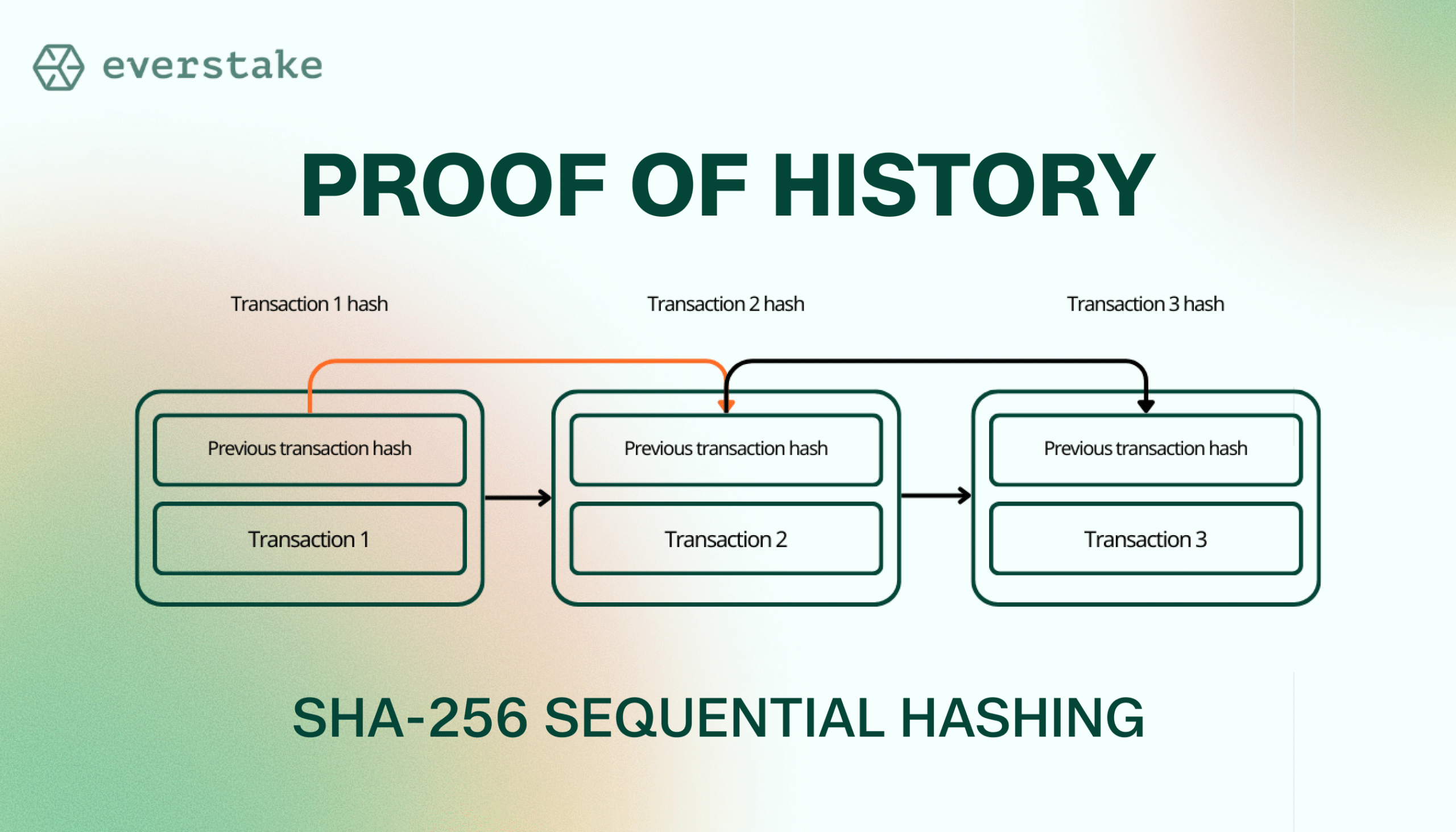
At its core, PoH uses a sequential preimage-resistant hash function (specifically SHA-256) to create an immutable record of time. Network is structurally enhanced by pairing PoH with a PoS model to create a comprehensive and fast Solana consensus mechanism.
- PoH handles timing. It establishes the order and timing of transactions.
- PoS handles security. It manages validator selection and ensures their stake is their “skin in the game.”
Validators must commit (stake) SOL tokens to participate. They can be slashed if they act maliciously, such as by emitting two different blocks for the same slot.
The network remains secure as long as 2/3 of the stake-weighted participants are honest.
If dishonest nodes control more than 2/3 of the stake, they could potentially approve fraudulent transactions.
Proof of History Terms to Know
Sequential Hashing
The system runs a constant process where each output becomes the input for the next computation. Because this must be done sequentially on a single-core processor, it creates a verifiable record proving that a specific amount of time has passed.
Ticks and Slots
Solana measures time in “ticks” (fractions of a second based on hash iterations) to achieve node synchronization. These ticks are grouped into slots, with a specific validator assigned as the leader for each slot according to a predetermined leader schedule.
Step-by-Step Process
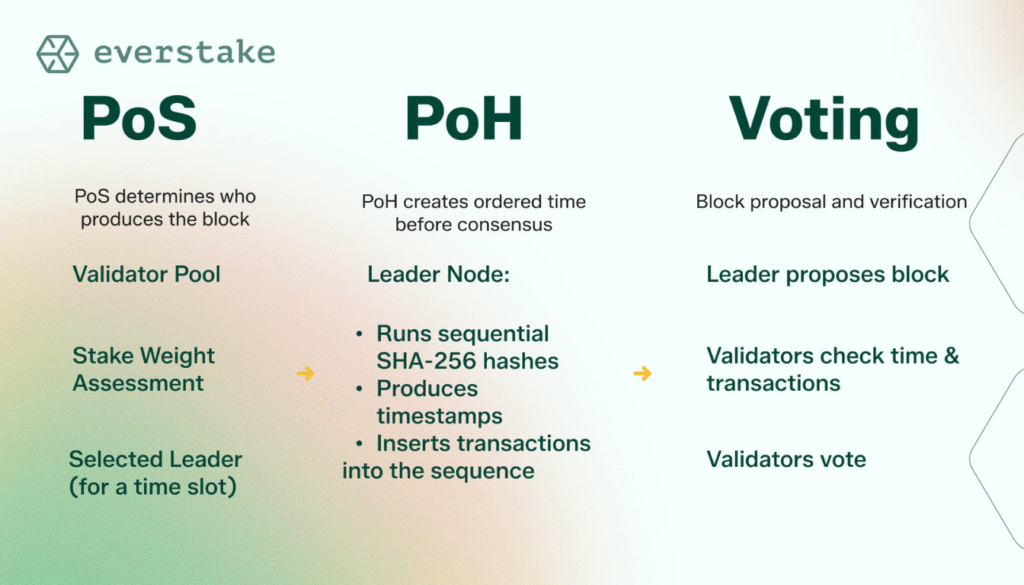
- Time is created cryptographically: All validators continuously run a chain of SHA-256 hashes. Each hash depends on the previous one, so they must be computed in order. This sequence acts as the network’s internal clock.
- Time is divided into slots: The continuous hash sequence is grouped into small time windows called slots. Each slot represents a short period during which one validator is allowed to produce a block.
- Slots are grouped into epochs: Precisely 432,000 slots form an epoch. Before an epoch starts, the full order of which validator will lead each slot is already determined.
- The leader schedule is calculated in advance: Using stake-weighted randomness and past network data, the system assigns validators to specific future slots. Because the process is deterministic, every validator independently computes the same leader schedule.
- A validator becomes a slot leader: When its assigned slot begins, the scheduled validator is the only one allowed to propose a block.
- The leader produces a block with Proof of History data: While verifying transactions, the leader continues running the hash sequence and includes part of it in the block. This proves how much time passed during the slot.
- Other validators check if the data in the block is correct and consistent.
- Validators vote: If everything checks out, validators vote on the block. The next scheduled leader then continues from the previous hash value.
The network always knows who the leader is, can verify timing without a shared wall clock, and can sequence blocks efficiently and securely.
Tower BFT Explained
Tower BFT is Solana’s custom implementation of Practical Byzantine Fault Tolerance (PBFT), a consensus algorithm optimized for high performance in distributed systems like blockchains.
It builds on PBFT by incorporating Solana’s PoH as a global clock. This reduces communication overhead between validators, minimizes latency, and enables faster transaction confirmations usually in just one round of voting.
Unlike traditional PBFT, Tower BFT prioritizes liveness (ensuring the network keeps progressing) over strict consistency, making it suitable for Solana’s high-throughput design.
The Impact of PoH on Solana’s Performance
This backend mechanic fundamentally enhances Solana’s scalability by offloading the need for validators to constantly communicate to verify time. This allows the network to process transactions at a massive scale without traditional bottlenecks. Consequently, Solana is ideal for applications requiring near-instantaneous settlement, such as DeFi trading or gaming.
Key Benefits
- ~400ms Block Times: PoH’s pre-consensus timing allows leaders to produce slots every ~400 milliseconds, faster than Ethereum’s 12-second blocks or Bitcoin’s 10-minute intervals.
- High TPS: With PoH handling transaction ordering upfront, Solana achieves real-world throughput of 1,000 – 4,000 TPS on average, with peaks over 5,000 TPS and theoretical maxima of 65,000 TPS (potentially exceeding 1 million with upgrades like Firedancer). This contrasts with Bitcoin’s ~7 TPS or Ethereum’s 15 – 30 TPS, directly resulting from PoH’s efficiency in streaming ordered data to validators.
- Deterministic Finality: PoH integrates with Tower BFT to provide economic finality in approximately 12.8 seconds. While “optimistic confirmation” happens in sub-second times, the upcoming Alpenglow consensus protocol is expected to reduce true deterministic finality to just 100–150ms, eliminating the risk of reorgs common on other chains.
- Parallel Execution: PoH powers Sealevel, Solana’s parallel smart contract execution runtime, by providing a verifiable sequence of transactions that Sealevel can then process concurrently across CPU cores without conflicts. By enabling parallel execution, Solana can support tens of thousands of transactions per second.
Securing the Network: Staking on Solana
Solana’s economic security is rooted in its Proof of Stake (PoS) mechanism, where validators and delegators lock up SOL tokens as collateral to participate in network operations. This creates a system where honest behavior is incentivized through rewards, while malicious actions are deterred by slashing.
The cost of acquiring enough SOL to attack the network (e.g., over 33% of total stake to cause liveness failures or 67% for censorship) acts as a prohibitive economic barrier, making attacks financially ruinous due to market impacts and potential slashing.
Staking SOL directly secures the Tower BFT consensus by weighting validator votes proportionally to their effective stake.
In Tower BFT, which builds on Practical Byzantine Fault Tolerance (PBFT) and integrates Proof of History (PoH) for timing, validators vote on proposed blocks during each slot (~400ms). These votes stack into a “tower.” Each successive vote on the same branch doubles the lockout period, making it increasingly costly to switch to a competing block. This mechanic actively discourages equivocation.
Consensus is achieved when a supermajority (approximately 67%) confirms a branch, leading to optimistic confirmation (after one round) and eventual finality (typically within 12–32 slots, or ~12.8 seconds).
This stake-weighted voting ensures that validators with more “skin in the game” have greater influence.
Coming Next: What Alpenglow Means for Proof of History
The most consequential development for Solana‘s consensus is Alpenglow, described by Anza as the largest consensus change in the network’s history. It passed validator governance in September 2025 with 98.27% approval under SIMD-0326.
Alpenglow went live on a dedicated community test cluster on May 11, 2026, including a live “Alpenswitch” migration from Tower BFT. It is expected to reach mainnet by the Agave 4.1 release, with deployment currently anticipated for late 2026 (Anatoly Yakovenko has suggested Q3 2026 is possible if testing holds).
Alpenglow will remove Proof of History from the consensus process and replace Tower BFT entirely. The new architecture is built on two components:
- Votor, a voting protocol that collapses the current 32-round process into one or two rounds
- Rotor, a data relay that replaces Turbine
When 80% of validator stake is online, finality is achieved in a single round at around 100 milliseconds. At 60% participation, it takes two concurrent rounds targeting 150 ms.
Beyond faster finality, Alpenglow also frees up block capacity. Because Votor moves voting off-chain instead of publishing votes as on-chain transactions, roughly 75% of previously consumed block capacity is freed for user transactions.
Proof of History remained Solana‘s defining innovation for years and is the reason the network reached its current performance. Alpenglow supersedes the timing role PoH once played, using local timeouts and a fixed 400ms block time.
Why Run Your Solana Operations with Everstake
The implementation of PoH adds significant complexity, which may contribute to a higher rate of network outages compared to simpler systems. Operators must tune their hardware, specifically high-clock-speed CPUs to ensure their clock is intact.
Everstake has spent years building a reputation for reliability backed by external audits and a flawless operational record. The company has established itself as a dependable, institutional-grade node operator, delivering 99.98% uptime across all networks, with billions in staked value.
- 99.98% Uptime: Our infrastructure is engineered for near-perfect availability. On a network like Solana, where 400ms block times are the standard, our 99.98% uptime ensures you never miss a slot or a voting window.
- Zero Slashing History on Solana: Since our inception in 2018, Everstake has maintained a clean record on Solana. Our rigorous DevOps protocols and multi-layered monitoring prevent the double-signing or downtime events that trigger slashing.
- Full Compliance: Everstake takes security and compliance seriously. That’s why the company maintains SOC 2 Type II, ISO 27001:2022, and NIST CSF certifications, as well as GDPR and CCPA compliance. This ensures secure, scalable, and compliant operations along with slashing protection.
- Geo-distributed Bare Metal Servers: Our servers are strategically distributed across major global data hubs to minimize latency and ensure network redundancy.
- Deeply Technical Team: Everstake’s team mostly consists of blockchain professionals with deep expertise in complex systems, PoS network decentralization, and blockchain product development.
Frequently Asked Questions
Is Proof of History the same as Proof of Stake?
No. Proof of Stake (PoS) is the consensus layer where validators secure the network with collateral, while Proof of History (PoH) is a decentralized clock that cryptographically timestamps transactions to establish their order before consensus even begins.
How does Solana achieve 400ms block times?
Solana achieves this by using Proof of History to eliminate the need for validators to talk to each other to agree on time, combined with Turbine, which breaks data into small “shreds” for rapid parallel distribution.
What happens if a Solana validator goes offline?
It temporarily stops earning staking rewards and its voting power drops out of consensus until it comes back online. Prolonged downtime can reduce its future delegations, but the network continues operating as long as less than one third of total stake is offline.
What is a Verifiable Delay Function (VDF) and why does Solana use one?
A VDF is a cryptographic function that takes measurable time to compute but can be verified quickly, and it cannot be sped up with extra hardware. Solana uses it as the foundation of Proof of History to guarantee that a specific amount of time has actually passed between events.
How are validators selected to produce blocks on Solana?
Solana uses a predetermined leader schedule calculated before each epoch, assigning validators to specific slots through stake-weighted randomness. Because the process is deterministic, every validator independently computes the same schedule and knows who leads each slot.
What is Tower BFT and how does it work with Proof of History?
Tower BFT is Solana’s consensus algorithm that uses PoH as a global clock, with validator votes stacking into a “tower” where each successive vote doubles the lockout period. Consensus is reached when roughly 67% of stake confirms a branch, enabling fast confirmation and finality within 12–32 slots.
***
All metrics displayed on the website, including without limitations value of staked assets, total number of active users, rewards rates, and networks supported, are historical figures and may not represent the actual real-time data.
Share with your network