ethereum
How to Stake Ethereum in 2026: A Complete Guide to All Methods
Learn how to stake Ethereum in 2026. Compare solo, delegated, pooled, liquid, and exchange staking methods, with risks, requirements, and step-by-step guidance.
APR 22, 2026
Last updated JUN 19, 2026 · V1
Key Takeaways
- There are five methods for Ethereum staking: solo staking, staking-as-a-service, pooled staking, liquid staking (LSTs), and centralized exchange staking. Each trades off control, complexity, fees, and liquidity differently.
- Solo staking requires 32 ETH and technical expertise but offers the highest rewards and strongest contribution to decentralization.
- Liquid staking and pooled staking remove the 32 ETH barrier, letting anyone participate with any amount of ETH, while having extra flexibility in making liquid staked ETH productive in DeFi.
- Staking rewards are variable, driven by total ETH staked, network activity, and MEV capture. Check Everstake’s Ethereum staking page for current live rates.
- Risks include slashing, validator downtime, smart contract vulnerabilities, counterparty exposure (on exchanges), and exit queue delays during periods of high withdrawal demand.
- Staking suits long-term ETH holders who want their funds to stay productive while they wait. It does not eliminate price risk on the underlying asset.
- Running your own validator requires dedicated hardware, two separate software clients (execution and consensus), and ongoing maintenance, but gives you full control and the complete share of rewards.
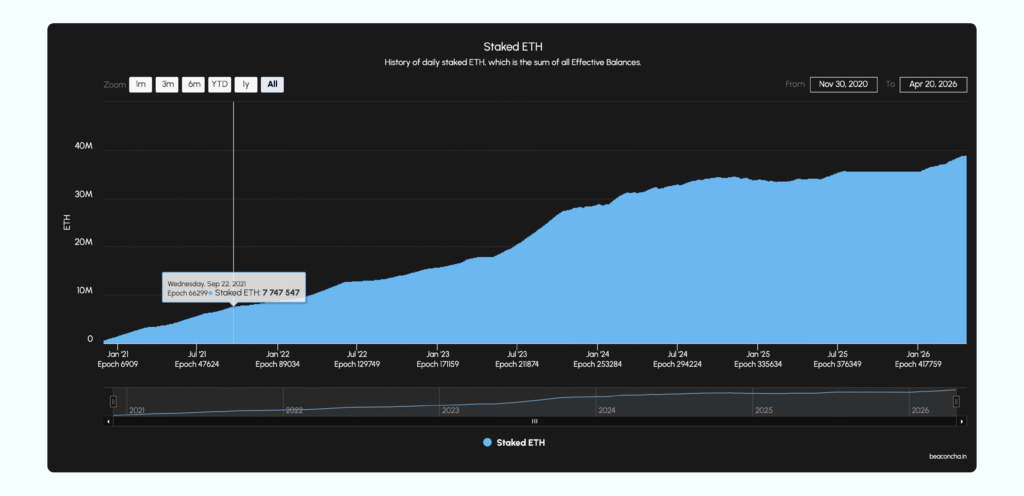
As of early 2026:
- roughly 39 million ETH is staked
- across nearly 1 million active validators,
- accounting for about 32% of the total circulating supply.
The question is no longer whether to stake, but how.
How Ethereum Staking Works
Proof-of-Stake and Validators
Ethereum transitioned from Proof-of-Work to Proof-of-Stake during the Merge in September 2022.
Key changes:
- Under this consensus mechanism, the network is secured by validators rather than miners.
- Each validator commits ETH as collateral and is responsible for proposing and attesting to blocks.
- The protocol issues rewards proportional to the validator’s effective balance and uptime.
The incentive design is straightforward: validators who behave honestly and stay online receive rewards, while those who act maliciously or go offline face penalties.
The system ensures every participant has meaningful “skin in the game,” making it economically irrational to attack the network.
How Rewards Are Generated
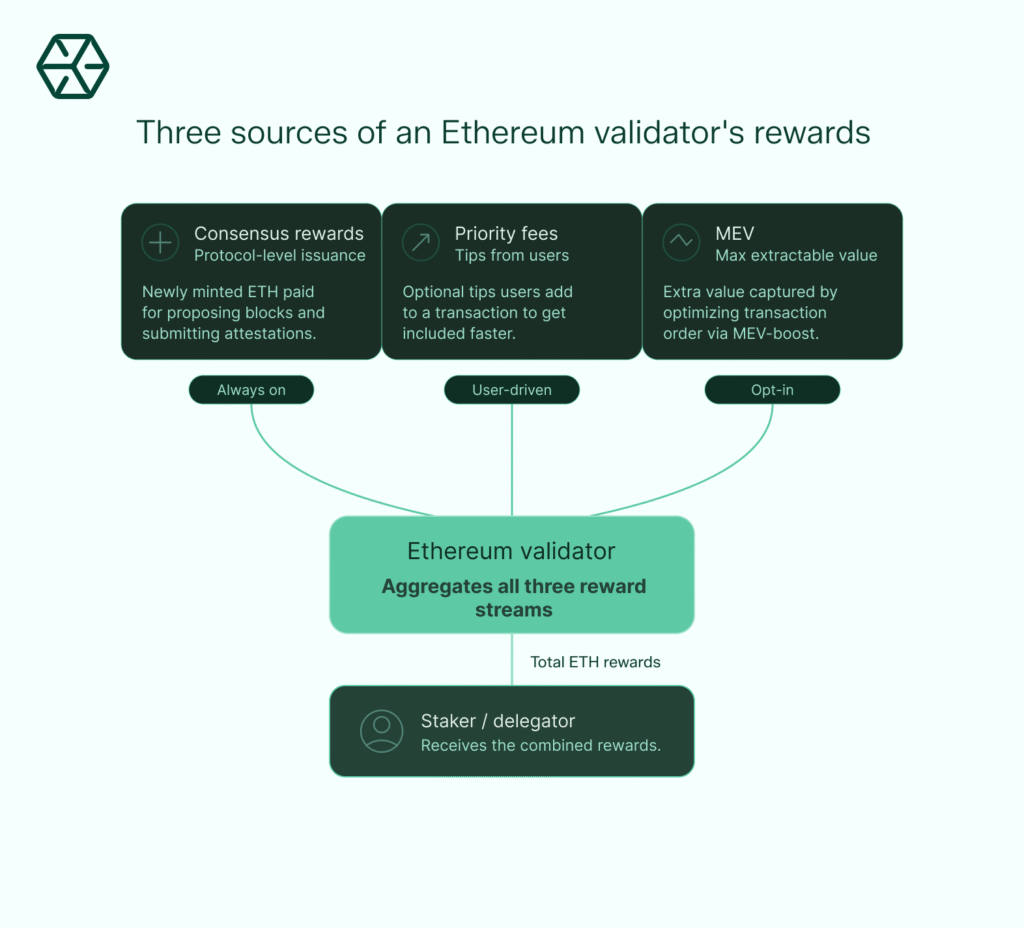
Staking rewards come from three sources.
- Consensus rewards: the protocol mints new ETH to compensate validators for proposing blocks and submitting attestations.
- Priority fees: when users submit transactions, they can include a tip to incentivize faster inclusion.
- MEV (Maximum Extractable Value): validators who use MEV-boost software get additional rewards by optimizing the transaction ordering within the blocks they propose.
The relative weight of each source shifts with network activity.
- During periods of heavy on-chain usage, priority fees and MEV can meaningfully boost rewards above the base consensus rate.
- During quieter periods, consensus rewards account for the bulk of validator proceedings.
The Role of 32 ETH
The protocol requires each validator to deposit exactly 32 ETH into the Beacon Chain deposit contract. This threshold was chosen to balance accessibility (low enough to encourage broad participation) with network efficiency (high enough to keep the validator set manageable).
Following the Pectra upgrade, EIP-7251 raised the maximum effective balance to 2,048 ETH per validator. This means large holders can now consolidate into fewer validators rather than run dozens of separate nodes, reducing operational overhead and network message load. The minimum to run a validator, however, remains 32 ETH. For those who hold less, pooled and liquid staking options remove that barrier entirely.
The Five Ways to Stake Ethereum
There is no single right way to stake ETH. Each method makes different trade-offs among:
- control,
- complexity,
- fees,
- liquidity.
Below is a breakdown of the five primary approaches.
Solo Staking (Running Your Own Validator)
Solo staking means operating your own validator node:
- You deposit 32 ETH directly into the Ethereum deposit contract.
- Run both an execution client and a consensus client on dedicated hardware.
- Maintain uptime around the clock.
You receive the full share of all rewards with no intermediary taking a cut.
This method offers the highest staking rewards rate and contributes the most to Ethereum’s decentralization. It also carries the greatest responsibility:
- you manage your own keys,
- monitor your node for downtime,
- apply client updates,
- bear direct slashing risk if your setup misbehaves.
Solo staking suits technically comfortable users who view active node operation as part of their commitment to the network.
Staking as a Service (Delegated Non-Custodial)
Staking-as-a-Service (SaaS) providers run the validator infrastructure on your behalf while you retain control of your withdrawal keys. You supply 32 ETH, the provider handles hardware, uptime monitoring, client diversity, and software updates, and you pay a percentage-based fee on rewards.
This approach is suitable for holders who meet the 32 ETH threshold but do not want to manage servers.
The key evaluation criteria are:
- fee structure,
- track record (especially slashing history),
- client diversity practices,
- whether the provider is truly non-custodial.
Everstake’s Ethereum staking service, for example, operates a non-custodial model with audited smart contracts, meaning you never hand over control of your funds.
How Does Pooled Staking Work?
Pooled staking protocols enable participation in staking with less than 32 ETH. The rewards are distributed proportionally after the pool operator’s fee.
Lido and Rocket Pool are the best-known decentralized pooling protocols, in which node operators deposit a portion of their own ETH alongside pooled deposits, creating an aligned incentive structure.
Pooled staking could lower the entry threshold as well as the technical and operational burden. The trade-off is that you rely on the pool’s smart contracts and operator set, introducing:
- smart contract risk,
- a layer of trust in the pool’s governance.
Liquid Staking (LSTs)
Liquid staking protocols accept your ETH deposit and issue a secondary token, known as a liquid staking token (LST), that represents your staked position plus accumulated rewards. Lido’s stETH and Rocket Pool’s rETH are typical examples of an LST.
The defining feature of liquid staking is that your funds remain productive while staked. Users can:
- trade the LST on secondary markets,
- use it as collateral in lending protocols,
- deploy it into liquidity pools.
In the meantime, the underlying ETH continues to earn staking rewards.
In early 2026 liquid staking accounted for 31.1% of all staked ETH (10.53 million ETH), centralized exchanges held about 24%, staking pools contributed roughly 17.7%, and liquid restaking represented 6.6%.
The risks are correspondingly layered:
- smart contract vulnerabilities in the protocol itself,
- potential price deviation (depeg) between the LST and ETH during market stress,
- governance concentration.
Protocol fees typically run around 10% of rewards received.
Centralized Exchange Staking
Major exchanges such as Coinbase, Kraken, and Binance offer built-in staking products. You keep your ETH on the exchange, toggle staking on, and start receiving rewards. Some exchanges issue their own LSTs (such as Coinbase’s cbETH), while others credit rewards to your account balance.
Exchange staking is the simplest path:
- no wallet setup,
- no smart contract interaction,
- no minimum beyond a few dollars of ETH in some cases.
The cost of that simplicity is that you give up custody of your keys, accept higher fee structures (often 15–50% of rewards), and assume counterparty risk inherent in holding assets on a centralized platform. Regulatory actions could also affect exchange-staking products with little notice.
Comparing Ethereum Staking Methods
| Factor | Solo Staking | Staking as a Service | Pooled Staking | Liquid Staking (LSTs) | Exchange Staking |
| Minimum ETH | 32 ETH | 32 ETH (some services accept 0.1+ ETH) | Any amount | Any amount | Any amount |
| Technical Skill | High | Low | Low | Low | None |
| Custody | Full self-custody | Non-custodial (you hold withdrawal keys) | Smart contract custody | Smart contract custody | Exchange custody |
| Fee on Rewards | None | 5-15% | 5-15% | ~10% | 15-50% |
| Liquidity | Locked until exit | Locked until exit | Varies by protocol | Liquid (trade LST anytime) | Varies by exchange |
| Slashing Risk | Direct | Managed by the provider | Distributed across the pool | Distributed across the protocol | Managed by the exchange |
| Decentralization Impact | Highest | High | Medium | Medium (depends on operator set) | Low |
Step-by-Step: How to Stake Ethereum
Preparation and Prerequisites
Before staking, you need three things:
- ETH in a compatible wallet,
- a clear understanding of your time horizon (staking works best as a long-term commitment),
- a decision on which method best suits your situation.
If you are using a non-custodial wallet (MetaMask, Ledger, Trezor, or similar), make sure your seed phrase is securely backed up. If you plan to solo-stake, you also need dedicated hardware with at least:
- 16 GB of RAM,
- a 2 TB SSD,
- a stable internet connection,
and familiarity with command-line operations.
Choosing Your Method
Your decision comes down to three variables:
- how much ETH you hold,
- how technically involved you want to be,
- How important liquidity is to you.
- Holding less than 32 ETH: liquid staking and pooled staking may be the available options, as they don’t require a full validator deposit.
- Holding 32 ETH or more without wanting to manage infrastructure: staking-as-a-service providers may handle the operational workload while the user retains control over withdrawal keys.
- Holding 32 ETH or more and wanting to operate independently: solo staking involves running your own validator, which means full control over the setup and direct receipt of rewards, along with the associated technical and uptime responsibilities.
- Exchange staking may make sense primarily for users who already hold ETH on an exchange and prioritize convenience above all else.
Executing Your First Stake
For liquid or pooled staking, the process is typically straightforward:
- Connect your wallet to the protocol’s interface.
- Specify the amount of ETH you want to stake.
- Approve the transaction.
- Receive your LST or pool token.
The entire process takes a few minutes, plus the time for the transaction to be confirmed.
For staking-as-a-service, the workflow varies by provider. With Everstake’s ETH staking solution, you connect your wallet, deposit as little as 0.01 ETH, and begin earning rewards without managing any validator infrastructure yourself.
NOTE: As of June 2026, the minimum to stake ETH with Everstake is 0.01 ETH, down from 0.1 ETH. The new minimum applies to new stakes only. Figures and screenshots elsewhere in this article may still reflect the old 0.1 ETH minimum. See current minimums on the ETH staking page.
For solo staking, the process involves:
- Setting up your hardware.
- Installing and syncing execution and consensus clients.
- Generating validator keys through the Ethereum Launchpad.
- Depositing 32 ETH per validator.
The Ethereum Foundation’s launchpad guides you through each step or check out Everstake’s staking guide.
What to Consider Before Staking ETH
Reward Variability
Staking rewards are not fixed or guaranteed in any reasonable way.
- They fluctuate based on network conditions, total ETH staked across the protocol, on-chain transaction volume, and whether validators capture MEV.
- Reward outcomes can differ across staking models due to variations in fee structures, validator performance, technical setup, and other factors.
No single method consistently delivers the same results in all circumstances, and this must always be kept in mind when it comes to Ethereum staking.
- Rather than relying on static figures that quickly become outdated, consult Everstake’s Ethereum staking page for current live rates, or use aggregators like StakingRewards.com for cross-protocol comparisons.
For a deeper look at what drives reward trends over time, Everstake’s Ethereum Staking Insights report covers the topic in detail.
Trade-offs and Opportunity Costs
Staking involves locking ETH for a period of time, which limits how quickly you can access or redeploy those funds. Different methods impose different liquidity constraints: solo and SaaS staking require waiting through the protocol’s exit queue, while liquid staking offers secondary-market tradability at the cost of potential price deviation from the underlying ETH.
Each staking method also carries its own risk profile, including:
- smart contract exposure,
- counterparty dependence,
- slashing potential,
- operational complexity.
The risk profile should be weighed alongside any other uses you may have for the same capital.
Who Typically Stakes ETH
Staking generally tends to appeal to holders with a longer time horizon who plan to retain their ETH regardless of short-term price movements. Users who require immediate and full liquidity, or who are uncomfortable with the specific risks associated with their chosen staking method, may find that staking does not align with their circumstances.
This section is informational and does not constitute financial, investment, or tax advice. Readers should conduct their own research and consult qualified professionals before making any decisions regarding staking or digital assets.
Ethereum Staking Risks
Every staking method carries risk. Understanding these risks is more important than chasing an extra fraction of a percent in rewards.
Slashing
Slashing is the protocol’s penalty for validator misbehavior. A validator can be slashed for:
- double-signing (attesting to two conflicting blocks),
- surround-voting.
Slashing results in a forced exit from the validator set and a penalty that scales with the number of other validators slashed simultaneously.
- For solo stakers, the risk is primarily operational: misconfigured setups or running redundant validator instances with the same keys.
- For delegators and liquid stakers, slashing risk is distributed across the provider’s or the protocol’s entire validator set, making the individual impact smaller but nonzero.
Validator Downtime
Validators that go offline do not get slashed, but they do incur inactivity penalties. These penalties are small under normal conditions but can escalate dramatically during an “inactivity leak,” a scenario in which more than one-third of validators are simultaneously offline.
Choosing a provider with a strong historical uptime record and multi-client infrastructure reduces this risk.
Smart Contract Risk
Any staking method that involves smart contracts (pooled, liquid, or SaaS solutions with on-chain components) carries the risk that a bug or exploit in the contract code could result in loss of funds.
Established protocols mitigate this through multiple independent audits, bug bounty programs, and formal verification.
The risk is not zero, but it diminishes as protocol maturity and audit coverage increase.
Counterparty Risk
When you stake through a centralized exchange, you trust that exchange to:
- safeguard your assets,
- remain solvent,
- honor withdrawal requests.
Exchange failures, regulatory seizures, and account freezes are all real possibilities.
Non-custodial staking methods eliminate this specific risk category.
Lockup and Unbonding Period
Ethereum’s protocol enforces a queue system for both entry and exit. Under normal conditions, unstaking takes a few days. During periods of high exit demand, wait times can stretch significantly.
Thus, in late 2025, the exit queue swelled to over 2.6 million ETH with wait times exceeding 40 days. For a detailed explanation of how exit queues work and what drives them, see Ethereum’s Record Exit Queue, Explained.
Liquid stakers can bypass the exit queue by selling their LST on secondary markets, though they may receive slightly less than the underlying value during periods of market stress.
How ETH Staking Rewards Are Determined
Staking rewards depend on:
- your chosen method,
- the total amount of ETH staked across the network,
- on-chain activity levels,
- whether your validator or provider captures MEV.
Rewards are not fixed or guaranteed, and fluctuate over time.
As more ETH is staked across the network, individual validator rewards decrease (since the protocol distributes a relatively fixed reward pool across more participants). When network activity surges, priority fees and MEV increase, temporarily boosting reward rates for all stakers.
For the most current figures, visit Everstake’s Ethereum staking page, which displays live data alongside a staking calculator.
How to Become an Ethereum Validator
Running a solo validator is the most hands-on way to participate in Ethereum’s consensus. Below is a condensed technical walkthrough.
- Hardware requirements: A dedicated machine (not your daily-use computer) with at least:
- 16 GB of RAM,
- a 2 TB NVMe SSD,
- a quad-core CPU,
- a reliable internet connection with at least 25 Mbps bandwidth.
Many solo stakers use an Intel NUC, a refurbished server, or a cloud VPS, though running on your own hardware is preferred for decentralization.
- Software setup: You need to run two pieces of software simultaneously:
- an execution-layer client (such as Geth, Nethermind, Besu, or Erigon),
- a consensus-layer client (such as Prysm, Lighthouse, Teku, Lodestar, or Nimbus).
Client diversity matters. The Prysm outage in December 2025, when validator participation briefly dropped to roughly 75%, demonstrated the danger of too many validators relying on the same client. Choose a minority client combination to strengthen the network.
- Key generation: Use the official Ethereum Staking Deposit CLI tool to generate your validator keys on an air-gapped machine. This produces:
- a keystore file (used by your validator client),
- a deposit data file (used to activate your validator on-chain).
Guard these files carefully. Losing your keys means losing access to your validator.
- Deposit and activation:
- Go to the Ethereum Launchpad.
- Connect your wallet.
- Upload your deposit data.
- Send 32 ETH to the deposit contract.
After the deposit is processed, your validator is added to the activation queue. Under normal conditions, activation takes hours to a few days, but during high-demand periods, it can take weeks.
5. Ongoing maintenance:
- Keep both clients updated,
- Monitor uptime and attestation effectiveness,
- Consider enabling MEV-boost, which may affect validator-level reward outcomes depending on network conditions and configuration.
Join community channels (such as the EthStaker Discord) for real-time support and upgrade coordination.
Frequently Asked Questions
Can I stake less than 32 ETH?
Yes. Liquid staking protocols, pooled staking services, and centralized exchanges all accept deposits of less than 32 ETH. Some services, including Everstake’s ETH staking solution, allow staking from as little as 0.01 ETH.
What happens to my ETH while it is staked?
Your ETH is locked in the Ethereum protocol (or in a staking smart contract, depending on your method). It remains eligible for staking rewards, subject to protocol rules and validator performance, but cannot be transferred or traded until you initiate unstaking and the withdrawal is complete. If you use liquid staking, you receive an LST that can be traded or used in DeFi while the underlying ETH remains staked.
How long does unstaking take?
Under normal conditions, the process takes a few days. During periods of heavy exit demand, the queue can extend to weeks or longer. Validators may continue receiving rewards while in the exit queue.
Can I lose my staked ETH?
Yes, through slashing (if your validator commits a protocol violation) or through smart contract exploits (if staking through a protocol with a vulnerability). Under normal operations with a reputable provider or a properly configured solo setup, the risk of loss is low but never zero.
Are staking rewards taxable?
In most jurisdictions, staking rewards are subject to taxation. Tax treatment varies by country, and regulations continue to change over time. Consult a qualified tax advisor for guidance specific to your situation.
What is the difference between liquid staking and solo staking?
Solo staking means running your own validator with 32 ETH, receiving full rewards, and managing your own infrastructure. Liquid staking means depositing any amount of ETH into a protocol that stakes it on your behalf and issues you a tradeable token representing your position.
Next Steps
Staking Ethereum is one of the most straightforward ways to receive staking rewards on your holdings while contributing to the network’s security. The right method depends on your funds, technical comfort, and liquidity needs.
If you are ready to start, Everstake offers non-custodial Ethereum staking with 99.98% uptime, audited smart contracts, and a low entry threshold of 0.01 ETH.
Ready to stake? Everstake offers non-custodial Ethereum staking with 99.98% uptime:
Disclaimer
The information provided is not intended for recipients residing in the United Kingdom.
This material is provided for general informational and educational purposes only and does not constitute investment, financial, legal, tax, or other professional advice, nor a recommendation or offer to buy, sell, stake, or hold any digital asset. Staking involves technical, market, liquidity, smart contract, counterparty, and other risks, and outcomes are not guaranteed. Readers should assess their own circumstances and consult their own professional advisers before making any decision.
Share with your network