Institutional
web3 infrastructure
How Wallets Can Monetize Staking Without Building Infrastructure: Wallet SDK and API
The Everstake Wallet SDK and API allow wallet operators to integrate non-custodial staking directly into their interface without the burden of node management.
MAR 26, 2026
Last updated JUL 08, 2026 · V1
TL;DR
- For modern digital asset wallets, the transition from simple storage to comprehensive financial hubs is quite often a matter of necessity.
- Users increasingly expect their wallets to offer native reward-generating features, seeking an all-in-one solution for convenience.
- Still, for most product teams, the technical debt associated with maintaining staking infrastructure can outweigh the potential benefits.
- The Everstake Wallet SDK and API offer a middle ground, allowing wallet operators to integrate non-custodial staking directly into their interface without the burden of node management.
The Staking Opportunity Wallets Are Leaving on the Table
As total value locked (TVL) in Proof-of-Stake (PoS) networks continues to grow, wallets that fail to offer native staking risk losing user engagement and assets under management (AUM) to platforms that do. Currently, billions of dollars in assets are held in non-custodial wallets without being staked, representing a significant missed reward stream for operators and a missed opportunity for users.
The Infrastructure Problem
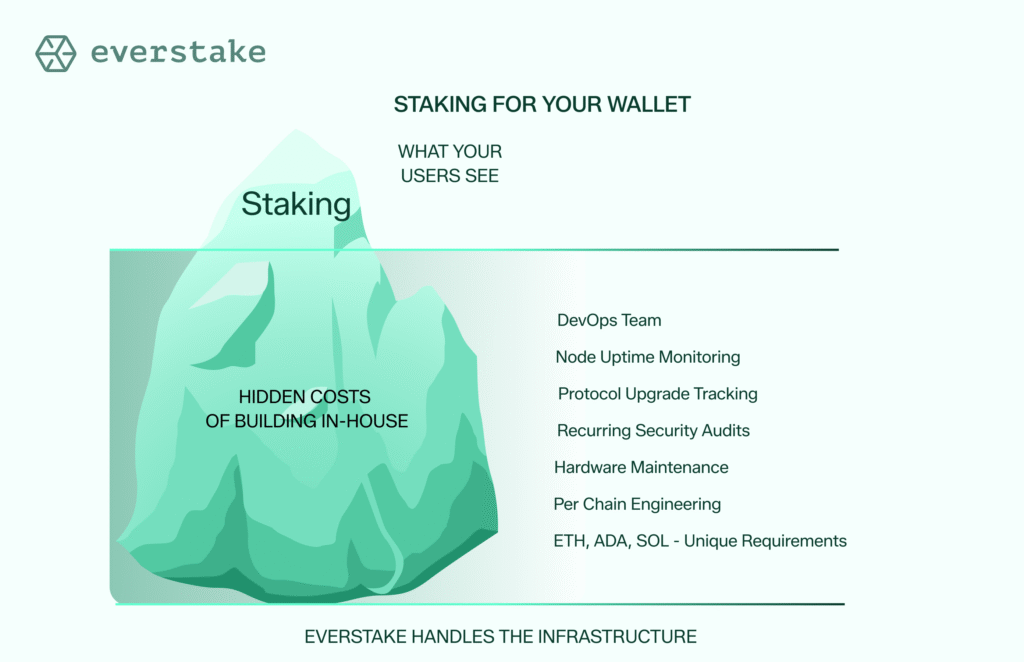
Building and maintaining staking infrastructure in-house is a resource-intensive endeavor. It requires dedicated DevOps teams to manage node uptime, monitor protocol upgrades, and ensure security. Each blockchain has unique requirements, so a staking implementation for Ethereum differs significantly from one for Solana or Cardano. These hidden costs, ranging from hardware maintenance to recurring security audits, often make internal builds prohibitively expensive for all but the largest institutional players.
The Partnership Alternative
Rather than building from scratch, wallets can utilize a “plug-and-play” model. Integrating an established staking API can unlock rewards overnight while maintaining their focus on user experience and core wallet functionality. This approach allows wallets to leverage the reliability of established validators while retaining control over their brand.
How the Everstake Wallet SDK & API Works
The Everstake Wallet SDK and API serve as a non-custodial staking layer that bridges the gap between the wallet interface and the validator nodes. Because the solution is non-custodial, the wallet remains the sole holder of the private keys, and Everstake merely facilitates the communication between the user’s wallet and the blockchain’s staking contracts.
The Integration Path: Step by Step
Integrating the API is designed to be a streamlined process, typically following five key stages.
- Access and Onboarding: Partners begin with API key provisioning and access to a sandbox environment. This allows developers to test interactions without risking real assets. A dedicated onboarding call ensures the technical team understands the specific requirements of the chosen networks.
- Network and Asset Selection: Wallets can choose from a wide range of supported chains, including Ethereum (ETH), Solana (SOL), Cardano (ADA), Cosmos (ATOM), and more. Operators can configure which networks to expose to their users based on their target demographic.
- Staking Flow Integration: The integration utilizes delegation endpoints. When a user decides to stake, the wallet generates a transaction, which the user signs locally. The API then broadcasts this to the network. Throughout this process, reward-tracking data endpoints provide real-time information to the wallet’s UI.
- Unstaking and Withdrawal Handling: Managing the lifecycle of a stake is as critical as the initial delegation. The API handles the complexities of unbonding periods, exit queues, and webhook notifications to keep users informed of when their assets will be liquid.
- Dashboard and Analytics: Partners gain access to a dedicated portal. This provides high-level visibility into total staked volume, rewards distributed, and overall user activity, allowing for data-driven product decisions.
Technical Requirements
The solution is delivered via a REST API and a mobile- and web-compatible SDK. With minimal engineering lift, the average integration timeline is significantly shorter than an internal build.
Security remains the highest priority, and the architecture ensures that no private key is exposed at any point in the transaction lifecycle.
White-Label Customization
One of the primary advantages of the Everstake SDK is its branding flexibility. The staking feature is designed to look and feel like a native part of the wallet’s own ecosystem.
There is no strict requirement for Everstake branding within the user-facing interface, although optional co-branding is available for partners who wish to leverage Everstake’s reputation as an industry-leading validator. This way, the wallet maintains its brand integrity while providing a professional-grade staking service.
Revenue Model: How Wallets Earn from Staking
The partnership is built on a sustainable revenue-share structure that aligns the interests of the wallet, the validator, and the user.
Understanding the Structure
Everstake charges a commission on the rewards generated by the validator nodes.
When a wallet integrates via the API, a portion of that commission is shared with the wallet operator. Importantly, this model is non-dilutive to user rewards.
The wallet earns its share from the validator’s existing fee, meaning the user’s advertised staking rewards rate remains competitive and unaffected.
Revenue-Share Tiers
Commercial terms are structured to support wallets at various stages of growth:
| Tier | Profile | Description |
| Standard | Entry-level partners | Baseline revenue-share percentage, ideal for early-stage wallets establishing a footprint. |
| Growth | Mid-market wallets | Increased revenue-share unlocks as the wallet reaches meaningful staked volume. |
| Strategic | Institutional platforms | Custom commercial terms and deeper integration support for high-volume operators. |
Revenue Projections
To illustrate the potential, consider a wallet with 100,000 Monthly Active Users (MAU). If 5% of those users stake an average of $2,000 each in assets, the wallet manages a $10M staked balance.
Based on average network rewards and commission splits, this could generate a consistent monthly reward stream with zero maintenance overhead.
The Everstake Partner Ecosystem
Everstake’s infrastructure currently powers staking for some of the industry’s most recognized names. These partners have integrated Everstake to provide their users with reliable, high-uptime staking across dozens of blockchains.
- MetaMask Portfolio and Trust Wallet: Facilitating seamless staking for millions of mobile and browser-based users.
- Hardware Wallets (Trezor and Ledger): Providing secure, cold-storage staking options for security-conscious investors.
- Exodus: Utilizing the API to offer a simplified, one-click staking experience across multiple assets.
Beyond the API: Comprehensive Support
A partnership with Everstake extends beyond technical documentation.
- Dedicated Support: Every partner is assigned a success manager and provided with direct communication channels (Slack or Telegram) for technical queries.
- Reliability: With a multi-year track record and an industry-leading uptime SLA, Everstake ensures your users rarely experience downtime, protecting your brand’s reputation.
- Compliance and Security: Everstake provides comprehensive audit reports and maintains a GDPR-compliant architecture, and holds SOC 2 Type II, ISO 27001, NIST CSF 2.0, CCPA, and ITGC certifications. No sensitive user data is retained, simplifying the regulatory burden for wallet operators.
- Co-Marketing: Partners can benefit from joint announcements, features in the Everstake partner directory, and social media amplification to drive user adoption of the new staking features.
Addressing Common Technical and Business Concerns
“We want to run our own validators eventually.”
The API is an excellent starting point. It allows you to capture market share and generate rewards immediately. If your volume grows to a scale where self-operating nodes make sense, Everstake supports migration paths to help you transition smoothly.
“Our users are in regulated jurisdictions.”
The non-custodial model is fundamentally different from custodial “Earn” programs. Because the user retains control of their keys and interacts directly with the protocol, it may often fall into a different regulatory category. Everstake provides the necessary documentation to assist your legal team in their review.
“How long does integration take?”
While timelines vary based on the complexity of your UI, a standard integration typically moves from API access to production within 2 to 4 weeks.
Getting Started
Adding staking to your wallet does not have to be a multi-month engineering project. By leveraging Everstake’s existing infrastructure, you can enable access to staking yield your users demand while securing a new, scalable revenue stream for your business.
Next Steps for Wallet Teams
- Request a Partnership Call: Reach out to our team to discuss your specific needs and view a technical demo of the API.
- Download the Partner One-Pager: Review our high-level overview of supported chains and commercial structures.
Disclaimer
The information provided is not intended for recipients residing in the United Kingdom.
Share with your network