Institutional
Institutional DeFi and Onchain Vaults: The Complete Guide
Quick Summary What Is Institutional DeFi? Institutional DeFi is the participation of regulated entities in decentralized finance protocols through structured and compliance-aware infrastructure. It is not the same as retail DeFi. A retail user can connect a wallet, sign a transaction, and interact directly with a smart contract in minutes. An institution cannot. Banks, asset...
APR 24, 2026
Last updated APR 24, 2026 · V1
Quick Summary
- Institutional DeFi comprises regulated entities accessing DeFi through compliance-ready infrastructure, not direct wallet interaction like retail users.
- Onchain vaults aggregate assets, execute rules-based strategies via smart contract, and issue tokenized shares, offering real-time transparency vs. quarterly reporting in traditional funds.
- ERC-4626 is the Ethereum standard that makes vaults interoperable, reducing operational overhead for institutions managing multiple onchain positions.
- Institutional-grade vaults require KYC whitelisting, transparent governance, custodian compatibility, and 24/7 monitoring.
- Key risks remain: smart contract exploits, protocol failures, liquidity crunches, stablecoin depegs, and evolving regulation always requires independent legal and financial due diligence.
What Is Institutional DeFi?
Institutional DeFi is the participation of regulated entities in decentralized finance protocols through structured and compliance-aware infrastructure.
It is not the same as retail DeFi.
A retail user can connect a wallet, sign a transaction, and interact directly with a smart contract in minutes. An institution cannot. Banks, asset managers, family offices, and funds operate under regulatory frameworks that require:
- custody policies,
- counterparty disclosures,
- risk controls,
- documented governance.
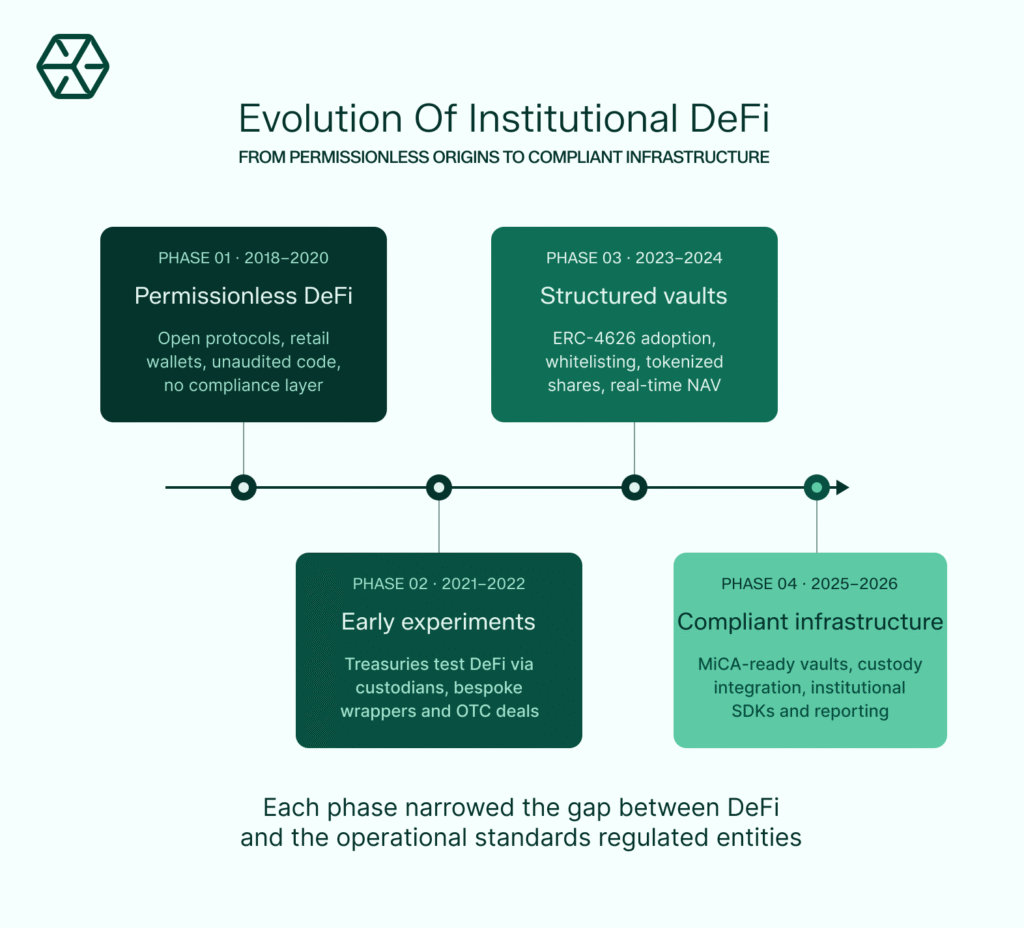
By 2026, institutional DeFi has matured into a distinct layer of the onchain economy. Protocols now build dedicated access tiers.
Vault providers design products specifically for entities that cannot accept unaudited, permissionless risk. The result is a growing market of tokenized, structured products that sit between traditional finance and open DeFi.
Why Institutions Need Structured Access to DeFi
Direct smart contract interaction introduces risks that most institutional mandates explicitly prohibit.
The core problem is not technology. Smart contracts on major chains are publicly verifiable. The problem is operational and legal. When a treasury desk or fund manager asks “how do we access DeFi,” the answer is rarely “connect a hot wallet.”
Institutions need:
- Documented custody arrangements with clear asset segregation
- On-chain positions that can be reported to risk committees
- Legal wrappers or entity structures that satisfy local regulatory requirements
- Audited contracts with third-party security verification
- Counterparty risk disclosure
The structured vault model addresses all five. It places a compliance and governance layer between the institution and raw protocol interaction. The institution holds a vault token. The vault manager handles protocol interaction, rebalancing, and operational risk.
There is also a commercial argument. DeFi protocols have historically offered higher rates than traditional money markets. Accessing those rates through structured products allows institutions to capture onchain efficiency without abandoning their compliance obligations.
What Is an Onchain Vault?
An onchain vault is a smart contract that aggregates assets from multiple sources, deploys it according to a defined strategy, and issues tokenized shares representing each depositor’s proportional claim.
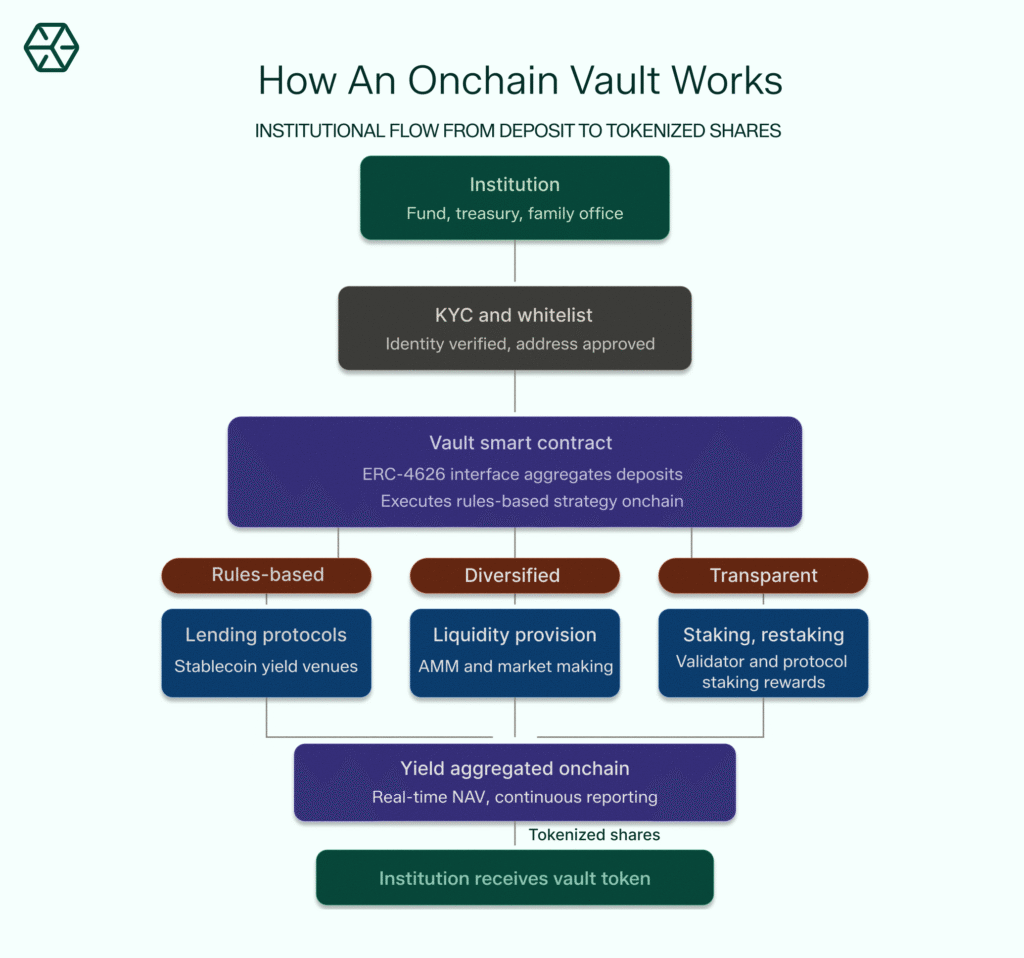
- The vault operates entirely on-chain. All deposits, strategy executions, and withdrawals are recorded on a public ledger. This is what distinguishes it from an off-chain fund: every action is observable in real time.
- Vault strategies vary widely. Some deploy assets into stablecoin lending protocols. Others use liquidity provisioning, restaking, or protocol-specific mechanisms. The key design principle is that the strategy is encoded in the contract, not decided by a manager on a discretionary basis. This reduces execution risk and makes the product behavior predictable.
- A defi vault that targets institutional participation adds access controls, KYC whitelisting, and governance mechanisms on top of the base vault logic. These elements make the vault compliant without removing its onchain nature.
ERC-4626: The Standard Behind Institutional Vaults
ERC-4626 is an Ethereum token standard that defines a common interface for tokenized vaults, making them interoperable across the DeFi ecosystem.
Before ERC-4626, every vault had a custom interface. Integrating a vault into a dashboard, analytics tool, or third-party protocol required custom engineering for each one.
ERC-4626 Core Vault Functions
ERC-4626 solved this by standardizing the core vault functions:
deposit()— accepts assets and mints shares to the depositorwithdraw()— burns shares and returns assets to the recipientredeem()— converts share amounts to asset equivalentstotalAssets()— reports the total assets in the vaultconvertToShares()andconvertToAssets()— price discovery functions
Accounting functions expose vault state: total assets under management, share-to-asset and asset-to-share price discovery, and the address of the underlying token.
Preview functions simulate each action at the current block, including fees and rounding. These are what accounting systems and NAV dashboards call for accurate pre-trade reporting.
Max functions disclose per-caller limits. For institutional vaults, this is where access controls surface: a non-whitelisted wallet sees a zero deposit ceiling; a paused redemption queue shows a zero withdrawal ceiling. Integration layers can read these values continuously without off-chain knowledge of the vault’s access rules.
For institutions, this standardization ensures that a risk system that can read one ERC-4626 vault can read all of them.
Accounting integrations, custodian reporting, and real-time NAV calculations become replicable across products. The standard is now widespread among institutional DeFi infrastructure.
- Institutional vaults typically extend ERC-4626 with access controls.
- Depositors may be whitelisted.
- Withdrawal conditions may include notice periods.
These extensions preserve compliance requirements while retaining the standard interface.
Some products use ERC-7540, a newer extension of ERC-4626 that adds native support for asynchronous deposits and redemptions.
Redemption requests enter a queue, are fulfilled when liquidity permits, and are then claimed in a separate transaction.
ERC-7540 is particularly relevant for institutional vaults with gated liquidity or strategies that require time to unwind underlying positions. Both extensions preserve the standard interface while meeting compliance and operational requirements.
Institutional DeFi vs Traditional Fund: Side-by-Side
Onchain vaults and traditional funds both aggregate assets and execute strategies, but they differ fundamentally in transparency, settlement speed, and operational overhead.
| Feature | Traditional Fund | Onchain DeFi Vault |
| Settlement | T+1 to T+2 | Near-instant, onchain |
| Transparency | Quarterly NAV reporting | Real-time, publicly visible |
| Custody | Third-party custodian required | Smart contract + qualified custodian option |
| Auditability | Annual audit, limited access | Continuous, open ledger |
| Access controls | Manual KYC, subscription docs | Whitelisted wallets, onchain KYC |
| Minimum size | Often $1M+ | Protocol-dependent, flexible |
| Counterparty risk | Fund manager, broker, custodian | Smart contract, oracle, protocol |
| Regulatory status | Licensed fund structures | Varies by jurisdiction and structure |
| Redemption | Gate provisions possible | Defined in contract, may include lockups |
The table above reflects general design differences, not universal rules. Specific onchain vault implementations vary significantly. Due diligence on individual products is always required.
High-Yield Stablecoin Vaults on Everstake’s Yield Infrastructure
Everstake’s Yield Infrastructure supports institutional access to partner-operated onchain vault products, like High-Yield Stablecoin Vaults.
Everstake provides validator operations, integration tooling, and SDK access; the vault strategies themselves are designed, managed, and risk-controlled by independent partners.
Everstake-supported High-Yield Stablecoin Vault (HYSV) is a DeFi structured vault designed specifically for institutions operating under compliance constraints.
Everstake provides the underlying staking and integration infrastructure only. Everstake does not offer investment products, manage strategies, or handle client assets.
The following strategies are created and managed by independent partners.
- Issued by Midas (token issuance/structuring)
- Managed by Apollo Crypto (strategy and risk manager, responsible for allocation, risk monitoring, NAV inputs)
- Supported by Everstake (infrastructure, integration tooling, operational layer only)
Everstake is one of the largest non-custodial staking providers globally, has supported over $7 billion in staked assets to date, onboarded 130+ networks, actively operating across 35+ Proof-of-Stake networks today. The HYSV is a separate product that brings the same operational discipline to stablecoin vault infrastructure.
Key structural features of HYSV include:
- Non-custodial, partner-operated.
- Objective: market-neutral stable asset strategy aimed at generating 7–12% indicative annual returns and deployed across DeFi venues.
- Strategy: partner-managed allocation with real-time onchain reporting of price, 7-12% indicative annual return, and redemption activity.
- Risk controls: set exclusively by strategy partners.
- Liquidity: designed for instant redemption when available according to current NAV, with asynchronous queues when liquidity is constrained.
- A live public instance (mEVUSD) is operated by Midas.
HYSV sits at the convergence of institutional compliance and DeFi efficiency. Institutions access stablecoin DeFi rates. They do so through a regulated, structured product rather than direct protocol interaction. This is the intended use case for best-in-class DeFi vaults for institutions.
What Makes a Vault Institutional-Grade
An institutional-grade vault is not simply a vault with a large TVL. Institutional-grade means it satisfies the compliance, security, and operational standards that regulated entities require.
The five defining criteria are:
- Access controls: Deposits must be restricted to whitelisted addresses. KYC or identity verification must occur before whitelist entry. Permissionless access disqualifies a vault from institutional use.
- Transparent governance: Upgrade mechanisms, parameter changes, and strategy adjustments must be governed by documented processes. Anonymous or opaque governance is a disqualifying risk.
- Custody compatibility: The vault token must be holdable by qualified custodians. This often requires ERC-20 compatibility and integration with custody platforms like Fireblocks or BitGo.
- Operational uptime and monitoring: Institutional vaults require 24/7 monitoring, incident response protocols, and documented business continuity plans.
Compliance requirements vary by jurisdiction. Institutions should engage legal counsel before committing to any onchain product. The criteria above are operational minimums, not legal advice.
How to Evaluate an Onchain Vault: A Decision Framework
Due diligence on a tokenized vault should follow a structured checklist rather than a marketing review. The following framework covers the key evaluation dimensions.
Security Layer
- What smart contract security measures are in place, and how are they verified?
- How are admin keys managed multisig, timelocks, or hardware security modules?
- What is the incident response process if a vulnerability is discovered?
Strategy Layer
- What protocols does the vault deploy assets into?
- What is the maximum concentration in any single protocol?
- Are strategy parameters fixed in code or discretionary?
- How does the vault respond to a protocol exploit or black swan event?
Compliance Layer
- What KYC/AML process governs wallet whitelisting?
- Is there a legal entity or jurisdiction of registration?
- Are there sanctions screening mechanisms at the deposit level?
- What documentation is provided for accounting and tax reporting?
Liquidity Layer
- What is the redemption process? Are there lockup periods?
- Is there a withdrawal queue? How is it prioritized?
- What liquidity conditions could delay redemption?
- What is the historical redemption fulfillment time?
Operational Layer
- Who manages the vault operationally? What is their track record?
- Is there a published incident response policy?
- Are admin keys secured through multisig or timelocks?
- Does the vault integrate with qualified custodians?
Risks
Onchain vaults carry material risks that all institutional participants must assess independently before deploying.
Smart contract risk is the most fundamental. Even audited contracts can contain exploitable vulnerabilities. Audits reduce risk but do not eliminate it. A successful exploit can result in partial or total loss of deposited assets.
Other risk categories include:
- Protocol risk: The underlying protocols a vault deploys into may be exploited, paused, or deprecated. Vault assets are exposed to this risk.
- Liquidity risk: Redemption queues, liquidity crunches, or protocol pauses may delay or prevent timely withdrawal.
- Regulatory risk: The regulatory treatment of DeFi products is evolving. A product that is compliant today may face new restrictions in relevant jurisdictions.
- Oracle risk: Price feeds that inform vault logic may be manipulated or fail. Oracle failures can affect strategy execution.
- Stablecoin risk: Vaults holding USDC or USDT are exposed to issuer risk, depeg events, and regulatory actions targeting stablecoin issuers.
- Governance risk: Changes to vault parameters or strategy through governance may affect expected behavior.
Frequently Asked Questions
What is the difference between an onchain vault and a traditional fund?
An onchain vault operates via smart contract on a public blockchain. All transactions are visible in real time. A traditional fund uses legal agreements, third-party custodians, and periodic reporting. Settlement in a traditional fund takes days. An onchain vault settles in seconds. Governance and strategy logic in a vault are encoded in the contract, not managed by a discretionary committee.
What is ERC-4626 and why does it matter for institutional DeFi?
ERC-4626 is a standardized interface for tokenized vaults on Ethereum. It defines how vaults accept deposits, issue shares, and process withdrawals. Standardization means vault positions are readable by any compliant analytics, custody, or reporting tool. It eliminates the need for custom integrations with each vault. For institutions managing multiple onchain positions, this reduces operational overhead significantly.
What is Everstake HYSV?
HYSV (High-Yield Stablecoin Vault) is a category of non-custodial, partner-operated stablecoin vault products supported by Everstake’s Yield Infrastructure, with strategy and risk managed by independent partners. The live public instance, mEVUSD, is issued by Midas and managed by Apollo Crypto, denominated in USDC, and targets an indicative 7–12% annual return for whitelisted institutional wallets.
Are DeFi vaults safe for institutional use?
No DeFi vault is without risk. Institutional-grade vaults minimize risk through audits, access controls, governance transparency, and operational monitoring. However, smart contract exploits, protocol failures, and regulatory changes remain real possibilities. Institutions should treat DeFi vault participation as a risk-managed allocation, not a risk-free position.
How do institutions handle custody of vault tokens?
Vault tokens are typically ERC-20 compatible and can be held by qualified custodians. Platforms like Fireblocks, BitGo, and Anchorage support institutional custody of tokenized positions. Institutions should confirm that their chosen custodian supports the specific vault token before depositing. Some vaults also offer integration support for common custody platforms.
What regulatory frameworks apply to institutional DeFi participation?
Regulatory treatment varies by jurisdiction and product structure. In the European Union, the MiCA regulation (Markets in Crypto-Assets) introduced a framework for crypto-asset service providers in 2024. In the United States, regulatory clarity remains fragmented across the SEC, CFTC, and FinCEN. Institutions must assess how their specific jurisdiction classifies onchain vault products. Independent legal counsel is required.
What is the minimum required to access institutional DeFi vaults?
Minimums vary by product. Some vaults set formal minimums, such as $100,000 or $500,000. Others are accessible at lower thresholds but impose higher compliance requirements for smaller entities. Practical minimums are also driven by gas costs on Ethereum. For smaller institutional allocations, Layer 2 deployments may offer better efficiency.
Disclaimer:
Everstake acts solely as a technical provider. Everstake does not engage in the provision of investment advice, portfolio management, brokerage services, custody of client funds, or any other regulated service, does not perform any regulated brokerage or dealing services, does not act as a fiduciary, agent, advisor, or representative authorized to act on behalf of the users.
This article is for informational purposes only. Nothing in this article constitutes legal, tax, financial, or investment advice. Institutions should conduct independent due diligence and consult qualified advisors before engaging with any DeFi protocol or vault product. Past performance of any protocol or vault does not indicate future results.
The information provided is not intended for recipients residing in the United Kingdom.
Share with your network