
Institutional
web3 infrastructure
The White-Label Model: How Custodians Can Offer Staking Without Becoming a Validator
Learn how custodians can offer branded staking services without running a single node, using white-label validator infrastructure.
MAR 16, 2026
Last updated JUL 09, 2026 · V1
- For custodians, an attempt at building an in-house staking infrastructure would divert significant resources from core security functions, thus bringing about new operational and financial risks.
- The solution to this complex is to delegate those complexities to a professional validator.
- White-label staking allows custodians to offer a branded, seamless staking experience while offloading the technical and operational burden to a specialized provider like Everstake.
- This model enables platforms to bridge the gap between secure asset custody and active network participation, without ever needing to spin up a single node.
What is White-Label Staking?
White-label staking is a strategic partnership that separates the front-end user experience from the back-end technical execution.
In simpler terms, a specialized infrastructure provider runs and maintains the validator nodes on behalf of the custodian who, in turn, retains its brand and UI and UX.
To the end user, the experience is entirely native: they stake directly through their trusted custodian. Behind the scenes, the complex machinery of node operation is managed by a team of DevOps engineers.
The Invisible Infrastructure: A B2B2C Delivery Model
Unlike “direct staking,” where a user delegates tokens to a public validator and manages the process themselves, white-label staking operates on a B2B2C (Business-to-Business-to-Consumer) model.
The staking provider builds the institutional infrastructure (B2B), and the custodian delivers the simplified service to their clients (B2C). The infrastructure remains invisible to the end user, who benefits from a frictionless experience without having to vet validators or understand the nuances of protocol-specific delegation.
Self-Custodial by Design
The most critical aspect of this model is its security architecture. While infrastructure operations are outsourced, control of private keys remains entirely with the custodian.
Staking providers like Everstake operate on a non-custodial (otherwise known as self-custodial) basis. They provide the hardware, uptime, and technical maintenance required to validate blocks, but they never have access to the actual assets.
The funds remain locked in the custodian’s secure environment, thus neutralizing counterparty risk regarding asset theft.
The Operational Risks of Going it Alone
For a custodian, the allure of capturing 100% of staking rewards by building an in-house solution is often overshadowed by the harsh realities of running a node. Running institutional-grade validators is a 24/7/365 endeavor fraught with hidden costs and systemic risks.
- The Engineering Overhead: Modern blockchain ecosystems are highly fragmented and incredibly volatile. Managing a single network requires dedicated DevOps engineers. Managing even dozens of chains, let alone more, is a monumental undertaking. Protocols undergo constant updates, emergency patches, and hard forks.
A custodian attempting to manage this in-house must maintain a massive engineering team solely dedicated to tracking protocol changes, syncing nodes, and managing infrastructure upgrades across entirely different consensus mechanisms. - The Slashing Threat: In Proof-of-Stake networks, if a validator goes offline for an extended period, or worse, double-signs a block due to a misconfigured active-passive backup setup, a portion of the staked assets is permanently destroyed by the network.
For a custodian, a slashing event would be a catastrophic reputational failure. The cost of a single misconfiguration can easily outweigh years of accrued staking revenue. - Compliance Barriers: Institutional custodians operate under strict regulatory scrutiny. Adding a complex secondary service, such as node operation, significantly complicates compliance.
Achieving and maintaining certifications like SOC 2 Type II or ISO 27001 requires rigorous audits of all operational processes. Attempting to certify a nascent, in-house staking operation can delay core product launches and drain compliance budgets, whereas partnering with an already-certified provider instantly bypasses this hurdle.
Key Benefits of the White-Label Model for Custodians
Adopting a white-label staking architecture transforms a heavy operational burden into a streamlined, revenue-generating product feature. The benefits extend across technical, financial, and marketing domains.
- Faster Time-to-Market: Building an in-house staking solution can take months or even years of development, testing, and security auditing. By leveraging a white-label solution, custodians can launch comprehensive staking services for dozens of protocols in a matter of weeks.
- Brand Continuity: Client trust is a custodian’s most valuable asset. The white-label model ensures that users remain entirely within the custodian’s ecosystem. There is no redirecting to third-party dashboards, no confusing external branding, and no disruption to the user journey. The staking flow feels like a natural extension of the custody platform.
- Monetization and Revenue Sharing: White-label staking is a powerful new revenue stream. Custodians can negotiate base fee structures with the infrastructure provider and then set their own commission rates for their end users. Thus, they can monetize the service effectively, turning a complex technical requirement into a highly scalable business unit.
- Customization: A true white-label solution offers deep customization. Custodians can choose to operate under custom validator names, reinforcing their brand on-chain. Furthermore, they can make crucial protocol-level choices, such as selecting specific Maximum Extractable Value (MEV) relays to ensure compliance with internal requirements (e.g., OFAC-compliant transaction filtering).
Seamless Integration
The transition from traditional custody to a staking-enabled platform is facilitated through modern, developer-friendly integration pathways designed specifically for institutional workflows.
- API-First Approach: The core of the white-label model is an API-first architecture. Providers like Everstake offer a unified White-Label Staking API that normalizes the complexities of different blockchains into a single, cohesive interface. This way, custodians can automate user onboarding, trigger staking and unstaking transactions, and query network states programmatically without building bespoke integrations for Ethereum, Solana, Cosmos, and other networks.
- Ecosystem Compatibility: White-label providers ensure deep compatibility with industry-standard custody stacks. Whether a platform uses Fireblocks, BitGo, Anchorage, or a proprietary HSM (Hardware Security Module) setup, the staking workflows are designed to integrate natively with these existing transaction-signing and policy-engine frameworks.
- Reporting and Analytics: Institutional clients require institutional reporting. Scraping blockchain explorers for reward data is not a scalable solution. White-label infrastructure provides comprehensive, audit-ready data feeds. Custodians can access granular historical reports on rewards generated, commission applied, and validator performance, which can be piped directly into the custodian’s client-facing statements and internal accounting systems.
Why Everstake for White-Label Solutions?
The choice of infrastructure provider dictates the security and success of the custodian’s offering. Everstake is the premier partner for institutional white-label staking in reliability, security, and compliance.
- Institutional-Grade Reliability: Everstake maintains a proven 99.98% uptime across its infrastructure, historically supporting over $7 billion in staked assets.
- The “Full Stack” Certification: Everstake is unique in its commitment to verifiable security, standing as the only provider to hold a comprehensive 5-pillar certification suite: SOC 2 Type II, ISO 27001, NIST, GDPR, and CCPA. For a custodian conducting its own vendor risk assessments, this full-stack compliance profile drastically accelerates due diligence and provides true peace of mind.
- Geographic Redundancy: To eliminate single points of failure, Everstake leverages a highly distributed, bare-metal infrastructure. By operating enterprise-grade hardware across multiple geographic regions and diverse data centers, Everstake isolates its validators from localized outages, cloud provider blackouts, and regional network disruptions.
Real-World Applications
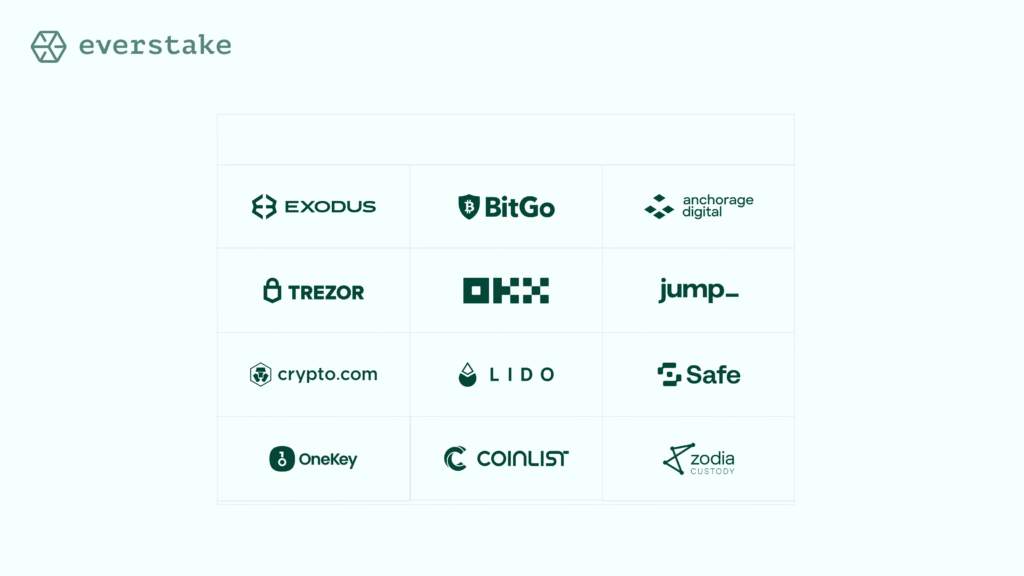
Taurus, Zodia Custody, and Trezor are among the infrastructure providers and custodians that have adopted the white-label model. Each has integrated natively embedded staking via B2B infrastructure APIs, enabling users to stake assets directly from secure vaults or hardware devices.
The end user interacts with a branded interface with “Stake” and “Unstake” controls, without visibility into the geo-redundant server clusters and 24/7 DevOps monitoring operating underneath.
Scale Effortlessly
For custodians, integrating digital assets into their suites requires a strategic assessment of core competencies. A custodian’s primary directive is the unassailable security of client assets and the delivery of exceptional financial services.
Enabling the white-label model allows custodians to maintain this focus while leaving staking experts to handle the hardware, hard forks, and late-night protocol updates. This way, custodians can deploy a fully branded staking product that scales effortlessly with the future of the decentralized web.
Learn more:
Frequently Asked Questions
What is white-label staking?
White-label staking is a partnership model in which a specialized infrastructure provider, such as Everstake, runs and maintains validator nodes on behalf of a custodian. The custodian retains its own brand, UI, and UX; the end user stakes directly through their trusted platform without any visibility into the underlying infrastructure.
How does white-label staking differ from direct staking?
In direct staking, a user delegates tokens to a public validator and manages the process independently. In the white-label model, the staking provider builds institutional infrastructure for the custodian (B2B), and the custodian delivers that service to its clients (B2C).
Does the staking provider ever control client assets?
No. Everstake operates on a non-custodial basis. Private keys remain entirely with the custodian at all times. Everstake provides the hardware, uptime, and technical maintenance required to validate blocks but has no access to the underlying assets.
What are the main risks of building in-house staking infrastructure?
Custodians that build in-house face 3 categories of risk:
- Managing protocol updates, hard forks, and node syncing across multiple chains requires a dedicated DevOps team.
- Slashing: a misconfigured active-passive backup setup can cause double-signing, permanently destroying a portion of staked assets on Proof-of-Stake networks.
- Certifying a nascent in-house staking operation for SOC 2 Type II or ISO 27001 can delay core product launches and drain compliance budgets.
How quickly can a custodian launch staking services using the white-label model?
Building an in-house staking solution can take months or years of development, testing, and security auditing. White-label integration allows custodians to launch staking services for dozens of protocols in weeks.
What certifications does Everstake hold?
Everstake holds a 5-pillar certification/attestation suite: SOC 2 Type II, ISO 27001, NIST, GDPR, and CCPA. This compliance profile accelerates vendor due diligence for custodians conducting their own risk assessments.
What uptime does Everstake’s infrastructure guarantee?
Everstake maintains 99.98% uptime across its infrastructure, historically supporting over $7 billion in staked assets.
How does white-label staking integrate with existing custody stacks?
Everstake offers a unified White-Label Staking API that normalizes multi-chain complexity into a single interface. The staking workflows are designed to integrate natively with custody stacks including Fireblocks, BitGo, Anchorage, and proprietary HSM (Hardware Security Module) setups.
Can custodians customize the staking service for compliance purposes?
Yes. Custodians can operate under custom validator names and select specific MEV (Maximum Extractable Value) relays — for example, OFAC-compliant transaction filtering — to meet internal compliance requirements.
What reporting capabilities does white-label staking infrastructure provide?
White-label infrastructure provides audit-ready data feeds covering validator performance, commission applied, and historical reward data. These feeds can be integrated directly into custodian internal accounting systems.
Disclaimer
The information provided is not intended for recipients residing in the United Kingdom.
Share with your network