ethereum
Ethereum’s Historic Staking Milestone: Over 50% of Supply Passes Through PoS Contract
Ethereum just crossed a meaningful threshold, as more than half of ETH ever issued has passed through Ethereum’s Proof-of-Stake (PoS) deposit contract. As of February 2026, the PoS contract holds approximately 80.95 million ETH, representing 50.18% of the historical issuance before accounting for token burns via mechanisms like EIP-1559. This milestone, highlighted by on-chain analytics...
FEB 20, 2026
Last updated JUL 07, 2026 · V1
Ethereum just crossed a meaningful threshold, as more than half of ETH ever issued has passed through Ethereum’s Proof-of-Stake (PoS) deposit contract.
As of February 2026, the PoS contract holds approximately 80.95 million ETH, representing 50.18% of the historical issuance before accounting for token burns via mechanisms like EIP-1559.
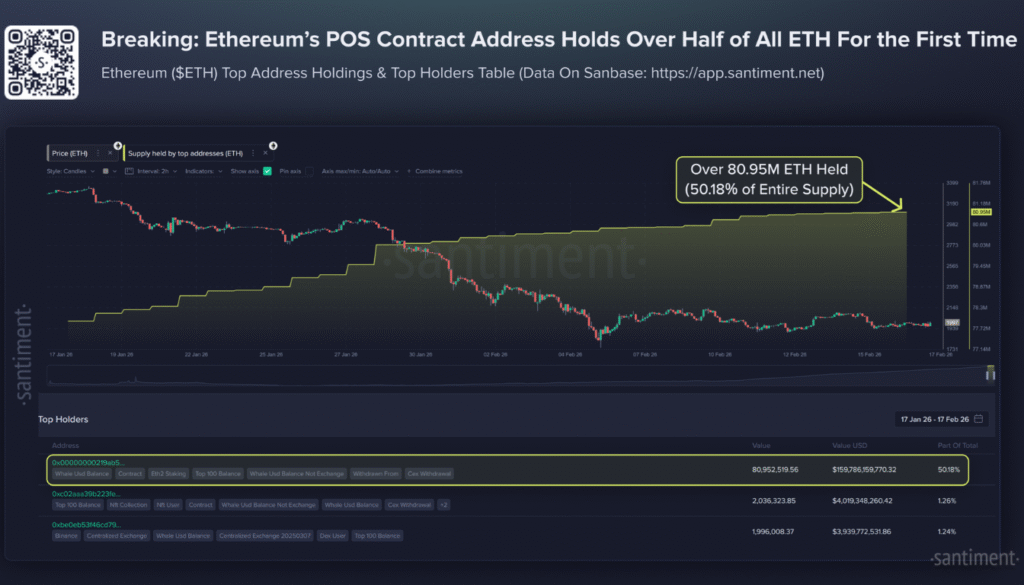
This milestone, highlighted by on-chain analytics firm Santiment, is a focal point of Ethereum’s continuous evolution into a full-fledged ecosystem.
But what does this really mean for Ethereum’s future?
In this article, we’ll break down the significance of this event, its impact on network dynamics, and the crucial role of staking providers in shaping the landscape.
Understanding the Milestone: Cumulative Deposits vs. Active Staking
To grasp the importance, it’s essential to differentiate between the deposit contract’s balance and the actual ETH actively staked on the network.
As a part of Ethereum’s transition from Proof-of-Work to Proof-of-Stake, the deposit contract serves as a one-way vault where users lock ETH to become validators and secure the blockchain.
ETH sent to the deposit contract is not directly retrievable. Upon validators exit, their principal and rewards are freshly minted on the Ethereum mainnet.
This mechanic means the contract’s balance only grows with new deposits and never decreases, even as net staking fluctuates.
The 80.95 million ETH figure represents cumulative deposits over time, not the current locked amount.
The active staked ETH (the portion truly securing the network) stands at around 37.3 million ETH, or approximately 30.5% of the current circulating supply of about 122 million ETH.
Critics have called the 50% headlines “misleading” because it overstates the effective staking rate, but it still symbolizes strong long-term commitment from holders.
This crossing of the 50% threshold reflects Ethereum’s deflationary trends and growing appeal as a staking asset, especially in times of rapid institutional adoption.
Why This Milestone Matters: Security, Supply Dynamics, and Market Confidence
Crossing the threshold of over 50% of historical supply in the deposit contract signals several key developments for Ethereum:
- Enhanced Network Security: In PoS, security scales with the amount of ETH staked, attackers would need to control a majority (over 50%) of active staked ETH to compromise the network, a costly endeavor known as a “51% attack.” With active staking now exceeding 30% (37.3 million ETH), majority control will require enormous resources.
This milestone reinforces Ethereum’s position as a secure settlement layer for high-value transactions, surpassing other blockchains in staked value and making it increasingly resistant to attacks. - Reduced Liquid Supply: As more ETH flows into staking, the available supply on exchanges and in wallets shrinks. According to basic economic principles, this reduction in liquid supply increases market sensitivity to sudden changes in demand.
- Ecosystem Progress: Crossing this threshold highlights growing interest in PoS, adopted fully with The Merge in 2022. It also aligns with broader trends like the rise of real-world asset tokenization and stablecoins on Ethereum, where over 50% of stablecoin supply is issued.
- Confidence: More and more users choose to stake. Overall, it’s a sign that Ethereum is getting closer to becoming a “security settlement layer,” where staking underpins not just consensus but also confidence in the network.
Opportunities for Validators and Delegators
Staking providers, or validators are the backbone of Ethereum’s PoS system. They operate nodes to validate transactions, earning rewards in return.
As of February 2026, the validator landscape shows a total of almost 1 million active validators managing 37.3 million staked ETH. Just a few months earlier another important milestone was achieved: the Ethereum validator entry queue reached record high. The momentum continues.
Ethereum network activity reached its ATH at the start of 2026. Daily transactions have risen more than 100% year over year, daily active addresses have doubled, and tokenized real-world assets are increasingly moving through layer-2 networks that settle back to Ethereum’s base layer.
High Time to Stake
Collectively, these trends signal a network scaling in both throughput and utility, solidifying its position as the foundational infrastructure for decentralized finance.
Everstake remains committed to securing the Ethereum mainnet and supporting its long-term decentralization.
The current environment is particularly reassuring, as liquid supply tightens, it is reflected in the market’s sensitivity to activity spikes.
By staking now, participants are the first in line to absorb the effects of both reduced supply and massive institutional interest.
Conclusion
Since more than half of all ETH ever issued has now passed through the staking contract, Ethereum has crossed another structurally meaningful threshold.
Higher staking participation enhances network security and reduces liquid supply. It opens the way to channel capital toward ETH as core settlement infrastructure for onchain finance.
As more ETH enters staking, a growing share generates rewards through validator participation. Crossing the 50% staked threshold signals a structural evolution, where security is fueled by long-term conviction instead of speculation, making it a major signal of the protocol’s stability.
***
***
All metrics displayed on the website, including without limitations value of staked assets, total number of active users, rewards rates, and networks supported, are historical figures and may not represent the actual real-time data.
Share with your network