solana
How to Stake Solana (SOL) in 2026: Complete Guide
TL;DR Whether you hold a handful of SOL or a significant position, staking is one of the most transparent ways to participate in securing the network. This guide extensively covers the available staking methods. Solana changed minimum amount of stake from 0.01 SOL to 1 SOL as of June 18, 2026. The change affects only...
APR 17, 2026
Last updated JUL 10, 2026 · V1
TL;DR
- Two ways to participate: You can stake SOL either as a delegator or by running your own validator.
- Epoch system: Stake activation and deactivation only happen at epoch boundaries (~every 2 days), meaning you wait up to a few days before receiving staking rewards or accessing unstaked SOL.
- Five staking methods: Native delegation, liquid staking, staking pools, CEX staking, and running a validator. Each trades off custody, liquidity, risk, and complexity differently.
- Rewards are inflation-driven: Payouts come from Solana’s inflation schedule (currently ~3.9% annually, declining toward 1.5%), distributed proportionally by stake weight and validator vote performance, minus commission.
- No active slashing: Unlike Ethereum, Solana currently enforces no slashing penalties. The staked balance is not at risk from protocol-level punishment, though validator underperformance can reduce your rewards.
- Validators face real economics: Vote fees cost ~1 SOL/day regardless of stake size, so small validators often operate at a loss until they attract enough delegation to cover hardware and voting costs.
Whether you hold a handful of SOL or a significant position, staking is one of the most transparent ways to participate in securing the network. This guide extensively covers the available staking methods.
Solana changed minimum amount of stake from 0.01 SOL to 1 SOL as of June 18, 2026. The change affects only new stakes. No action is required from users.
Check out the current minimum delegation amount on our staking dashboard.
How Solana Staking Works
Proof-of-Stake and Solana’s Consensus
Solana secures its network through a variant of Proof-of-Stake (PoS) combined with a mechanism called Tower BFT, a PoS-based implementation of Practical Byzantine Fault Tolerance built on top of Solana’s Proof of History (PoH) clock.
- PoH timestamps transactions cryptographically before consensus runs, letting validators agree on transaction ordering without heavy back-and-forth communication.
- The result is one of the fastest production blockchains in existence, targeting 50,000+ transactions per second with fast block times with optimistic confirmation in under a second, though full finality takes roughly 12–13 seconds under Tower BFT.
- The staking mechanism is keeping the network honest. Validators put SOL at stake introducing economic skin in the game which aligns their incentives with network health.
- If validators behave correctly, they receive staking rewards. If they don’t, they risk penalties.
The Role of Validators and Delegators
What validators do:
- run full nodes,
- process transactions,
- vote on blocks,
- and receive SOL staking rewards.
Running a validator is technically demanding, capital-intensive, and carries real operating costs.
- Delegators are token holders who assign their staking weight to a validator without giving up custody of their SOL.
- The tokens remain in the delegator’s possession. Only the economic influence is lent to the validator.
- In return, the validator shares a portion of block rewards with delegators, after deducting their commission.
This delegation model is what makes staking accessible to ordinary SOL holders.
Understanding Solana Epochs
Solana organizes time into epochs: discrete periods of approximately 432,000 slots each. At Solana’s current slot rate, one epoch lasts roughly two days.
The critical point: stake activation and deactivation do not happen continuously. They happen only at epoch boundaries.
What this means in practice:
- If you delegate SOL partway through an epoch, your stake will not become active until the next epoch begins, one epoch after that your stake will begin generating staking rewards.
- Depending on when you stake, that could mean waiting around four days before you see your first reward.
- Similarly, if you initiate unstaking (deactivation), your stake enters a cooldown phase.
- It will not be fully withdrawable until the current epoch ends and the following one begins. No rewards are available during this cooldown window.
Stake Accounts vs Token Accounts
Solana uses two distinct on-chain account types that are worth distinguishing:
- A token account holds SPL tokens which is the standard for fungible tokens on Solana.
- A stake account is a purpose-built account created when you delegate SOL natively:
- It records your delegation, the validator you chose, and your stake’s current activation state.
- When you stake through Phantom or Solflare, the wallet creates and manages this stake account automatically.
- When you unstake, the account is deactivated and your SOL eventually becomes withdrawable.
Solana Staking Requirements
For Delegators (No Minimum)
There is no official minimum SOL to delegate.
In practice, you need enough to cover the rent exemption for the stake account (~0.00228 SOL) plus whatever amount you actually want to stake.
For Validators (Hardware, Stake, Vote Credits)
Running a validator is a different proposition entirely.
The Solana Foundation’s current hardware recommendations call for high-end server-grade machines:
- a modern CPU with 12+ cores,
- 256–512 GB of RAM,
- enterprise NVMe SSDs with high IOPS,
- a 10 Gbps or faster network connection. Purpose-built or co-located server infrastructure is the standard.
Beyond hardware, validators must pay vote transaction fees continuously to participate in consensus.
These voting costs run to approximately 1.1 SOL per day, which means a validator must get sufficient block rewards to cover its own operating expenses. Validators with low delegated stake may operate at a loss.
Minimum SOL to Stake
- As a delegator: effectively none (beyond the small rent exemption).
- As a validator: the hardware and vote fee economics effectively require significant delegated stake. There is no protocol-enforced minimum for validators.
Ways to Stake Solana
There are five main methods for staking SOL, each suited to a different profile of holder.
Solana Staking Methods Comparison:
| Method | Min SOL | Custody | Skill Level | Liquidity | Main Risk |
| Native delegation | ~0 | Self (wallet) | Low | Epoch-based unstaking | Validator performance |
| Liquid staking (e.g. JitoSOL) | ~0 | Smart contract | Low | Instant via LST | Smart contract, depeg |
| Staking pool | ~0 | Smart contract | Low | Protocol-dependent | Pool operator |
| CEX staking | ~0 | Custodial | Very low | Exchange-dependent | Counterparty |
| Running a validator | 5,000+ SOL + hardware | Self | Very high | Locked while voting | Operating costs, missed rewards |
Native Delegation to a Validator
Native staking means delegating your SOL directly to a validator of your choice through a Solana wallet like Phantom, Solflare, or via CLI.
- Your SOL stays in your wallet; only the delegation is recorded on-chain through a stake account.
- Rewards accumulate epoch by epoch and are compounded to your stake. In order to access the rewards as liquid SOL, users need to go though the unstaking which remains subject to the epoch-based unstaking cooldown.
- Native staking gives you the most direct exposure to validator rewards and lets you choose your validator based on performance, commission rate, and decentralization considerations.
- It is the most transparent method and avoids smart contract risk entirely.
Liquid Staking
Liquid staking protocols accept your SOL, stake it across a set of validators, and give you a liquid staking token (LST) in return like JitoSOL from Jito for example. This LST represents your staked position and accrues value as rewards accumulate. Crucially, the token is freely transferable and usable in DeFi protocols.
The trade-off: users may be exposed to smart contract risk and, in extreme scenarios, depeg risk.
Staking Pools
Staking pools aggregate SOL from many holders and delegate across validators. Some pools issue a receipt token, while others simply track balances internally.
The Solana Foundation operates a stake pool program that is widely used. Pools are generally beginner-friendly and spread validator risk automatically.
Centralized Exchange Staking
The exchange handles everything.
The cost is custody and control. Your SOL sits on the exchange’s balance sheet, not in your own wallet.
Reward rates may be lower than native staking because the exchange takes a cut, and users may be exposed to counterparty risk: insolvency or frozen withdrawals.
Running Your Own Validator
Validators get both their commission from delegators and the full block rewards on their own staked SOL, but it requires
- sustained technical operation,
- significant capital,
- acceptance of operational risks.
For most retail holders, running a validator may not be considered practical, due to high operational and maintaining costs.
How to Stake Solana Step by Step
Staking SOL with Phantom Wallet

Phantom is the most widely used Solana wallet and has a smooth native staking interface.
1. Open Phantom and ensure you have SOL in your wallet. Keep a small amount (at least 0.01 SOL) unstaked to cover transaction fees.
2. Tap or click the SOL asset in your portfolio to open the SOL detail view.
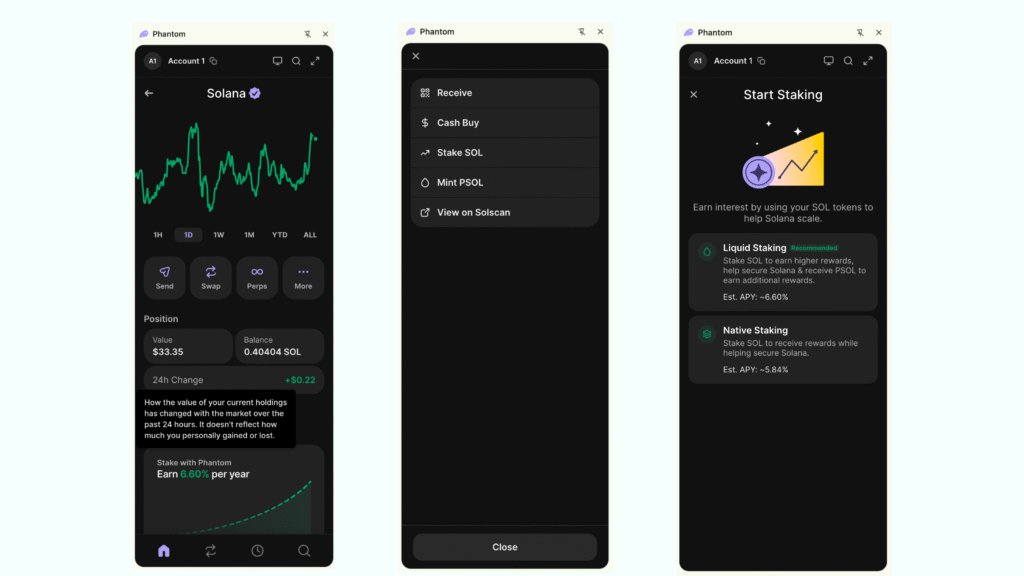
3. Select “More” and “Stake”.
Phantom will display a list of validators with performance metrics and commission rates. Take a moment to review: lower commission is not always better if the validator has poor uptime.
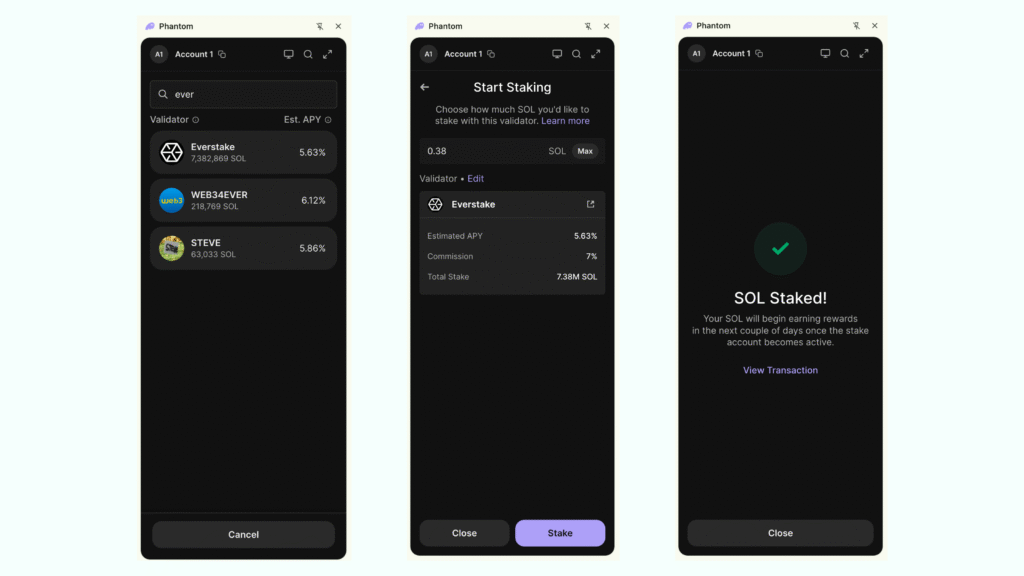
4. Choose a validator and enter the amount of SOL you want to stake. Confirm the transaction.
5. Phantom creates a stake account on-chain. Your SOL will show as “activating” until the next epoch begins, at which point it becomes active.
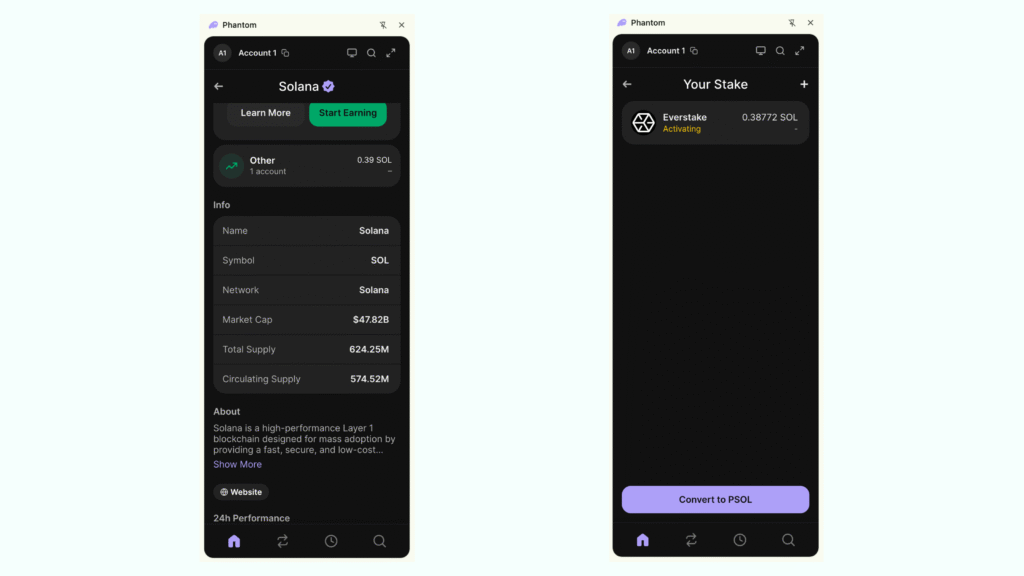
6. To unstake: navigate to your staking section, select your active stake, and choose “Unstake.” Your SOL will enter the deactivation cooldown and be withdrawable at the end of the current epoch.
Everstake has established itself as a reliable institutional-grade node operator, delivering 99.98% uptime, providing staking infrastructure on Solana since its early days.
Staking SOL with Solflare

Solflare is a Solana-native wallet with particularly detailed staking tooling, including a validator analytics view that surfaces epoch performance data.
- Open Solflare and connect or create your wallet. Fund it with SOL.
- Navigate to the Staking tab in the main menu.
- Click “Stake Now” and browse the validator list. Solflare shows annual estimates, and total staked, so users can compare options.
- Select your validator, enter your stake amount, and click “Stake.” Approve the transaction.
- Your new stake account will appear in the Staking tab with its current status (activating, active, deactivating).
- Read the full guide on How to Stake SOL with Solflare Wallet.
Staking SOL with Ledger Hardware Wallet
Solana staking with Ledger works through Ledger Live or by connecting your Ledger to Phantom or Solflare.
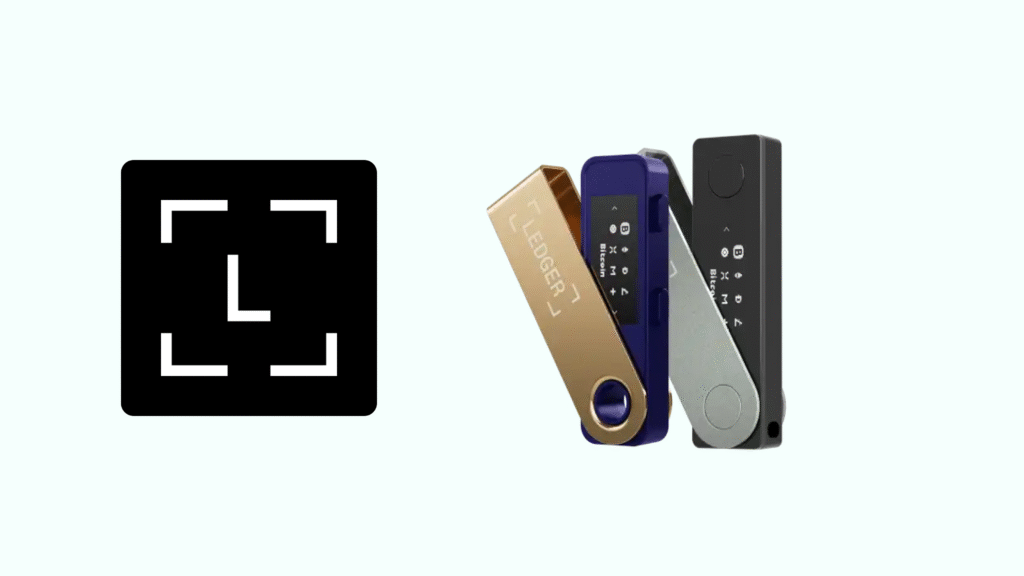
Via Ledger Live:
- Install the Solana app on your Ledger through Ledger Live’s app catalog.
- In Ledger Live, go to Accounts, select your Solana account, and click “Earn rewards.”
- Follow the on-screen prompts to choose a validator and delegate. All transaction signing happens on the Ledger device itself confirm on the hardware wallet when prompted.
- Read the full guide on How to Stake SOL with Ledger.
Via Phantom or Solflare with Ledger connected:
- Open Phantom or Solflare and choose “Connect Hardware Wallet” during setup.
- Connect your Ledger via USB, unlock it, and open the Solana app on the device.
- Once connected, your Ledger account appears in the wallet interface. Proceed with staking exactly as described in the wallet-specific sections above. Each transaction will prompt a confirmation on the Ledger device.
The Ledger workflow is slightly more friction than a software wallet, but for any meaningful SOL holding, the security trade-off is worthwhile.
Delegating to a Validator
When choosing a validator for native delegation, consider the following:
- Commission rate is the percentage of your rewards the validator keeps. Typical rates range from 0% to 10%.
- Be cautious of 0% commission validators since they may raise rates later, and zero-commission validators sometimes run at a loss long-term, creating sustainability concerns.
- Uptime and vote credits matter more than commission for staking rewards.
- A validator with 8% commission and 99.9% uptime will surpass than a 0% commission validator with 97% uptime.
Managing Your Stake Account
Once you are staking, your stake account is visible in your wallet’s staking section. Key things to know:
- You can have multiple stake accounts, each delegation to a validator creates its own account.
- Rewards accumulate in the stake account and compound automatically over epoch.
- You do not need to manually claim.
- You can split a stake account to delegate partial amounts to different validators.
Solana Staking Rewards and Fees
For current staking reward figures and a staking calculator, see Everstake’s Solana staking page.
We keep live data there and deliberately do not hardcode rates in this article, because they change with network conditions.
How Rewards Are Calculated
Solana staking rewards come from the network’s inflation schedule.
Each epoch, a pool of newly minted SOL is distributed to active validators in proportion to their share of total staked SOL (weighted by vote credits received that epoch).
Validators then distribute a portion to their delegators, minus their commission.
Your effective reward rate depends on:
- the network-wide inflation rate,
- the percentage of total SOL that is currently staked (the higher this is, the more diluted individual rewards become),
- your validator’s vote credit performance,
- and the validator’s commission.
Validator Commission
Commission is expressed as a percentage of your staking rewards, not your original SOL balance.
The commission is set by the validator and can technically be changed.
It is worth monitoring your validator’s commission over time, especially for long-term delegations.
Inflation and Reward Schedule
Solana launched with an initial inflation rate of 8% annually, with a disinflationary schedule reducing it by 15% per year until it reaches a long-run rate of 1.5%.
As of April 2026, the inflation rate is well into descent: 3.9%. This means staking APRs are structurally declining over time which is a design feature.
Long-term, staking rewards stabilize as inflation reaches its terminal rate.
Solana Unstaking Period and Epochs
How Deactivation Works
When you decide to unstake SOL, you initiate a deactivation transaction. This marks your stake account as “deactivating” but the SOL does not become immediately available.
Deactivation is processed at the epoch boundary following your transaction. Your SOL will be in a cooldown state for the remainder of the current epoch.
Warmup and Cooldown Explained
Both activation (warmup) and deactivation (cooldown) follow the same epoch-boundary logic:
- Warmup: Stake delegated during Epoch N becomes active at the start of Epoch N+1. No rewards are accumulated during the warmup period.
- Cooldown: Stake deactivated during Epoch N finishes cooling down at the end of Epoch N+1. No rewards are accumulated during cooldown. After the epoch ends, your SOL is fully withdrawable.
In practice, this means the worst-case wait time delegating at the very start of a long epoch and unstaking right at the next epoch start could total 4–6 days. The typical real-world wait for unstaking is 1–3 days.
When You Can Withdraw
Once your stake account shows “inactive” status in your wallet, your SOL is fully withdrawable.
In Phantom and Solflare, a “Withdraw” or “Unstake” button will appear once the cooldown is complete. The SOL returns to your main wallet balance and is freely usable.
Risks of Staking Solana
Validator Performance Risk
Your rewards are tied directly to your validator’s performance. A validator with poor uptime or low vote credits gets fewer rewards and those reduced rewards flow through to you.
This risk is manageable by choosing well-established validators with public performance histories and monitoring your stake periodically.
Network Outages
Solana has experienced multiple significant outages in its early days with major incidents concentrated in 2022.
These have been addressed through protocol upgrades and improved validator coordination, and the network has run without a consensus failure since February 2024, the longest such stretch in its history.
This history is relevant to stakers for two reasons: first, no rewards during an outage; second, it raises questions about the long-term reliability of the network as a staking platform.
By early 2026 Solana had not had a prolonged outage in a significant period.
Opportunity Cost and Lockup
Staked SOL in a native delegation is subject to the epoch-based unstaking cooldown. During this period (usually one to three days) you cannot sell, transfer, or use your SOL in DeFi.
Solana Staking in 2026?
Solana vs Other Chains
- Solana’s staking rewards sits in a competitive range relative to major PoS chains.
- Ethereum validators’ rewards vary with network conditions;
- Cosmos chains offer varied rates depending on the chain;
- Solana’s inflation-based rewards produce rewards in a broadly similar range.
How to Become a Solana Validator
Hardware Requirements
The Solana Foundation publishes hardware requirements that evolve with the network. As of 2026, the practical minimum for a competitive validator includes:
- A high-core-count server CPU (AMD EPYC or Intel Xeon equivalents are commonly used),
- with 512 GB RAM recommended for optimal performance,
- enterprise NVMe SSDs with high sequential write speeds (the accounts database is write-intensive),
- and a network connection of 10 Gbps with low latency to major network hubs.
Consumer-grade hardware is generally not sufficient.
Most validators use purpose-built bare-metal servers in co-location facilities, not cloud VMs (which have insufficient I/O performance for Solana’s demands).
Vote Credits and Voting Costs
Validators must submit a vote transaction for every block they process to participate in consensus.
Each vote costs a small transaction fee but at Solana’s block rate, these fees add up to approximately 1 SOL per day in ongoing operational costs. It all depends on delegated stake, commission, infrastructure costs, and MEV revenue, not vote costs alone.
Vote credits are received each epoch based on both participation and speed. Solana’s Timely Vote Credits system awards up to 16 credits per slot for fast votes, tapering down to 1 credit for slow ones.
Since inflation rewards scale with credits multiplied by delegated stake, downtime or high latency hurts both the validator and its delegators.
Economic Considerations
The economics of running a validator depend heavily on total delegated stake.
A validator with 1,000 SOL of total delegation is given far less in rewards than one with 100,000 SOL, while incurring the same hardware and voting costs.
This means early-stage validators may often operate at a loss until they accumulate enough delegation.
Potential validator operators should model their expected costs (hardware, bandwidth, vote fees) against realistic reward projections at various stake levels before committing.
The Solana Foundation’s delegation program has historically provided bootstrapping stake to new validators that meet performance criteria.
Solana vs Ethereum Staking
| Solana | Ethereum | |
| Consensus | Tower BFT + PoH (soon Alpenglow) | Gasper (PoS) |
| Validator minimum (solo) | No hard min, ~5,000+ SOL economically | 32 ETH |
| Delegation | Yes. Dlegate without running a node | No native delegation (use liquid staking) |
| Unstaking period | 1–3 days (epoch-based) | Hours to days (exit queue, variable) |
| Liquid staking | JitoSOL, mSOL | Lido (stETH), Rocket Pool (dominant) |
| Slashing severity | Low (limited conditions) | Higher (correlation penalty possible) |
| Network outage history | Documented outages in the past (improving) | High uptime historically |
Frequently Asked Questions
How do I stake Solana?
The simplest way is through a non-custodial wallet like Phantom or Solflare. Open the staking section, choose a validator, enter your SOL amount, and confirm the transaction. Your stake activates at the next epoch boundary (within one to three days).
How long is the Solana unstaking period?
Unstaking (deactivation) takes until the end of the current epoch. Epochs are roughly two to three days each, so in the worst case, you could wait close to three days. In practice, most users wait one to two days. Once the epoch ends, your SOL is fully withdrawable.
Can I stake SOL on Phantom wallet?
Yes. Phantom has a built-in staking interface. Navigate to your SOL balance, select the staking option, choose a validator, and delegate. Phantom handles the stake account creation automatically.
Can I stake SOL on Ledger?
Yes. You can stake through Ledger Live directly, or connect your Ledger hardware wallet to Phantom or Solflare and use their staking interfaces. All transaction approvals happen on the Ledger device.
What is the minimum SOL to stake?
There is no protocol minimum for delegators. You need only enough to cover the stake account rent exemption (~0.00228 SOL) plus your desired stake amount. Effectively any amount above a fraction of a SOL is sufficient.
What are Solana epochs?
Epochs are fixed time periods of approximately 432,000 slots (~2–3 days). Stake activation and deactivation take effect only at epoch boundaries, which is why there is a warmup and cooldown period when staking or unstaking SOL.
Does Solana have slashing?
Solana slashing is not currently active. No slashing penalties are enforced at the protocol level. SIMD-0204 introduced an on-chain mechanism to log evidence of slashable behavior, but it creates only a verifiable record, it does not yet result in any stake penalties.
Are there risks to staking Solana?
Yes. Key risks include validator underperformance (reducing your rewards), potential network outages (no rewards), epoch-based illiquidity during cooldown periods, and broader market risk on the SOL price itself.
Ready to stake SOL?
Share with your network